• HOME
  • NEWS
  • EXPLORE
    • CAREER
      • Companies
      • Jobs
    • EVENTS
    • iGEM
      • News
      • Team
    • PHOTOS
    • VIDEO
    • WIKI
  • BLOG
  • COMMUNITY
    • FACEBOOK
    • INSTAGRAM
    • TWITTER
Monday, May 18, 2026
BIOENGINEER.ORG
No Result
View All Result
  • Login
  • HOME
  • NEWS
  • EXPLORE
    • CAREER
      • Companies
      • Jobs
        • Lecturer
        • PhD Studentship
        • Postdoc
        • Research Assistant
    • EVENTS
    • iGEM
      • News
      • Team
    • PHOTOS
    • VIDEO
    • WIKI
  • BLOG
  • COMMUNITY
    • FACEBOOK
    • INSTAGRAM
    • TWITTER
  • HOME
  • NEWS
  • EXPLORE
    • CAREER
      • Companies
      • Jobs
        • Lecturer
        • PhD Studentship
        • Postdoc
        • Research Assistant
    • EVENTS
    • iGEM
      • News
      • Team
    • PHOTOS
    • VIDEO
    • WIKI
  • BLOG
  • COMMUNITY
    • FACEBOOK
    • INSTAGRAM
    • TWITTER
No Result
View All Result
Bioengineer.org
No Result
View All Result
Home NEWS Science News Chemistry

Structural and biochemical studies clarify the methylation mechanism of anticodon in tRNA

Bioengineer by Bioengineer
November 6, 2019
in Chemistry
Reading Time: 2 mins read
0
IMAGE
Share on FacebookShare on TwitterShare on LinkedinShare on RedditShare on Telegram

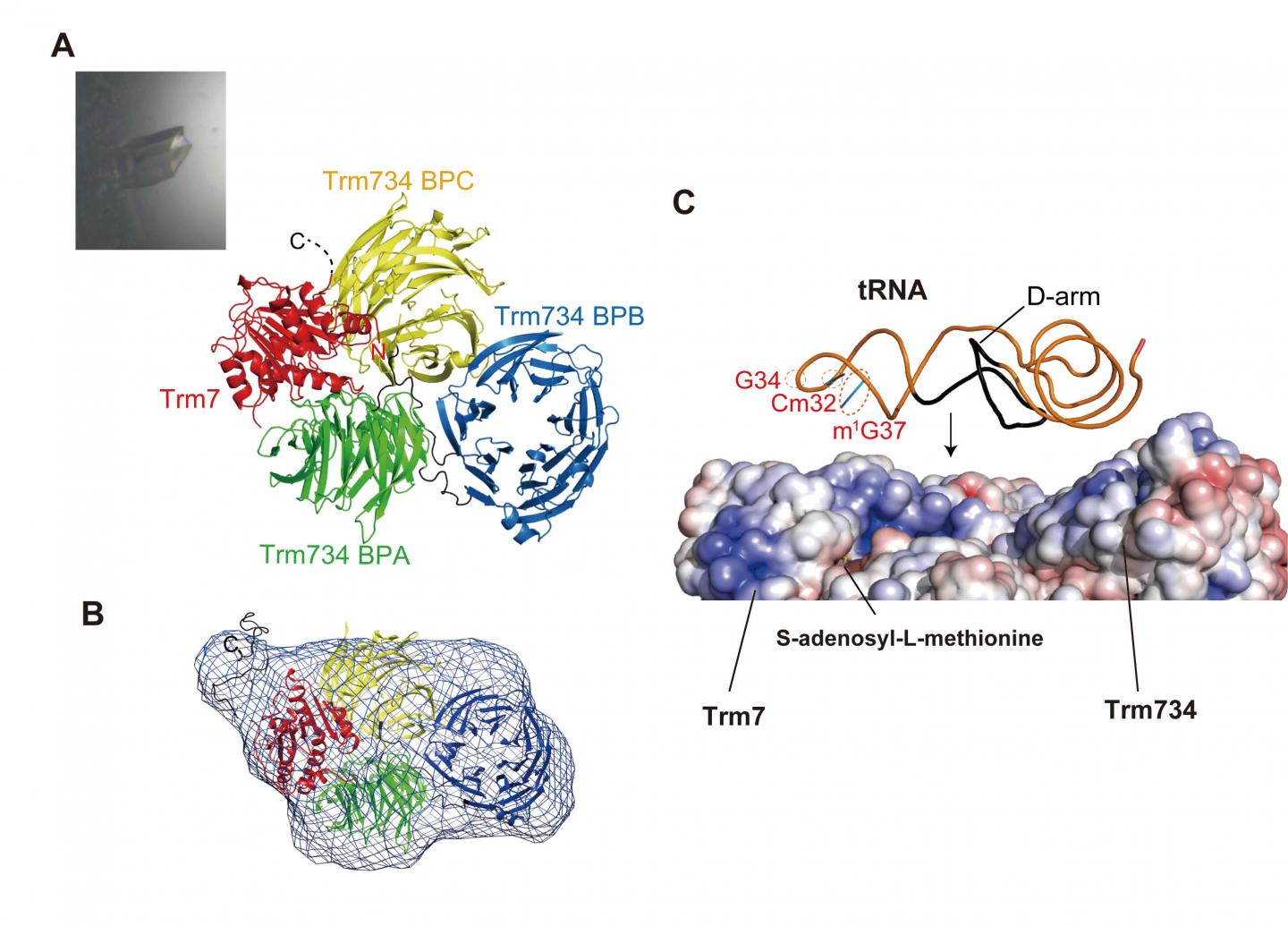
Transfer RNA recognition mechanism of eukaryotic tRNA methyltransferase Trm7-Trm734 complex and functions of its subunits
IMAGE

Credit: Ehime University


Genetic information on DNA is transcribed onto messenger RNA and then is decoded by transfer RNA (tRNA) during protein synthesis. The methylation of ribose of the first position of anticodon (position 34 in tRNA) is commonly observed in tRNAs from three domains of life. This methylation reinforces the codon-anticodon interaction and prevents errors during protein synthesis. We knew that eukaryote, a protein complex between Trm7 and Trm734 (Trm7-Trm734), is the responsible tRNA methyltransferase for this methylation. However, important questions remained. For example, why does Trm7-Trm734 act only on specific tRNA?, and why is Trm734 required for the methylation at position 34 in tRNA? To address these issues, a group at Ehime University (Akira Hirata, Keisuke Okada, Kazunori Yoshii, Hiroyuki Shiraishi and Hiroyuki Hori) working with a group at KEK (Shinya Saijo, Kento Yonezawa and Nobutaka Shimizu) solved the crystal structure of Trm7-Trm734 and measured a small angle X-ray scattering. Based on these structural studies, they performed biochemical studies. Their findings are as follows: Trm7-Trm734 preferentially methylates tRNA transcript variants possessing two of three factors (Cm32, m1G37 and pyrirmidine34). Therefore, tRNAPhe, tRNATrp and tRNALeu are specifically methylated by Trm7-Trm734. Trm7 possesses a Rossmann-fold catalytic domain, while Trm734 consists of three WD40 ?-propeller domains (termed BPA, BPB and BPC). BPA and BPC form a unique V-shaped cleft, which docks with Trm7. Small angle X-ray scattering reveals that Trm7-Trm734 exists as a hetero-dimer in solution and Trm734 is required for the positioning of tRNA for methylation.

It has long been a mystery as to why Trm7-Trm734 acts only on specific tRNAs. The study explains the tRNA recognition mechanism of Trm7-Trm734 and clarifies the roles of the subunits. In humans, the defect of methylation at the first position of anticodon in tRNA causes nosyndromic X-linked intellectual disability. Therefore, this study contributes to the understanding of genetic defects and developments in genetic diagnosis and gene therapy.

###

The synchrotron radiation experiments were performed at the BL26B1, BL38B1 and BL45XU in the SPring-8 with the approval of the Japan Synchrotron Radiation Research Institute (JASRI) (Proposal No. 2013B1272, 2014A1246, 2014B1063, 2015B2047 and 2016A2547), and at the BL-10C in the Photon Factory with the support of the Platform for Drug Discovery, Informatics, and Structural Life Science (PDIS) from Japan Agency for Medical Research and Development (AMED). This research was partially supported by the Platform Project for Supporting Drug Discovery and Life Science Research [Basis for Supporting Innovative Drug Discovery and Life Science Research (BINDS)] from AMED under Grant Number JP19am0101071 (support number 0997). Furthermore, the authors thank the Division of Material Science and Applied Protein Research of the Advanced Research Support Center, Ehime University for the Typhoon FLA 7000 system.

Media Contact
Public Relations Division
[email protected]

Related Journal Article

http://dx.doi.org/10.1093/nar/gkz856

Tags: BiochemistryBiology
Share12Tweet8Share2ShareShareShare2

Related Posts

New Drexel Study Reveals Key to Keeping Students on Track in Physics Learning — Chemistry

New Drexel Study Reveals Key to Keeping Students on Track in Physics Learning

May 15, 2026
Reversible Glue Technology Powers Up with Electric Activation — Chemistry

Reversible Glue Technology Powers Up with Electric Activation

May 15, 2026

Sweet as Honey: Unveiling a New Heat Transport Regime in Ultrathin Semiconductors

May 15, 2026

High-Precision Boltzmann Luminescent Nanothermometry Achieved Through Predictive Rules

May 15, 2026
Please login to join discussion

POPULAR NEWS

  • Research Indicates Potential Connection Between Prenatal Medication Exposure and Elevated Autism Risk

    844 shares
    Share 338 Tweet 211
  • New Study Reveals Plants Can Detect the Sound of Rain

    731 shares
    Share 292 Tweet 182
  • Salmonella Haem Blocks Macrophages, Boosts Infection

    62 shares
    Share 25 Tweet 16
  • Breastmilk Balances E. coli and Beneficial Bacteria in Infant Gut Microbiomes

    58 shares
    Share 23 Tweet 15

About

We bring you the latest biotechnology news from best research centers and universities around the world. Check our website.

Follow us

Recent News

Micronutrients Linked to Mood and Psychotic Disorders

AI Tool in Radiotherapy Advances Global Fight to Eradicate Cervical Cancer

Detecting Illicit Bitcoin Transactions with Temporal Graph Learning

Subscribe to Blog via Email

Enter your email address to subscribe to this blog and receive notifications of new posts by email.

Join 82 other subscribers
  • Contact Us

Bioengineer.org © Copyright 2023 All Rights Reserved.

Welcome Back!

Login to your account below

Forgotten Password?

Retrieve your password

Please enter your username or email address to reset your password.

Log In
No Result
View All Result
  • Homepages
    • Home Page 1
    • Home Page 2
  • News
  • National
  • Business
  • Health
  • Lifestyle
  • Science

Bioengineer.org © Copyright 2023 All Rights Reserved.