


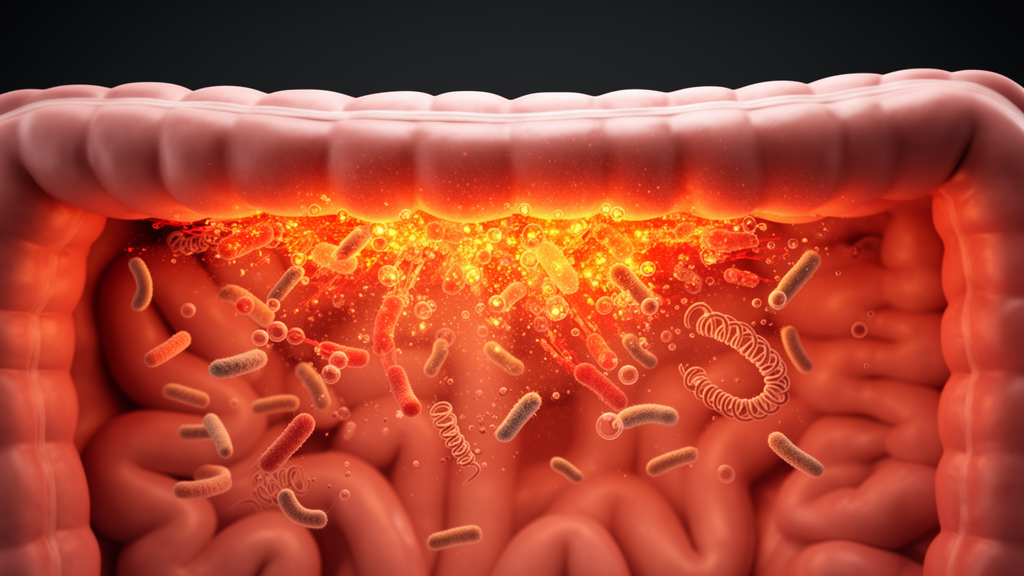
Stress has long been known to disrupt the gut microbiome, but the precise sequence of events that turns a stressed host into a dysbiotic one has remained elusive. A new study published in the journal Microbiome on 30 October 2026 reports that the process begins not with a wholesale reshuffling of microbial species, but with a rapid burst of reactive oxygen species, or ROS, inside the intestine. Working in zebrafish and confirming the pattern in restraint-stressed mice, the researchers found that this early oxidative signal precedes any detectable change in microbial composition, setting off a cascade that ultimately dismantles the gut’s protective hypoxic barrier.
The team observed that in zebrafish, stress rapidly elicits intestinal ROS accumulation specifically in the distal intestine, with the oxidative response emerging within hours. Crucially, this early ROS surge does not immediately restructure the microbial community. Instead, it induces what the authors describe as a functional collapse: anaerobic fermentation is selectively suppressed, and the production of short-chain fatty acids, or SCFAs, sharply declines even while the community structure remains largely intact. This distinction between structural stability and functional breakdown is central to the study’s findings, suggesting that current research focused on late-stage compositional shifts has been looking too late in the process.
The SCFAs deficit that follows has direct consequences for the epithelial cells lining the gut. According to the study, the drop in short-chain fatty acids weakens PPARγ-dependent epithelial metabolic programs, diminishes epithelial oxygen consumption, and erodes the physiological hypoxic barrier that normally keeps the intestinal lumen oxygen-poor. Loss of this barrier re-engineers the luminal niche, creating conditions that enable the relative enrichment of facultative pathobionts, microbes that can tolerate oxygen and expand when the environment shifts in their favour.
To test whether this cascade is truly causal rather than merely correlational, the researchers manipulated the pathway experimentally. Restoring epithelial bioenergetics or neutralizing intestinal ROS in zebrafish preserved gut hypoxia and prevented dysbiosis despite continued stress exposure. These intervention results identify intestinal ROS as an early initiating signal of stress-induced dysbiosis, rather than a by-product of it, and point to the maintenance of the intestinal hypoxic barrier as a critical therapeutic target for stress-related microbiome disorders.
The findings were not limited to fish. In restraint-stressed mice, the same ordered sequence was likewise observed: early ROS elevation, a decline in SCFAs, loss of hypoxia, and the relative enrichment of facultative taxa. The authors report that this phenotypic and temporal conservation across two vertebrate models supports the idea that the cascade is a reproducible biological program rather than a species-specific quirk. Because the study relies on zebrafish and mouse models, further work would be needed to establish whether the identical sequence operates in humans.
Conceptually, the study reframes stress-induced dysbiosis. Rather than a stochastic microbial drift, the authors conclude it is a highly reproducible ecological cascade triggered by an early intestinal ROS burst in zebrafish and phenotypically conserved in mice. By shifting attention from late-stage structural dysbiosis to the initial functional and microenvironmental collapse, the work suggests that interventions aimed at preserving epithelial oxygen consumption and gut hypoxia could potentially prevent dysbiosis before it takes hold, even when the stressor itself cannot be removed.
The research was published as an open-access article in Microbiome, a journal covering microbiome research, and was shared early to provide faster access to peer-reviewed, accepted research, carrying a permanent DOI while remaining subject to further edits before the final Version of Record. The study was led by Yabing Lv, Yihui Fan, Xingzheng Huang, Wenkai Xu, Jie Wang, Juchen Xu, Dapeng Li, Chao Ran, Zhigang Zhou, Xugang He and Jie Hou, with the corresponding and co-corresponding author roles distributed among Dapeng Li, Zhigang Zhou, Xugang He and Jie Hou.
For researchers studying the microbiome, the study’s most provocative implication is temporal: the microbial community can appear structurally normal while its function is already collapsing. The early oxidative window, emerging within hours of stress in zebrafish and preceding any detectable compositional change, offers a new diagnostic and therapeutic horizon. If the same ROS-driven, SCFAs-mediated, hypoxia-eroding sequence can be confirmed in human cohorts, it could reshape how stress-related microbiome disorders are detected and treated, moving intervention from the aftermath of dysbiosis to its earliest biochemical trigger.
Subject of Research: How stress-induced intestinal ROS initiates gut microbial dysbiosis by dismantling the intestinal hypoxic barrier
Article Title: Intestinal ROS triggers stress-induced dysbiosis by dismantling the hypoxic barrier
Article References: Lv, Y., Fan, Y., Huang, X., Xu, W., Wang, J., Xu, J., Li, D., Ran, C., Zhou, Z., He, X., & Hou, J. (2026). Intestinal ROS triggers stress-induced dysbiosis by dismantling the hypoxic barrier. Microbiome. https://doi.org/10.1186/s40168-026-02567-7
Image Credits: AI Generated
DOI: 10.1186/s40168-026-02567-7
Keywords: gut microbiome, intestinal ROS, dysbiosis, hypoxic barrier, short-chain fatty acids, PPARγ, zebrafish, restraint-stressed mice, pathobionts, stress physiology, Intestinal, triggers
News Source: Morgan Morrow. (October 30, 2026). Stress fuels gut dysbiosis through an early burst of intestinal ROS. Scienmag.



