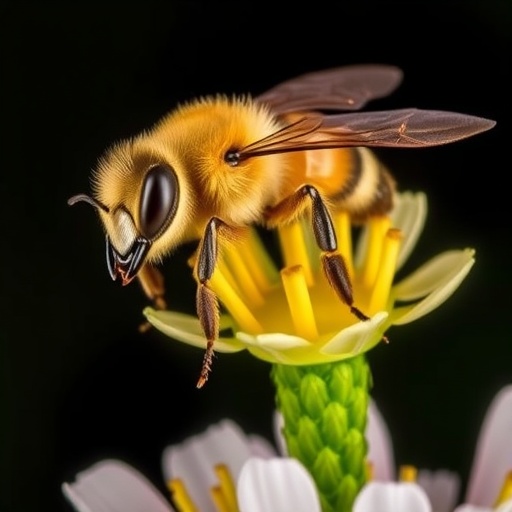
In a groundbreaking study that challenges conventional views on stress, researchers from Newcastle University have unveiled how acute stress sharpens visual perception and accelerates decision-making in bumblebees. This remarkable discovery suggests that, contrary to the often negative connotations of stress, short-term stress can enhance sensory processing, potentially offering survival advantages in high-pressure environments. The findings, recently published in the Journal of Experimental Biology, provide compelling evidence that stress does not merely disrupt cognitive functions but can recalibrate sensory priorities to promote rapid, efficient action in bees.
The research team, led by Dr. Vivek Nityananda, initiated the study by simulating acute stress in bumblebees through gentle shaking, which mimics the mechanical disturbance a bee might encounter during a predator attack. This experimental induction of stress allowed the scientists to closely monitor changes in visual perception under controlled conditions. Their approach focused on assessing how stress influences two critical facets of early visual processing: contrast sensitivity and spatial resolution, both essential for navigating complex environmental stimuli and detecting threats.
Analyzing the visual responses of stressed bumblebees revealed a notable enhancement in their ability to discern fine spatial details while simultaneously modulating contrast detection thresholds. These alterations indicate a precise tuning of the visual system rather than a generalized amplification of sensory inputs. In essence, stress appears to act as a biological filter, prioritizing subtle yet ecologically relevant visual features that could signify danger, such as a camouflaged predator lurking on a flower’s surface.
Beyond sensory perception, the study explored how these visual modifications translate into behavioral outcomes, specifically decision-making speed and accuracy. Bees were tasked with a visual discrimination test involving choice between distinct stimuli after exposure to induced stress. Remarkably, the bees under stress conditions made more rapid decisions and were more decisive in their selections. Crucially, this increased decisiveness did not come at the cost of accuracy, revealing an adaptive balance where speed and precision coalesce to optimize survival strategies.
Postdoctoral researcher Dr. Olga Procenko, who played a vital role in conducting the study, commented on the intriguing findings, emphasizing that stress not only reshapes sensory processing but also influences how bees commit to decisions based on early perceptual cues. This highlights a sophisticated interplay between sensory input and cognitive processing, orchestrated by internal physiological states, which reshapes behavior in a manner conducive to navigating uncertain or threatening situations.
The biological mechanism underlying these effects remains an open question, but the evidence underscores that acute stress exerts targeted neurophysiological modulation rather than merely elevating global arousal. This selective enhancement potentially involves neuromodulators like octopamine and dopamine, known to impact attention and sensory gain in insects, although further neurobiological investigations are required to delineate these pathways definitively.
Importantly, these insights offer a valuable comparative perspective across species. Although the study centers on bumblebees, previous human research has also documented stress-induced alterations in visual attention and perceptual acuity. The convergence of findings across distant taxa suggests that similar adaptive frameworks might have evolved to enable organisms to rapidly prioritize critical environmental information during stressful events, thereby enhancing survival and functional efficiency.
Dr. Nityananda highlighted the broader implications of these findings, noting that understanding stress’s nuanced modulation of perception is vital not only for the study of animal behavior but also for fields such as neuroscience, robotics, and artificial intelligence. For example, robots and autonomous systems operating in dynamic or hazardous environments could benefit from algorithms inspired by biological mechanisms that optimize decision-making under stress, enabling faster and more accurate responses to complex sensory inputs.
The research also opens pathways for exploring how varying intensities and durations of stress influence sensory-cognitive integration. Chronic versus acute stress states may exert distinct impacts on neural circuitry and behavioral outcomes, with potential trade-offs between enhanced performance and detrimental effects arising over time. By leveraging the simplicity and accessibility of the bee brain model, future work aims to unravel these temporal dynamics and their underlying cellular frameworks.
At an ecological level, the research underscores how behavioral plasticity affords bees flexibility to survive fluctuating environmental demands. Acute stress-induced sharpening of vision and decision speed may aid bees in evading predators, efficiently foraging, or navigating rapidly changing floral landscapes. These adaptive mechanisms reflect a fine-tuned balance between perception and action, optimized through evolutionary pressures to capitalize on fleeting opportunities or avoid immediate risks.
This study exemplifies the power of interdisciplinary collaboration, combining behavioral experiments, sensory physiology, and computational modeling to illuminate the subtle ways internal states bias sensory processing and behavior. As a model system, bumblebees offer a unique window into fundamental principles governing brain function, perception, and decision-making across the animal kingdom, providing analogies relevant to human cognition and artificial systems alike.
In summary, Newcastle University’s pioneering research reshapes our understanding of stress effects, revealing them as complex, context-dependent modulators rather than uniformly deleterious influences. The discovery that acute stress enhances visual processing and accelerates decision-making without compromising accuracy introduces new paradigms for studying how organisms integrate environmental cues with internal states to navigate their worlds effectively.
Subject of Research: Animals
Article Title: Acute stress modulates early visual perception and decision-making speed in bees
News Publication Date: 15-Jun-2026
Web References: http://dx.doi.org/10.1242/jeb.251716
References: Procenko, O., Nityananda, V. (2026). Acute stress modulates early visual perception and decision-making speed in bees. Journal of Experimental Biology. DOI: 10.1242/jeb.251716
Image Credits: Newcastle University, UK
Keywords: acute stress, bumblebees, visual perception, decision-making, sensory modulation, neuroethology, cognitive adaptability
Tags: acute stress effects on bumblebeesbumblebee sensory processing under stresscontrast sensitivity changes in stressed bumblebeesenhanced spatial resolution in beesJournal of Experimental Biology bumblebee studyNewcastle University bee researchpredator attack simulation in beesrapid decision-making in stressed insectssensory adaptation to environmental stressstress and visual perception in insectsstress-induced cognitive enhancementsurvival advantages of stress in insects