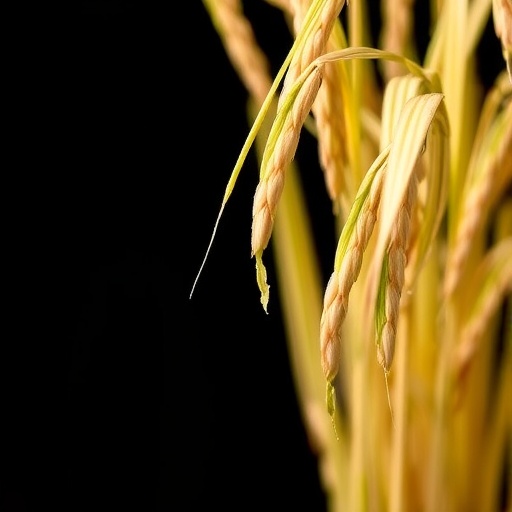
Every year, the world’s rice mills produce roughly 150 million tonnes of rice husk, an abundant agricultural byproduct that is largely burned or dumped. Buried inside those papery hulls is one of nature’s most generous silica reserves, sometimes exceeding 20 percent of the husk’s dry mass, yet extracting that silica in a pure, industrial-grade form has long demanded an environmental trade-off. Conventional protocols rely on concentrated mineral acids such as sulfuric or hydrochloric acid, aggressive solid-to-liquid ratios that flood reactors with spent chemicals, and energy-intensive thermal schedules. A new study published in Waste and Biomass Valorization offers a cleaner way forward, showing that ordinary kitchen-chemistry citric acid, applied at remarkable dilution, can unlock silica purities above 98 percent from this humble waste stream.
The research, led by Ibrahim Hamidu of the Department of Chemical Engineering at Kwame Nkrumah University of Science and Technology in Kumasi, Ghana, together with Benjamin Afotey, Bright Kwakye-Awuah, and Daniel Adjah Anang, demonstrates that leaching rice husk with a 5 percent by volume dilution of a 2 molar citric acid solution, at a modest solid-to-liquid ratio of 1 gram per 5 milliliters, achieves silica purity exceeding 95 percent. When that acid pretreatment is coupled with hydrothermal activation and controlled carbonization, the best combination delivers 98.3 percent silicon dioxide purity with an overall yield of 18.2 percent, all without a single drop of concentrated mineral acid. For a process aiming at industrial adoption, the significance lies as much in what the method avoids as in what it produces: no toxic effluent streams, no exotic reagents, and no heavy reliance on corrosive handling infrastructure.
Rice husk silica is not a niche curiosity. High-purity amorphous silica commands a substantial global market, feeding into semiconductor-grade silicon, photovoltaic wafers, catalyst supports, zeolite synthesis, tire fillers, pharmaceutical excipients, construction additives, and adsorbents for water treatment. The catch is that raw rice husk carries a suite of troublesome impurities, including alkali metals such as potassium and sodium, phosphorus compounds measured as phosphorus pentoxide, and transition metals like iron. During combustion or carbonization, these contaminants promote the formation of crystalline silicate phases and potassium silicates that degrade both the purity and the reactivity of the resulting ash. Acid leaching before thermal treatment is therefore the critical step that determines whether the final product is a premium material or an inferior ash.
Historically, that leaching step has been the environmental weak point. Strong mineral acids work well chemically, dissolving metal impurities embedded in the husk’s fibrous matrix, but they generate acidic wastewater requiring neutralization, corrode equipment, and pose serious handling hazards in regions where rice processing is often decentralized and small-scale. Organic acids, particularly citric acid, a chelating agent whose carboxyl groups can bind metal cations and carry them into solution, have been proposed as greener alternatives. Previous studies, including work by Umeda and Kondoh on carboxylic acid leaching and by Setiawan and Chiang comparing citric and gluconic acids, hinted at the promise of this route. What has been missing is a rigorous, statistically grounded map of how citric acid leaching interacts with the other major levers in the process: particle size, hydrothermal activation, and the temperature and duration of carbonization.
That map is precisely what the Ghanaian team has now drawn. Rather than testing every possible combination of variables, an approach that would have required an impractical number of experiments, the researchers employed a three-factor half-fractional factorial design, a statistical technique from the family of design-of-experiments methods that allows the main effects of multiple factors to be estimated with a fraction of the full experimental workload. The factors spanned coarse versus fine husk particles, with the coarse fraction measuring between 0.5 and 1 millimeter and the fine fraction between 0.125 and 0.25 millimeter; water leaching versus citric acid leaching, both conducted at 90 degrees Celsius for 2 hours; the presence or absence of an additional hydrothermal treatment step performed at 200 degrees Celsius for 3 hours; and carbonization conditions ranging from 550 to 750 degrees Celsius over 2 to 6 hours. The design revealed which variables actually move the needle on silica purity and yield, and, just as importantly, which do not.
The headline result is striking. Citric acid leaching alone lifted the silica purity of the coarse husk fraction to 96.2 percent, at the cost of a modest yield penalty of roughly 20.5 percent by weight, meaning some husk mass was sacrificed as the acid dissolved organic and mineral components along with the targeted impurities. Critically, citric acid outperformed plain water leaching in removing phosphorus pentoxide and alkali metals, the very contaminants that most severely compromise downstream applications. Water leaching, though cheap and clean, simply cannot coordinate metal ions the way citrate can. The chelation chemistry is the differentiator: citric acid’s three carboxylic acid groups form stable complexes with potassium, sodium, iron, and phosphorus species, pulling them out of the husk before heat ever touches it.
When the process was stacked to its optimal configuration, coarse husk, citric acid leach, hydrothermal treatment at 200 degrees Celsius for 3 hours, and carbonization at 550 degrees Celsius for 2 hours, the 0.5 to 1 millimeter fraction delivered 98.3 percent silicon dioxide with an 18.2 percent overall yield. The choice of the coarse fraction may seem counterintuitive, since finer particles expose more surface area to the leaching solution. But the regression analysis embedded in the factorial design identified citric acid leaching as the strongest predictor of silica purity, with a standardized coefficient of 9.58 and a p-value below 0.001, while particle size emerged as a key secondary factor. Meanwhile, the thermal parameters, carbonization temperature and hold time, exerted minimal linear effects on purity within the ranges tested, which is commercially encouraging: it suggests manufacturers do not need to push furnaces to the upper temperature extreme, saving energy and reducing the risk of unwanted crystallization of the amorphous silica into cristobalite, a phase transformation that becomes problematic at elevated temperatures.
The hydrothermal component deserves particular attention. Treating the leached husk in water at 200 degrees Celsius under autogenous pressure, a subcritical water regime, hydrolyzes hemicellulose and portions of the lignocellulosic matrix, opening the structure and further liberating entrapped minerals before carbonization. Previous work on subcritical water hydrolysis of rice husk has shown similar benefits, and the new study confirms that the additional energy investment in hydrothermal activation pays off when combined with mild-temperature carbonization rather than aggressive burning. The 550 degree Celsius condition is deliberately below the threshold where amorphous biogenic silica begins to sinter and crystallize, preserving the high surface area and reactive amorphous character that make rice husk silica valuable for catalyst supports, zeolite precursors, and cementitious additives.
Beyond the numbers, the study’s framing within green chemistry principles gives it broader resonance. The acid solution is diluted fivefold from its 2 molar stock, halving reagent consumption relative to many conventional protocols, and the leaching reagent itself is biodegradable and food-safe, a meaningful contrast with mineral acids that leave behind sulfate or chloride waste streams. The authors note that their protocol aligns with sustainable chemistry thinking while remaining scalable, a claim supported by the fact that every unit operation involved, milling, hot leaching, hydrothermal processing, and controlled carbonization, maps onto equipment already familiar in the biomass and materials processing industries. Rice husk is already collected at mills in enormous quantities across Asia, Africa, and South America, often serving as a low-grade boiler fuel; integrating a citric acid leaching stage into existing husk-to-energy flows could transform those plants into co-producers of high-value silica.
There are, of course, caveats. The 18.2 percent overall yield means more than four-fifths of the starting husk mass leaves the process as water, volatiles, dissolved organics, and removed impurities, and any industrial flowsheet would need to account for the valorization or safe disposal of those streams. Citric acid, while green, is not free, and its cost at scale must be weighed against the price premium that 98-plus percent purity silica commands. The study also relied on a fractional design, which estimates main effects efficiently but does not fully resolve every interaction between factors; the authors’ regression framework acknowledges this by focusing on the dominant linear predictors. Further work will likely explore continuous processing, reagent recycling, and the performance of the resulting silica in demanding applications such as electronic-grade silicon or mesoporous drug-delivery matrices.
Even with those qualifications, the study represents a persuasive case that the dirty chemistry long associated with rice husk valorization can be retired. By applying a statistically disciplined experimental design to a genuinely green reagent, the researchers have shown that purity, yield, and sustainability need not be mutually exclusive. For the millions of tonnes of rice husk generated annually, and for the communities that handle it, the work suggests a future in which agricultural waste is not merely burned for a few kilowatt-hours but refined, gently and cleanly, into one of industry’s most versatile raw materials. The silica was always there; what this study provides is a recipe for coaxing it out that the twenty-first century can actually live with.
Subject of Research: Green extraction of high-purity silica from rice husk using dilute citric acid leaching, hydrothermal treatment, and optimized carbonization via fractional factorial design
Subject of Research: Technology and Engineering
Article Title: Fractional Factorial Design for Process Optimization in Rice Husk Valorization: Integrating Citric Acid Leaching and Hydrothermal Treatment
Article References: Hamidu, I., Afotey, B., Kwakye-Awuah, B., & Anang, D. A. (2026). Fractional Factorial Design for Process Optimization in Rice Husk Valorization: Integrating Citric Acid Leaching and Hydrothermal Treatment. Waste and Biomass Valorization. https://doi.org/10.1007/s12649-026-03630-y
Image Credits: AI Generated
DOI: 10.1007/s12649-026-03630-y
Keywords: rice husk silica, citric acid pretreatment, hydrothermal processing, carbonization yield, agricultural waste valorization, fractional factorial design, high-purity silica, green chemistry, silica purity, biogenic silica
Cite Scienmag News
APA
MLA
Chicago
Alan Morgan. (September 9, 2026). Streamlined Leaching and Hydrothermal Process Boosts Rice Husk Valorization. Scienmag. https://scienmag.com/streamlined-leaching-and-hydrothermal-process-boosts-rice-husk-valorization/
Alan Morgan. “Streamlined Leaching and Hydrothermal Process Boosts Rice Husk Valorization.” Scienmag, 9 September 2026, https://scienmag.com/streamlined-leaching-and-hydrothermal-process-boosts-rice-husk-valorization/. Accessed 9 September 2026.
Alan Morgan. “Streamlined Leaching and Hydrothermal Process Boosts Rice Husk Valorization.” Scienmag. September 9, 2026. https://scienmag.com/streamlined-leaching-and-hydrothermal-process-boosts-rice-husk-valorization/
Copy citation
Download RIS
Tags: application of hydrothermal processes in biomass valorbyproduct utilization in agriculturecitric acid leaching for silica recoverycitric acid-based silica purificationclean technology for silica productioncleaner alternatives to acid leaching in biomass valorizationeco-friendly chemical processes for silica extractionenergy-efficient rice husk processing techniquesenvironmentally friendly leaching methodsenvironmentally friendly rice husk valorizationhigh purity industrial silica from rice huskshydrothermal activation for silica recoveryhydrothermal activation of rice husk ashindustrial-grade silica from agricultural wasteinnovative methods for rice husk silica extractionreduction of chemical usage in biomass processingrenewable silica sources from agricultural byproductsrenewable silica sourcing from rice husksrice husk biomass processing innovationsrice husk silica extractionsustainable rice husk valorizationsustainable rice husk waste managementwaste biomass valorization techniques