A computational study of the mineral stibnite (Sb2S3) has mapped how its electronic and transport properties change as the crystal is progressively reduced from a three-dimensional bulk solid to a two-dimensional cleavage layer and, ultimately, to a single unsupported atomic chain. Using hybrid density functional calculations combined with semiclassical Boltzmann transport theory, Gianfranco Ulian and Giovanni Valdrè report that the two dimensional reductions affect electrons and holes in strikingly different ways, producing a carrier-polarity-dependent crossover rather than a uniform trend. The work is published in Scientific Reports.
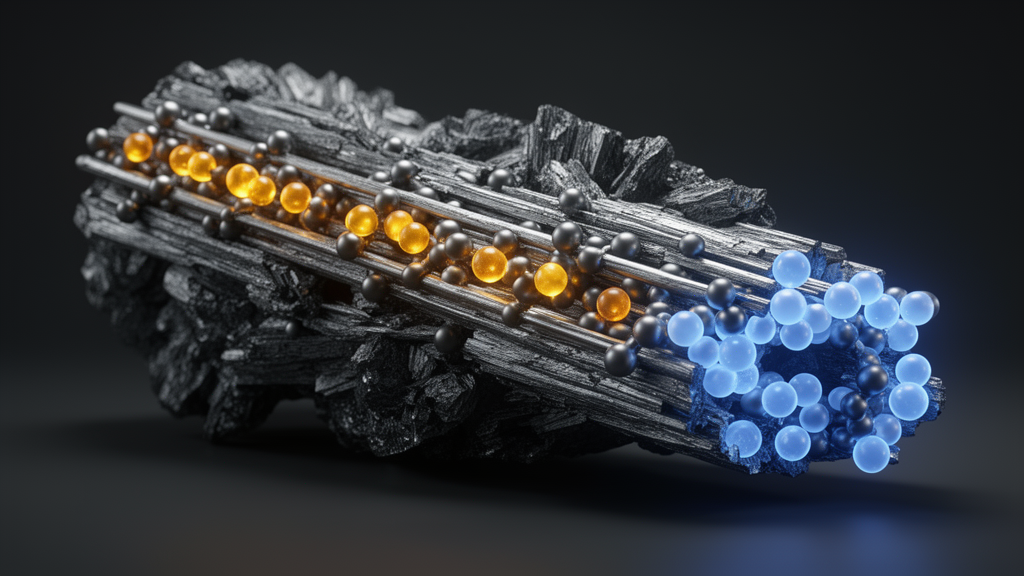
Chain-based chalcogenides such as stibnite are attractive for this kind of exploration because their crystal structures already contain one-dimensional building blocks. Instead of cutting or chemically passivating an extended two-dimensional lattice, researchers can study a naturally pre-formed chain motif. The authors built a structural hierarchy for Sb2S3 spanning the full bulk crystal, the natural (100) cleavage layer, and the isolated single-chain limit, allowing a direct comparison of how removing inter-chain interactions reshapes the frontier electronic states.
Phonon dispersion calculations confirmed that both the two-dimensional layer and the single chain are dynamically stable, meaning neither model should spontaneously distort or fall apart. An energy analysis quantified the progressive weakening and eventual removal of the interactions binding neighboring chains together in the bulk mineral. The two-dimensional layer retains a slightly enlarged indirect band gap relative to the bulk but exhibits the most dispersive conduction band along the chain direction of the three systems, translating into the lightest electron effective mass. Complete chain isolation behaves differently: the gap opens into a wider direct gap, and the valence-band edge becomes exceptionally flat and strongly non-parabolic while still showing finite dispersion across the full Brillouin zone.
Transport calculations performed at equal carrier loading revealed the central finding. Hole transport evolves comparatively regularly as the material is reduced from bulk to layer to chain. The electron branch, however, is non-monotonic: the highly dispersive conduction band in the two-dimensional layer simultaneously delivers high conductivity and weak energy selectivity, breaking what would otherwise be a smooth dimensional trend.
The study also probed how the isolated chain responds to its chemical environment. Water adsorption only weakly perturbs the single-chain structure, suggesting some robustness against ambient moisture. Oxygen, by contrast, produces structural activation and introduces an in-gap hybrid electronic state, actively reorganizing the chain’s electronic spectrum. Because the findings rest entirely on density functional theory and semiclassical transport modeling, they represent theoretical predictions for idealized model systems rather than measurements on fabricated devices. Even so, they define an intrinsic single-chain reference for Sb2S3 and provide a quantitative map for interpreting carrier-selective behavior in low-dimensional antimony sulfide, illustrating that dimensional reduction does not affect all charge carriers equally.
Subject of Research: Dimensional crossover of electronic transport in the mineral stibnite from bulk to the single-chain limit
Article Title: Carrier-selective dimensional crossover from bulk stibnite Sb2S3 to the single-chain limit
Article References: Ulian, G., & Valdrè, G. (2026). Carrier-selective dimensional crossover from bulk stibnite Sb2S3 to the single-chain limit. Scientific Reports. https://doi.org/10.1038/s41598-026-76714-3
Image Credits: AI Generated
DOI: 10.1038/s41598-026-76714-3
Keywords: stibnite, Sb2S3, low-dimensional materials, density functional theory, Boltzmann transport, band structure, carrier transport, chalcogenides, one-dimensional materials, phonon stability, surface adsorption, Carrier-selective
News Source: Denise Maddox. (October 23, 2026). Stibnite’s Atomic Chains Show Electrons and Holes Respond Differently to Dimensional Cutoff. Scienmag.