Stem cells are true multi-talents. They can develop into any cell type of an organism – in humans there are over 200 – and thus perform all vital tasks. Once the stem cells have decided on a task they can no longer be deterred from their goal. The final product, tissues and organs, almost always look the same and consist of defined proportions of different specialised cell types. But how do the cells actually know what they want to become and how many of them are actually allowed to do so?
Credit: MPI of Molecular Physiology
Stem cells are true multi-talents. They can develop into any cell type of an organism – in humans there are over 200 – and thus perform all vital tasks. Once the stem cells have decided on a task they can no longer be deterred from their goal. The final product, tissues and organs, almost always look the same and consist of defined proportions of different specialised cell types. But how do the cells actually know what they want to become and how many of them are actually allowed to do so?
Is it all just chance?
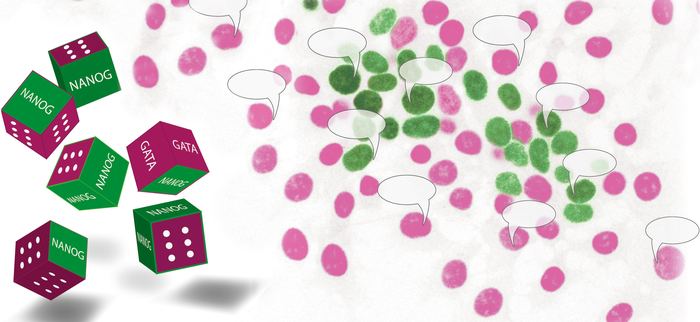
An important regulator of the distribution of tasks is the control of genes by transcription factors such as NANOG and GATA, which are both initially present in the undifferentiated stem cells. This changes fundamentally, however, in the very early development when the stem cells develop into two new cell types: Cells of the early embryo, in which now only NANOG is present and precursor cells of the fruit bladder which now exclusively carry GATA. Until now, it was thought that the decision of each individual cell was made rather randomly at an early stage, similar to a dice game, except that here only NANOG or GATA can be rolled.
Cells decide collectively
In a previous theoretical paper, Aneta Koseska, co-author of the study and former MPI group leader, was able to establish a new concept with the help of Christian Schröter, showing how stem cells specialize in right proportions in a coordinated manner. In the current publication, Christian Schröter and his team have now succeeded in substantiating the theoretical concept. Using stem cells in a test tube, the researchers were able to show that decision-making does not take place purely randomly at the level of individual cells, as previously assumed, but is communicated within the cell community.
Cheating at the stem cell dice game
In order not to leave the fate of the cells to chance, the researchers manipulated the NANOG-GATA dice in their investigations so that GATA is now rolled more often than NANOG. This was achieved experimentally by artificially increasing the amount of GATA. Even though a six was always rolled – i.e. GATA – the number of fruit bladder precursor cells could not be arbitrarily increased, but similar proportions of the two different cell types continued to emerge. The distribution of tasks during development must therefore be dependent on more than mere chance.
Decisions are communicated in the team
Following their theoretical concept, the scientists investigated the role of cellular communication in embryonic development. As a central means of communication cells use messenger substances such as growth factors, which they produce and secrete themselves. These substances are then received by other cells and control their specialization. If the researchers took away a growth factor that was important for cell development, the cells were no longer able to develop into fruit bladder precursor cells even in the presence of high amounts of GATA. However, the more of the growth factor the cells received, the more fruit bladder precursor cells also developed. Their ability to divide into the right proportions of the two cell types despite disturbances was thus lost. Stem cells must therefore communicate with each other in order to make the right decision.
“Communication in cell development is like working in a team. If the members choose tasks without consulting each other, some things are done twice and others not at all. A team that communicates well, on the other hand, can solve problems that arise and complete even complex projects reliably and efficiently”, Christian Schröter says. “So it’s not just the state of the individual cell that decides on its faith, but the functioning communication with the other cells.”
Journal
Development
DOI
https://doi.org/10.1242/dev.199926
Method of Research
Experimental study
Subject of Research
Cells
Article Title
Cell-cell communication through FGF4 generates and maintains robust proportions of differentiated cell types in embryonic stem cells
Article Publication Date
5-Nov-2021