• HOME
  • NEWS
  • EXPLORE
    • CAREER
      • Companies
      • Jobs
    • EVENTS
    • iGEM
      • News
      • Team
    • PHOTOS
    • VIDEO
    • WIKI
  • BLOG
  • COMMUNITY
    • FACEBOOK
    • INSTAGRAM
    • TWITTER
Sunday, May 10, 2026
BIOENGINEER.ORG
No Result
View All Result
  • Login
  • HOME
  • NEWS
  • EXPLORE
    • CAREER
      • Companies
      • Jobs
        • Lecturer
        • PhD Studentship
        • Postdoc
        • Research Assistant
    • EVENTS
    • iGEM
      • News
      • Team
    • PHOTOS
    • VIDEO
    • WIKI
  • BLOG
  • COMMUNITY
    • FACEBOOK
    • INSTAGRAM
    • TWITTER
  • HOME
  • NEWS
  • EXPLORE
    • CAREER
      • Companies
      • Jobs
        • Lecturer
        • PhD Studentship
        • Postdoc
        • Research Assistant
    • EVENTS
    • iGEM
      • News
      • Team
    • PHOTOS
    • VIDEO
    • WIKI
  • BLOG
  • COMMUNITY
    • FACEBOOK
    • INSTAGRAM
    • TWITTER
No Result
View All Result
Bioengineer.org
No Result
View All Result
Home NEWS Science News Chemistry

Stellar eggs near galactic center hatching into baby stars

Bioengineer by Bioengineer
March 29, 2021
in Chemistry
Reading Time: 2 mins read
0
IMAGE
Share on FacebookShare on TwitterShare on LinkedinShare on RedditShare on Telegram

IMAGE

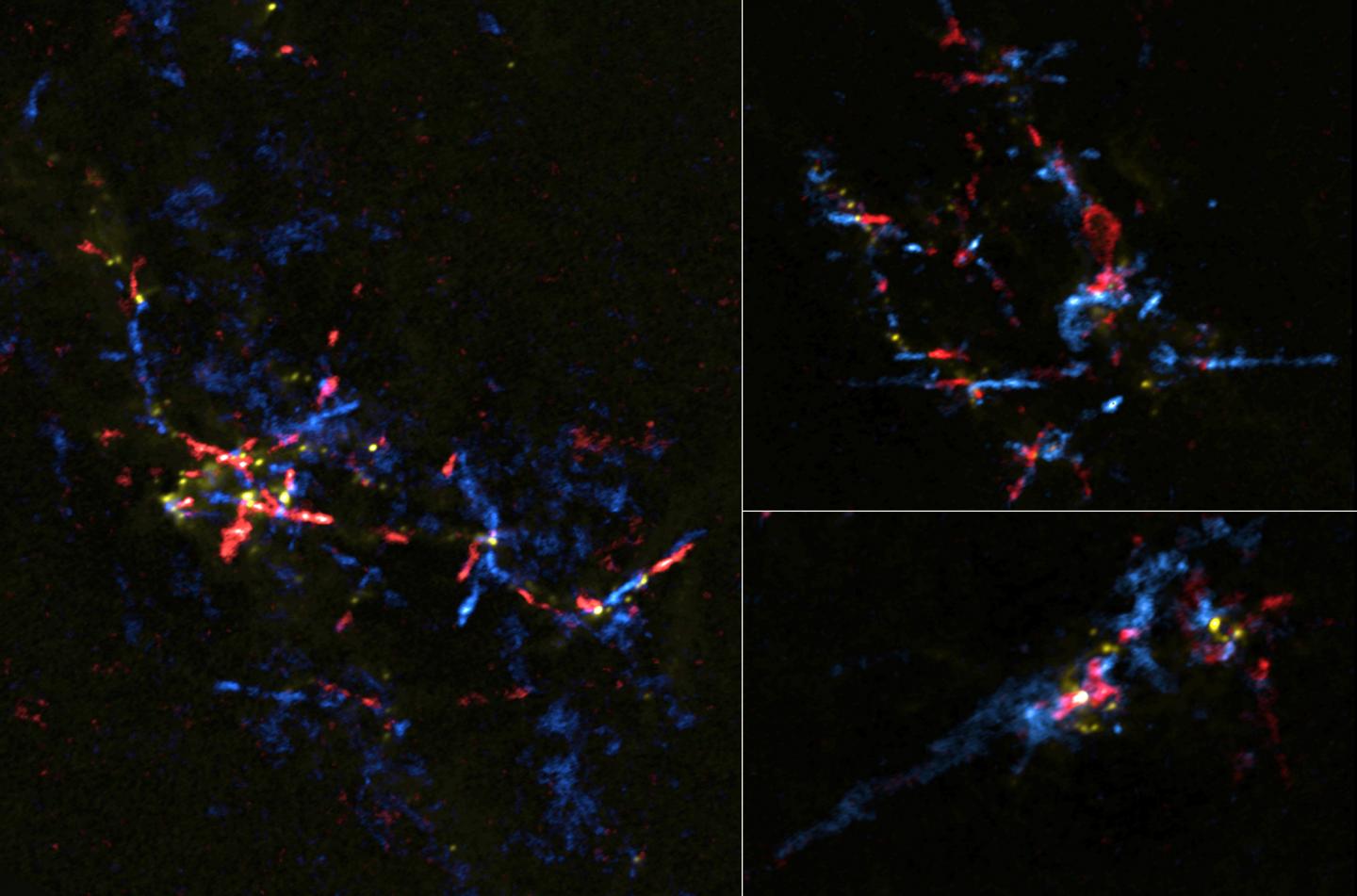
Credit: ALMA (ESO/NAOJ/NRAO), Lu et al.

Astronomers found a number of stellar eggs containing baby stars around the center of the Milky Way using the Atacama Large Millimeter/submillimeter Array (ALMA). Previous studies had suggested that the environment there is too harsh to form stars. These findings indicate that star formation is more resilient than researchers thought.

Stars form in stellar eggs, cosmic clouds of gas and dust which collapse due to gravity. If something interferes with the gravity driven contraction, star formation will be suppressed. There are many potential sources of interference near the Galactic Center. Strong turbulence can stir up the clouds and prevent them from contracting, or strong magnetic fields can support the gas against self-gravitational collapse. Previous observations indicated that star formation near the Galactic Center is much less efficient.

To investigate the mysteries of the suppressed star formation, a team led by Xing Lu, an astronomer at the National Astronomical Observatory of Japan, used ALMA to observe regions near the Galactic Center which contain ample gas, but no known star formation. Surprisingly, the team discovered more than 800 dense cores of gas and dust.

“The discovery leads to the question of whether they are actually ‘stellar eggs’ or not.” explains Lu. To answer this question, the team again used ALMA to search for energetic gas outflows which are indicative of stars forming in stellar eggs. Thanks to ALMA’s high sensitivity and high spatial resolution, they detected 43 small and faint outflows in the clouds. Lu comments, “our observations prove that even in the strongly disturbed areas around the Galactic Center, baby stars still form.”

The research team is now analyzing ALMA’s higher resolution observation data to better understand the processes driving the gas outflows and star formation near the Galactic Center.

###

Media Contact
Dr. Masaaki Hiramatsu
[email protected]

Original Source

https://www.nao.ac.jp/en/news/science/2021/20210329-alma.html

Related Journal Article

http://dx.doi.org/10.3847/1538-4357/abde3c

Tags: AstronomyAstrophysicsSpace/Planetary ScienceStars/The Sun
Share13Tweet8Share2ShareShareShare2

Related Posts

Miniature Sensor Uses Light to Detect Touch — Chemistry

Miniature Sensor Uses Light to Detect Touch

May 8, 2026
Iron Minerals Determine Whether Dissolved Organic Matter Fuels Microbes or Becomes Long-Term Carbon Storage — Chemistry

Iron Minerals Determine Whether Dissolved Organic Matter Fuels Microbes or Becomes Long-Term Carbon Storage

May 8, 2026

Kate Evans Appointed Associate Lab Director for Biological and Environmental Systems Science at ORNL

May 8, 2026

Advancing Multiscale Modeling and Overcoming Operational Challenges in Autothermal COâ‚‚-to-Methanol Reactors

May 8, 2026
Please login to join discussion

POPULAR NEWS

  • Research Indicates Potential Connection Between Prenatal Medication Exposure and Elevated Autism Risk

    840 shares
    Share 336 Tweet 210
  • New Study Reveals Plants Can Detect the Sound of Rain

    727 shares
    Share 290 Tweet 181
  • Scientists Investigate Possible Connection Between COVID-19 and Increased Lung Cancer Risk

    68 shares
    Share 27 Tweet 17
  • Salmonella Haem Blocks Macrophages, Boosts Infection

    61 shares
    Share 24 Tweet 15

About

We bring you the latest biotechnology news from best research centers and universities around the world. Check our website.

Follow us

Recent News

Evaluating Digoxin Use in Patients with Symptomatic Rheumatic Heart Disease

Evaluating the Effectiveness and Safety of Digitalis Glycosides in Treating Heart Failure

Urdu Fall Risk Questionnaire Adapted for Elderly

Subscribe to Blog via Email

Success! An email was just sent to confirm your subscription. Please find the email now and click 'Confirm' to start subscribing.

Join 82 other subscribers
  • Contact Us

Bioengineer.org © Copyright 2023 All Rights Reserved.

Welcome Back!

Login to your account below

Forgotten Password?

Retrieve your password

Please enter your username or email address to reset your password.

Log In
No Result
View All Result
  • Homepages
    • Home Page 1
    • Home Page 2
  • News
  • National
  • Business
  • Health
  • Lifestyle
  • Science

Bioengineer.org © Copyright 2023 All Rights Reserved.