• HOME
  • NEWS
  • EXPLORE
    • CAREER
      • Companies
      • Jobs
    • EVENTS
    • iGEM
      • News
      • Team
    • PHOTOS
    • VIDEO
    • WIKI
  • BLOG
  • COMMUNITY
    • FACEBOOK
    • INSTAGRAM
    • TWITTER
Thursday, March 26, 2026
BIOENGINEER.ORG
No Result
View All Result
  • Login
  • HOME
  • NEWS
  • EXPLORE
    • CAREER
      • Companies
      • Jobs
        • Lecturer
        • PhD Studentship
        • Postdoc
        • Research Assistant
    • EVENTS
    • iGEM
      • News
      • Team
    • PHOTOS
    • VIDEO
    • WIKI
  • BLOG
  • COMMUNITY
    • FACEBOOK
    • INSTAGRAM
    • TWITTER
  • HOME
  • NEWS
  • EXPLORE
    • CAREER
      • Companies
      • Jobs
        • Lecturer
        • PhD Studentship
        • Postdoc
        • Research Assistant
    • EVENTS
    • iGEM
      • News
      • Team
    • PHOTOS
    • VIDEO
    • WIKI
  • BLOG
  • COMMUNITY
    • FACEBOOK
    • INSTAGRAM
    • TWITTER
No Result
View All Result
Bioengineer.org
No Result
View All Result
Home NEWS Science News Chemistry

Stellar eggs near galactic center hatching into baby stars

Bioengineer by Bioengineer
March 29, 2021
in Chemistry
Reading Time: 2 mins read
0
IMAGE
Share on FacebookShare on TwitterShare on LinkedinShare on RedditShare on Telegram

IMAGE

Credit: ALMA (ESO/NAOJ/NRAO), Lu et al.

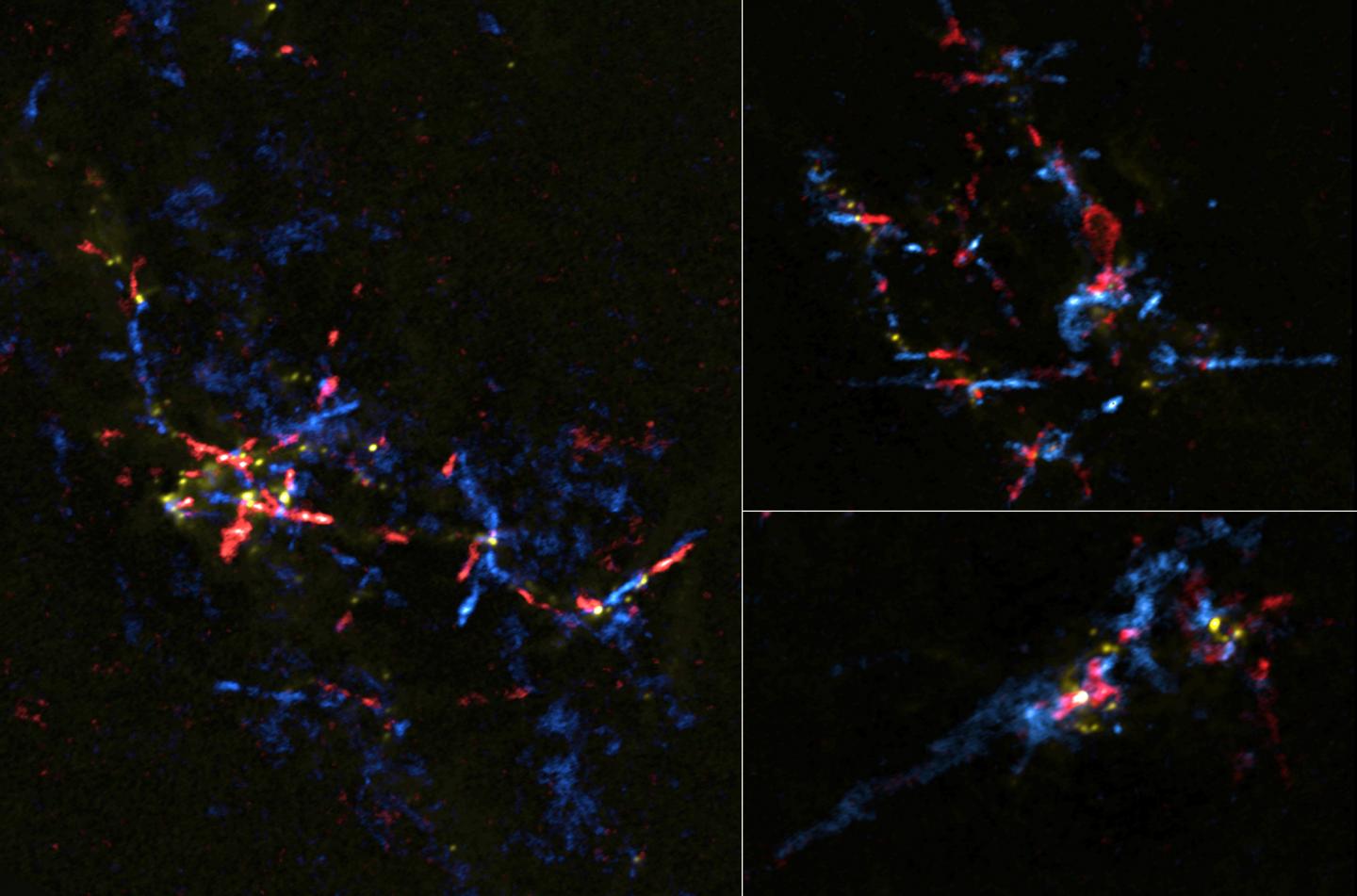
Astronomers found a number of stellar eggs containing baby stars around the center of the Milky Way using the Atacama Large Millimeter/submillimeter Array (ALMA). Previous studies had suggested that the environment there is too harsh to form stars. These findings indicate that star formation is more resilient than researchers thought.

Stars form in stellar eggs, cosmic clouds of gas and dust which collapse due to gravity. If something interferes with the gravity driven contraction, star formation will be suppressed. There are many potential sources of interference near the Galactic Center. Strong turbulence can stir up the clouds and prevent them from contracting, or strong magnetic fields can support the gas against self-gravitational collapse. Previous observations indicated that star formation near the Galactic Center is much less efficient.

To investigate the mysteries of the suppressed star formation, a team led by Xing Lu, an astronomer at the National Astronomical Observatory of Japan, used ALMA to observe regions near the Galactic Center which contain ample gas, but no known star formation. Surprisingly, the team discovered more than 800 dense cores of gas and dust.

“The discovery leads to the question of whether they are actually ‘stellar eggs’ or not.” explains Lu. To answer this question, the team again used ALMA to search for energetic gas outflows which are indicative of stars forming in stellar eggs. Thanks to ALMA’s high sensitivity and high spatial resolution, they detected 43 small and faint outflows in the clouds. Lu comments, “our observations prove that even in the strongly disturbed areas around the Galactic Center, baby stars still form.”

The research team is now analyzing ALMA’s higher resolution observation data to better understand the processes driving the gas outflows and star formation near the Galactic Center.

###

Media Contact
Dr. Masaaki Hiramatsu
[email protected]

Original Source

https://www.nao.ac.jp/en/news/science/2021/20210329-alma.html

Related Journal Article

http://dx.doi.org/10.3847/1538-4357/abde3c

Tags: AstronomyAstrophysicsSpace/Planetary ScienceStars/The Sun
Share13Tweet8Share2ShareShareShare2

Related Posts

blank

Physicists Identify Electronic Drivers Behind Flat Band Quantum Materials

March 21, 2026
Würzburg Chemistry Professor Claudia Höbartner Receives Prestigious Honor

Würzburg Chemistry Professor Claudia Höbartner Receives Prestigious Honor

March 20, 2026

Scientists Reveal How Magnets Control Metamaterial Behavior

March 20, 2026

Gallium-Based Liquid Metals: Pioneering Cybernetic Bridges for Human-Machine Integration

March 20, 2026
Please login to join discussion

POPULAR NEWS

  • blank

    Revolutionary AI Model Enhances Precision in Detecting Food Contamination

    96 shares
    Share 38 Tweet 24
  • Imagine a Social Media Feed That Challenges Your Views Instead of Reinforcing Them

    1003 shares
    Share 397 Tweet 248
  • Uncovering Functions of Cavernous Malformation Proteins in Organoids

    54 shares
    Share 22 Tweet 14
  • Promising Outcomes from First Clinical Trials of Gene Regulation in Epilepsy

    51 shares
    Share 20 Tweet 13

About

We bring you the latest biotechnology news from best research centers and universities around the world. Check our website.

Follow us

Recent News

In-Sensor Cryptography Links Physical Process to Digital Identity

Can Psychosocial Factors Influence Cancer Risk?

Depression Factors in Elderly: Pre vs. Post-COVID Analysis

Subscribe to Blog via Email

Success! An email was just sent to confirm your subscription. Please find the email now and click 'Confirm' to start subscribing.

Join 78 other subscribers
  • Contact Us

Bioengineer.org © Copyright 2023 All Rights Reserved.

Welcome Back!

Login to your account below

Forgotten Password?

Retrieve your password

Please enter your username or email address to reset your password.

Log In
No Result
View All Result
  • Homepages
    • Home Page 1
    • Home Page 2
  • News
  • National
  • Business
  • Health
  • Lifestyle
  • Science

Bioengineer.org © Copyright 2023 All Rights Reserved.