• HOME
  • NEWS
  • EXPLORE
    • CAREER
      • Companies
      • Jobs
    • EVENTS
    • iGEM
      • News
      • Team
    • PHOTOS
    • VIDEO
    • WIKI
  • BLOG
  • COMMUNITY
    • FACEBOOK
    • INSTAGRAM
    • TWITTER
Thursday, June 25, 2026
BIOENGINEER.ORG
No Result
View All Result
  • Login
  • HOME
  • NEWS
  • EXPLORE
    • CAREER
      • Companies
      • Jobs
        • Lecturer
        • PhD Studentship
        • Postdoc
        • Research Assistant
    • EVENTS
    • iGEM
      • News
      • Team
    • PHOTOS
    • VIDEO
    • WIKI
  • BLOG
  • COMMUNITY
    • FACEBOOK
    • INSTAGRAM
    • TWITTER
  • HOME
  • NEWS
  • EXPLORE
    • CAREER
      • Companies
      • Jobs
        • Lecturer
        • PhD Studentship
        • Postdoc
        • Research Assistant
    • EVENTS
    • iGEM
      • News
      • Team
    • PHOTOS
    • VIDEO
    • WIKI
  • BLOG
  • COMMUNITY
    • FACEBOOK
    • INSTAGRAM
    • TWITTER
No Result
View All Result
Bioengineer.org
No Result
View All Result
Home NEWS Science News Chemistry

Staying in the shade: how cells use molecular motors to avoid bright light

Bioengineer by Bioengineer
March 1, 2021
in Chemistry
Reading Time: 2 mins read
0
IMAGE
Share on FacebookShare on TwitterShare on LinkedinShare on RedditShare on Telegram

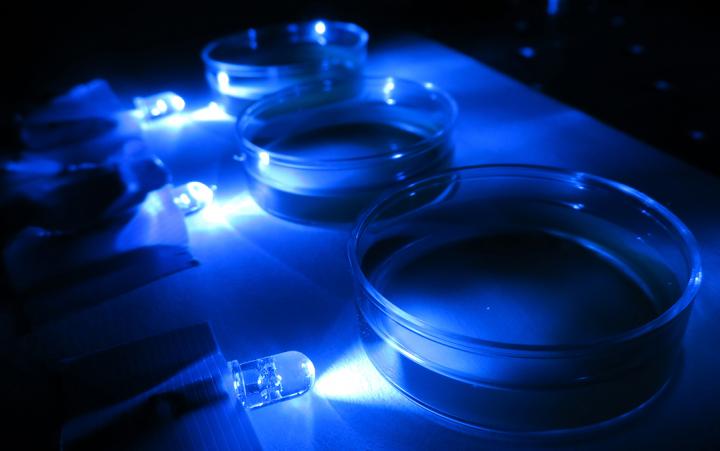
Research team led by the University of Tsukuba discover new component of molecular motors that drive cellular movement in response to light
IMAGE

Credit: University of Tsukuba

Tsukuba, Japan – Single-celled algae and animal sperm cells are widely separated in evolution but both swim in the same way, by waving their protruding hairs, called cilia or flagella. Motion is driven by molecular motors, complex assemblies of proteins that exert a force when changing shape. The motor proteins are connected to the cell’s internal skeleton of microtubules; the moving force from the motor causes microtubules to slide, moving the flagella and propelling the cell.

Now a team led by Professor Kazuo Inaba of the University of Tsukuba in collaboration with scientists from Osaka University, Tokyo Institute of Technology and Paul Scherrer Institute has described a new protein that is closely associated with one class of motors, called dyneins. They recently published their findings in Science Advances.

The team isolated molecular motor complexes from sperm cells of a marine invertebrate, the sea squirt Ciona intestinalis. Among the components, they discovered a novel protein related to a protein with a blue-light sensing function, called BLUF. They named the new protein “DYBLUP” for dynein-associated BLUF protein. Comparing gene sequences, they found DYBLUP has been conserved during evolution across a wide range of organisms, from some fungi and algae to animals (but is not found in arthropods or higher plants).

Working with the single-celled alga Chlamydomonas, the team used powerful electron microscopy techniques to show that DYBLUP is part of the molecular tether linking the motor protein to the microtubules.

They then showed that DYBLUP is also involved in regulating the motor in response to light. Chlamydomonas cells normally swim towards dim blue light but away from bright blue light, which damages the cells. Mutant cells of the algae that lacked DYBLUP behaved like normal cells in dim blue light. Initially they avoided strong blue light, but over time they became accustomed to and were then strongly attracted towards it.

“We have discovered a new feature of molecular motors”, says Professor Inaba, corresponding author. “Not only is DYBLUP conserved widely across different species, it’s also involved in responses to light. In mutant Chlamydomonas cells without DYBLUP protein, it seems the linkage between the motor and the cell skeleton is partly broken, leading to uncontrolled beating of the flagella and altered cell behavior in blue light.”

“Both the function and evolution of DYBLUP are fascinating,” Professor Inaba continues. “Greater understanding of this protein might also open the way for new technologies to manipulate molecular motors, perhaps using light as a trigger.”

###

The article, “A dynein-associated photoreceptor protein prevents ciliary acclimation to blue light”, was recently published in Science Advances at doi.org/10.1126/sciadv.abf3621

Media Contact
Naoko Yamashina
[email protected]

Related Journal Article

http://dx.doi.org/10.1126/sciadv.abf3621

Tags: BiochemistryBiologyBiomechanics/BiophysicsCell BiologyDevelopmental/Reproductive BiologyEcology/EnvironmentPlant Sciences
Share12Tweet8Share2ShareShareShare2

Related Posts

International Team Including Dresden Scientists Develops Novel Designer Proteins for Advanced Study of Living Tissue

June 25, 2026

New Study Uncovers Key Factors Driving Water Chemistry in Nanoscale Environments

June 25, 2026

Plasma Technology Extends Catalyst Lifespan in Hydrogen Production

June 24, 2026

Electric Field and Oxygen Spillover Collaborate to Control Electrode Migration in SOECs

June 24, 2026
Please login to join discussion

POPULAR NEWS

  • Saying Goodbye to PGY-6: Pediatric Fellowship Realities

    103 shares
    Share 41 Tweet 26
  • Multi-Hospital Study Reveals Long Covid Burden Is Twice as High as Current Estimates

    92 shares
    Share 36 Tweet 23
  • Detection of EDCs in Breast Milk and Infant Urine Up to Six Months Highlights Early Exposure Risks

    77 shares
    Share 31 Tweet 19
  • New Drug Candidate Developed at McMaster Shows Potential for Treating Brain Cancer

    58 shares
    Share 23 Tweet 15

About

We bring you the latest biotechnology news from best research centers and universities around the world. Check our website.

Follow us

Recent News

Energy-Saving Membrane Technology Developed by KAIST and Georgia Tech Enables Crude Oil Separation Without Boiling

Cracking the Code: How Cancer Evades Antibody-Drug Conjugates and New Strategies to Overcome Resistance

Chiral Laser Gyroscopes Surpass Lock-In Limit

Subscribe to Blog via Email

Enter your email address to subscribe to this blog and receive notifications of new posts by email.

Join 82 other subscribers
  • Contact Us

Bioengineer.org © Copyright 2023 All Rights Reserved.

Welcome Back!

Login to your account below

Forgotten Password?

Retrieve your password

Please enter your username or email address to reset your password.

Log In
No Result
View All Result
  • Homepages
    • Home Page 1
    • Home Page 2
  • News
  • National
  • Business
  • Health
  • Lifestyle
  • Science

Bioengineer.org © Copyright 2023 All Rights Reserved.