Researchers from the University of Tsukuba synthesize an elastic polymer from low-cost, sustainable materials, that can be used it to fabricate lenses that help keep infrared cameras focused in the dark
Credit: University of Tsukuba
Tsukuba, Japan – In a study recently published in ACS Applied Polymer Materials, researchers from the University of Tsukaba synthesized an infrared-transmitting polymer–based on low-cost, widely available materials–that retains its shape after stretching. The properties of this polymer are highly applicable to the preparation of cheaper night-vision lenses that retain focus while imaging at variable distances.
Cameras that function in the dark are common in many fields, including the military, security, firefighting, and wildlife tracking. However, infrared night-vision lenses are typically expensive, and the camera images tend to appear flat. Consequently, there is a need for lenses based on commonly available, cheap materials that are useful for more realistic vision in three dimensions.
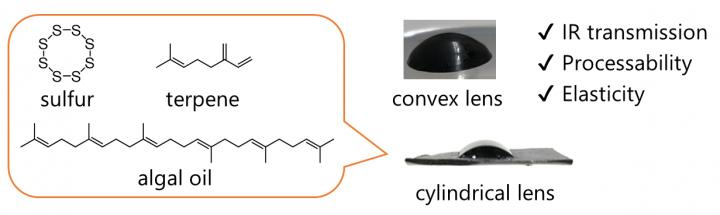
The researchers’ polymer is based on sulfur and compounds derived from algae and plants. The polymer is easy to prepare using a chemical process called inverse vulcanization: simply mix the constituent compounds together and stir while heating. As a first step, the researchers designed a polymer that is elastic–that is, reverts to its original shape–after being repeatedly restretched by 20%.
“Inverse vulcanization is an ideal synthetic approach for our polymers,” explains lead author Professor Junpei Kuwabara. “Squalene and other long unsaturated hydrocarbons help optimize the cross-linking structure and give the polymers a desirable elasticity.”
Next, the researchers needed to determine whether lenses constructed from their polymers are at least partially transparent to infrared light, for nighttime imaging. Lens construction was easy: simply pour the polymer into a lens-shaped silicone mold and heat for a few hours. Even a 3.3-millimeter-thick lens transmitted 10% of incoming infrared light.
“The lenses have two wavelength ranges that are infrared-transparent,” says senior author Professor Takaki Kanbara. “No lens is completely transparent; 10% transmission is an excellent value for these materials.”
Furthermore, the researchers confirmed that the polymer has variable-focus properties. By projecting an image through the lens, and monitoring the resulting image that came through while elongating the lens, much of the transmitted image remained in focus.
“The lens retained 54% of the focus variation, which is sufficient for practical uses,” explains Dr. Takashi Fukuda, senior researcher, National Institute of Advanced Industrial Science and Technology (AIST). “The lens also retained its full initial focus after contracting back to its original shape.”
The fabrication of conventional infrared night-vision lenses, in a way that allows users to easily change focus from one position to another, is typically difficult. Without a variable-focus capability, details that are pertinent to criminal or research investigations, for example, may be lost. The researchers of this study are overcoming current lens design limitations by using cheap, sustainable materials, and fabrication procecures that any researcher can carry out in their laboratory. Development of new materials in this area may benefit a range of sectors including emergency personnel and environmental researchers
###
The article, “Algae-inspired, sulfur-based polymer with infrared transmission and elastic function,” was published in ACS Applied Polymer Materials at DOI: 10.1021/acsapm.0c00924.
Media Contact
Naoko Yamashina
[email protected]
Related Journal Article
http://dx.