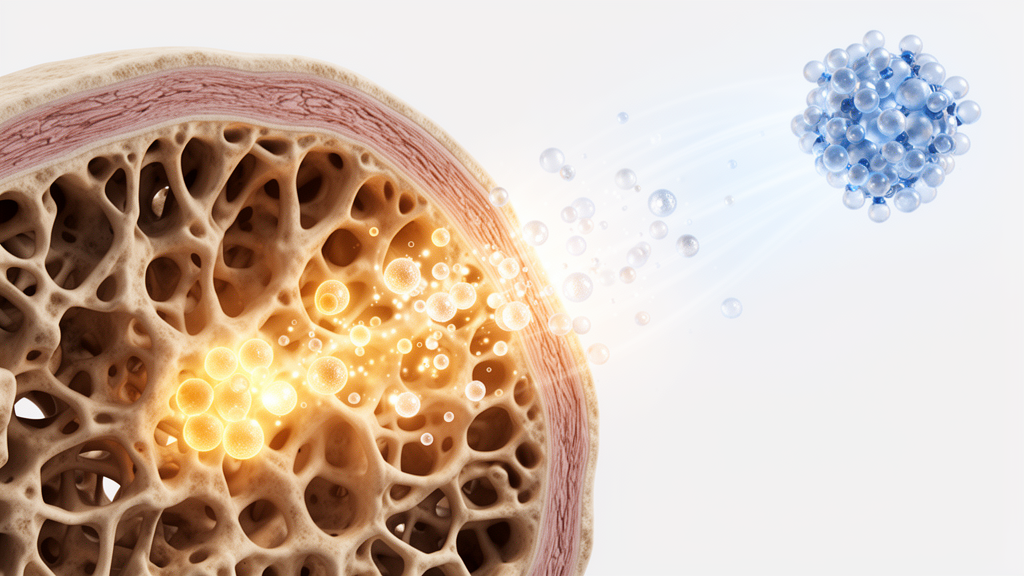
A study published in Nature Aging reports that statin use was associated with a slower annual decline in lumbar spine bone mineral density in postmenopausal women, and that in mice the drug atorvastatin promoted bone formation specifically under estrogen-deficient conditions. The work, led by Min Yang and Bo Shen with colleagues at the National Institute of Biological Sciences, Beijing, and collaborating hospitals, traces this skeletal effect to a defined population of bone marrow stromal cells and to a molecular pathway that runs through protein prenylation, the small GTPase RAC1 and the transcription factor NF-κB.
The human evidence comes from retrospective analyses of paired dual-energy X-ray absorptiometry scans. The researchers examined 169 postmenopausal women aged 55 to 65 years, drawn from Beijing Jishuitan Hospital (80 participants) and Kowloon Hospital in Suzhou (89 participants). All had been postmenopausal for at least three years and had undergone at least two lumbar spine DXA scans separated by at least six months. People with metabolic bone disease, inflammatory rheumatic disease, chronic kidney disease, malignancy or uncontrolled thyroid disease were excluded, as were those taking bone-active medications such as bisphosphonates, denosumab, teriparatide or glucocorticoids. Pharmacy dispensing records were used to divide participants into statin users, users of the PCSK9 inhibitor evolocumab, and controls receiving no lipid-lowering therapy.
In both cohorts, statin use was associated with a significantly slower annual percentage decline in bone mineral density compared with nonusers. Notably, plasma LDL cholesterol levels were comparable across the statin, evolocumab and control groups, yet evolocumab was not associated with a slower decline in bone density. That dissociation argues against LDL reduction as the explanation and hints at a direct skeletal action of statins. The authors caution, however, that these are observational associations from retrospective cohorts, and they note in their discussion that randomized and meta-analytic studies of statins and fracture outcomes have yielded inconsistent results, so the clinical implications remain to be tested prospectively.
To probe mechanism, the team turned to mice. In 18-month-old female mice, atorvastatin—but not evolocumab—significantly increased trabecular bone volume, trabecular number and thickness, bone mineral density and cortical thickness on micro-computed tomography. The drug also increased bone mass after ovariectomy, a surgical model of estrogen deficiency, but had no measurable effect in young adult mice, in orchiectomized males or in aged males. In ovariectomized mice, atorvastatin raised the mineral apposition rate and plasma levels of P1NP, a marker of bone formation, while markers of bone resorption, including CTX-1 and osteoclast numbers, were unchanged. The effect, in other words, was anabolic: more bone being built, not less being broken down.
The cellular target emerged as leptin receptor-expressing (LEPR+) bone marrow stromal cells, a population that includes skeletal stem and progenitor cells and that gives rise to more than 90 percent of osteoblasts and osteocytes formed during adulthood. Using a newly generated doxycycline-inducible Tet-On Lepr-Cre allele—chosen to avoid tamoxifen, itself a bone-active estrogen receptor modulator—the researchers fate-mapped LEPR+ cells and found that atorvastatin increased their contribution to osteoblasts and osteocytes in ovariectomized mice. Atorvastatin also promoted osteogenic differentiation of colony-forming unit-fibroblasts derived from both mouse and human bone marrow, and it reduced the number of bone marrow adipocytes in ovariectomized animals.
A striking part of the study concerns estrogen itself. When the researchers delivered estradiol via osmotic pumps to young mice, bone mass increased and LEPR+ cells contributed more heavily to osteoblast formation—establishing that estrogen acts directly on this early progenitor population. Reporter alleles and flow cytometry showed that the estrogen receptor alpha gene Esr1 was abundantly expressed in LEPR+ cells: about 85 percent of Esr1-GFP-positive bone marrow cells were LEPR-positive, and most LEPR+ cells expressed the reporter. Critically, deleting Esr1 specifically in LEPR+ cells markedly attenuated estradiol-induced bone gains in ovariectomized mice and accelerated age-associated bone loss, whereas deleting Esr1 only in mature osteoblasts and osteocytes did neither. The authors conclude that a major component of estrogen’s bone-forming action operates earlier in the osteogenic trajectory than previously appreciated.
Both estrogen and statins converged on a single downstream gene: Oln, which encodes osteolectin (OLN), a secreted growth factor produced by LEPR+ cells that promotes their own osteogenic differentiation. Estradiol-estrogen receptor alpha signaling promoted Oln transcription in LEPR+ cells, with ERα occupancy at an upstream regulatory region of the Oln locus increasing after estradiol treatment in mouse and human CFU-Fs. In ovariectomized mice, Oln deficiency attenuated—but did not abolish—the bone response to estradiol. In the human cohorts, multiplex immunoassay of plasma samples showed significantly higher circulating OLN levels in statin users than in nonusers; among 48 proteins examined, OLN and interleukin-16 were the only factors that differed significantly between groups in both cohorts.
The statin mechanism proved mechanistically distinct from estrogen’s. In ovariectomized mice, deleting Esr1 in LEPR+ cells did not blunt the atorvastatin-induced rise in Oln expression, indicating the drug acts independently of ERα. Instead, the pathway ran through the mevalonate pathway. Using an Oln-NanoLuc reporter, the researchers showed that atorvastatin increased Oln transcription in a dose-dependent manner, that a bisphosphonate blocking farnesyl pyrophosphate synthase phenocopied the effect, that blocking sterol synthesis at squalene epoxidase did nothing, and that supplying the prenyl donors geranylgeranyl pyrophosphate or farnesyl pyrophosphate abolished the response. In ovariectomized Oln-deficient mice, atorvastatin failed to increase bone mass at all, demonstrating that OLN is required for the statin effect.
A CRISPR-based screen of 197 candidate prenylated proteins, including 104 small GTPases, pinpointed RAC1 as the critical mediator: deleting Rac1 completely abolished the atorvastatin-induced increase in Oln reporter activity in mouse CFU-Fs and eliminated the response in human cells as well. Metabolic labeling with a clickable farnesyl pyrophosphate analog indicated that atorvastatin restricts RAC1 prenylation, and RAC1 activation assays showed increased GTP-bound RAC1 after treatment. Downstream, CUT&Tag and ChIP-qPCR revealed increased NF-κB occupancy at the Oln/OLN locus after atorvastatin treatment in both mouse and human cells. In ovariectomized mice with conditional Rac1 deletion in LEPR+ cells, atorvastatin neither increased bone mass nor reduced bone marrow adipocytes, confirming that RAC1 is required for the anabolic effect in vivo.
The authors frame their findings as repositioning estrogen action to an earlier stage of osteogenic differentiation and as identifying OLN as a shared mediator of bone formation during estrogen deficiency. They also emphasize the context dependence of the response: no statin effect appeared in aged males, young adults or orchiectomized males, suggesting that female estrogen deficiency provides a permissive endocrine setting, although sex-dependent differences in LEPR+ cells or OLN regulation may also contribute. Several limitations remain open, including whether estrogen and statins act broadly across the heterogeneous LEPR+ population or through a restricted subset, and whether other progenitor populations show similar sensitivity to impaired prenylation. With statins so widely prescribed in older populations, the researchers argue that understanding how distinct stem and progenitor states interpret impaired prenylation will be important for assessing the tissue-specific consequences of long-term use.
Subject of Research: How statins and estrogen signaling regulate bone formation through skeletal stem and progenitor cells during estrogen deficiency
Article Title: Statins promote bone anabolism in estrogen deficiency by inducing osteogenic differentiation of skeletal stem/progenitor cells
Article References: Yang, M., Guo, J., Ye, J., Meng, X., Ma, Y., Ni, Y., Chen, T., Zhang, Y., Guo, H., Shen, G., Yuan, Y., Qiao, X., Wu, Y., Li, J., Qi, X., Fang, S., Wang, L., & Shen, B. (2026). Statins promote bone anabolism in estrogen deficiency by inducing osteogenic differentiation of skeletal stem/progenitor cells. Nature Aging. https://doi.org/10.1038/s43587-026-01257-1
Image Credits: AI Generated
DOI: 10.1038/s43587-026-01257-1
Keywords: statins, bone loss, osteoporosis, menopause, estrogen deficiency, skeletal stem cells, LEPR+ cells, osteolectin, RAC1 prenylation, NF-κB, mevalonate pathway, bone mineral density
News Source: Drew Townsend. (October 27, 2026). Statins May Slow Bone Loss After Menopause by Rerouting Stem Cell Signals. Scienmag.