• HOME
  • NEWS
  • EXPLORE
    • CAREER
      • Companies
      • Jobs
    • EVENTS
    • iGEM
      • News
      • Team
    • PHOTOS
    • VIDEO
    • WIKI
  • BLOG
  • COMMUNITY
    • FACEBOOK
    • INSTAGRAM
    • TWITTER
Thursday, March 26, 2026
BIOENGINEER.ORG
No Result
View All Result
  • Login
  • HOME
  • NEWS
  • EXPLORE
    • CAREER
      • Companies
      • Jobs
        • Lecturer
        • PhD Studentship
        • Postdoc
        • Research Assistant
    • EVENTS
    • iGEM
      • News
      • Team
    • PHOTOS
    • VIDEO
    • WIKI
  • BLOG
  • COMMUNITY
    • FACEBOOK
    • INSTAGRAM
    • TWITTER
  • HOME
  • NEWS
  • EXPLORE
    • CAREER
      • Companies
      • Jobs
        • Lecturer
        • PhD Studentship
        • Postdoc
        • Research Assistant
    • EVENTS
    • iGEM
      • News
      • Team
    • PHOTOS
    • VIDEO
    • WIKI
  • BLOG
  • COMMUNITY
    • FACEBOOK
    • INSTAGRAM
    • TWITTER
No Result
View All Result
Bioengineer.org
No Result
View All Result
Home NEWS Science News Biology

Starving bacteria can eject their tails to save energy and stay alive

Bioengineer by Bioengineer
March 19, 2019
in Biology
Reading Time: 3 mins read
0
IMAGE
Share on FacebookShare on TwitterShare on LinkedinShare on RedditShare on Telegram

IMAGE

Credit: Morgan Beeby

When nutrients are dangerously low, a group of bacteria have been found to take the drastic measure of getting rid of their tails.

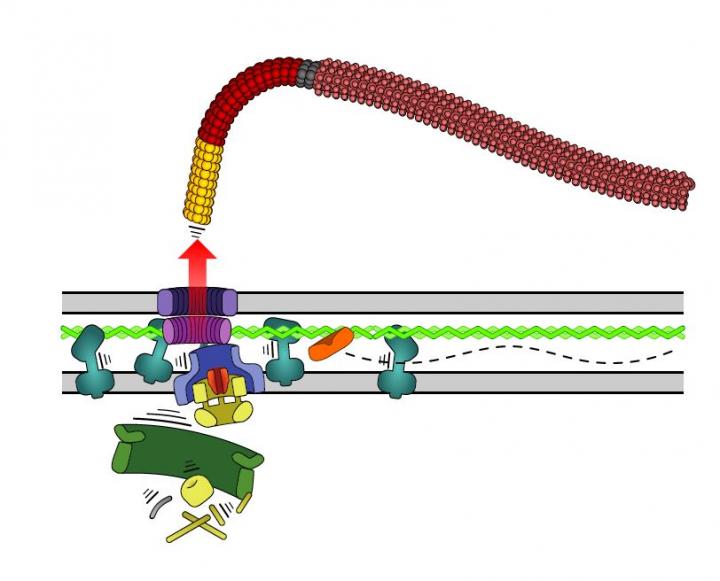
Some bacteria use tails, or flagella, to swim through liquids – including those in our bodies. However, new research published today in PLOS Biology reveals a surprisingly drastic measure taken by some bacteria when facing starvation: they eject their flagella, leaving themselves paralyzed, but conserving energy so they can stay alive.

The research team, led by Imperial College London in collaboration with researchers from the Francis Crick Institute, the University of Leiden, and Justus-Liebig-Universität Giessen, say this is the first time such curious behaviour has been observed in bacteria.

The serendipitous discovery was made when the team were collecting detailed images of the ‘motors’ that drive flagella in a group of bacteria that includes various harmful species, including Vibrio cholerae, which causes cholera.

They saw some instances where part of the motor ‘housing’ was present in the membrane of a bacteria, but not the motor or flagellum itself. This suggested two possibilities: either they had caught an image of the motor-flagellum complex as it was being assembled, or as it was being disassembled.

First author Josie Ferreira, from the Department of Life Sciences at Imperial, said: “Before we started our experiments, we thought we had caught the bacteria in the process of assembling their motor-flagella complexes. To our surprise, we found the opposite: not only had the bacteria ejected their flagella, they had plugged the hole it left behind. This suggested to us it was a deliberate action.”

Bacterial use their flagella to get around, even swimming through thick gut mucus as in the case of food-poisoning bacterium Campylobacter jejuni. However, flagella are costly to build and power, and constantly grow throughout the bacteria’s life, using up a lot of resources.

The team found that bacteria placed in environments that lacked nutrients ejected their flagella into the growth medium. The discarded flagella were complete, including the adaptor structure that connects flagella to their motors, suggesting that they were ejected whole from their base, and not broken off.

Lead author Dr Morgan Beeby, from the Department of Life Sciences at Imperial, said: “The bacteria’s actions appear to be deliberate. It’s not like when our fingers or toes drop off from frostbite – it’s more a calculated act like mountaineer Aron Ralston cutting off his arm in the film 127 Hours to free himself from under a rock.”

Bacteria have been observed swimming more slowly when nutrients are low, but this is the first time they have been observed jettisoning their flagella completely in a bid to save energy.

The team say that determining what mechanism harmful bacteria use to eject their flagella could suggest new targets for drugs that force them to push the eject button.

Dr Beeby also says that although the bacteria have evolved a clear mechanism for ejecting flagella and plugging the gap, the process shows how irrational and messy evolution can be. He said: “Evolution is not neat or tidy: leaving the motor structure behind in the membrane is a kind of ‘bacterial clutter’ that the bacteria close the door on. While an inelegant solution, their molecular clutter doesn’t hurt them.”

###

Media Contact
Hayley Dunning
[email protected]

Original Source

https://www.imperial.ac.uk/news/190586/starving-bacteria-eject-their-tails-save/

Related Journal Article

http://dx.doi.org/10.1371/journal.pbio.3000165

Tags: BacteriologyBiologyEvolutionMicrobiology
Share117Tweet8Share2ShareShareShare2

Related Posts

How to sway group opinions: Encourage opponents to stay undecided

How to sway group opinions: Encourage opponents to stay undecided

March 23, 2026
Deep Learning Model Maps How Individual Cells Shape Disease Outcomes

Deep Learning Model Maps How Individual Cells Shape Disease Outcomes

March 20, 2026

Removing only 15 female sharks annually could endanger the entire population, scientists warn

March 20, 2026

Scientists Urge Fragrance Industry to Transition from Sustainability Talk to Active Funding of Plant Conservation

March 20, 2026
Please login to join discussion

POPULAR NEWS

  • blank

    Revolutionary AI Model Enhances Precision in Detecting Food Contamination

    96 shares
    Share 38 Tweet 24
  • Imagine a Social Media Feed That Challenges Your Views Instead of Reinforcing Them

    1003 shares
    Share 397 Tweet 248
  • Uncovering Functions of Cavernous Malformation Proteins in Organoids

    54 shares
    Share 22 Tweet 14
  • Promising Outcomes from First Clinical Trials of Gene Regulation in Epilepsy

    51 shares
    Share 20 Tweet 13

About

We bring you the latest biotechnology news from best research centers and universities around the world. Check our website.

Follow us

Recent News

In-Sensor Cryptography Links Physical Process to Digital Identity

Can Psychosocial Factors Influence Cancer Risk?

Depression Factors in Elderly: Pre vs. Post-COVID Analysis

Subscribe to Blog via Email

Success! An email was just sent to confirm your subscription. Please find the email now and click 'Confirm' to start subscribing.

Join 78 other subscribers
  • Contact Us

Bioengineer.org © Copyright 2023 All Rights Reserved.

Welcome Back!

Login to your account below

Forgotten Password?

Retrieve your password

Please enter your username or email address to reset your password.

Log In
No Result
View All Result
  • Homepages
    • Home Page 1
    • Home Page 2
  • News
  • National
  • Business
  • Health
  • Lifestyle
  • Science

Bioengineer.org © Copyright 2023 All Rights Reserved.