• HOME
  • NEWS
  • EXPLORE
    • CAREER
      • Companies
      • Jobs
    • EVENTS
    • iGEM
      • News
      • Team
    • PHOTOS
    • VIDEO
    • WIKI
  • BLOG
  • COMMUNITY
    • FACEBOOK
    • INSTAGRAM
    • TWITTER
Saturday, July 4, 2026
BIOENGINEER.ORG
No Result
View All Result
  • Login
  • HOME
  • NEWS
  • EXPLORE
    • CAREER
      • Companies
      • Jobs
        • Lecturer
        • PhD Studentship
        • Postdoc
        • Research Assistant
    • EVENTS
    • iGEM
      • News
      • Team
    • PHOTOS
    • VIDEO
    • WIKI
  • BLOG
  • COMMUNITY
    • FACEBOOK
    • INSTAGRAM
    • TWITTER
  • HOME
  • NEWS
  • EXPLORE
    • CAREER
      • Companies
      • Jobs
        • Lecturer
        • PhD Studentship
        • Postdoc
        • Research Assistant
    • EVENTS
    • iGEM
      • News
      • Team
    • PHOTOS
    • VIDEO
    • WIKI
  • BLOG
  • COMMUNITY
    • FACEBOOK
    • INSTAGRAM
    • TWITTER
No Result
View All Result
Bioengineer.org
No Result
View All Result
Home NEWS Science News

Star birth with a chance of Winds?

Bioengineer by Bioengineer
January 27, 2017
in Science News
Reading Time: 2 mins read
0
Share on FacebookShare on TwitterShare on LinkedinShare on RedditShare on Telegram
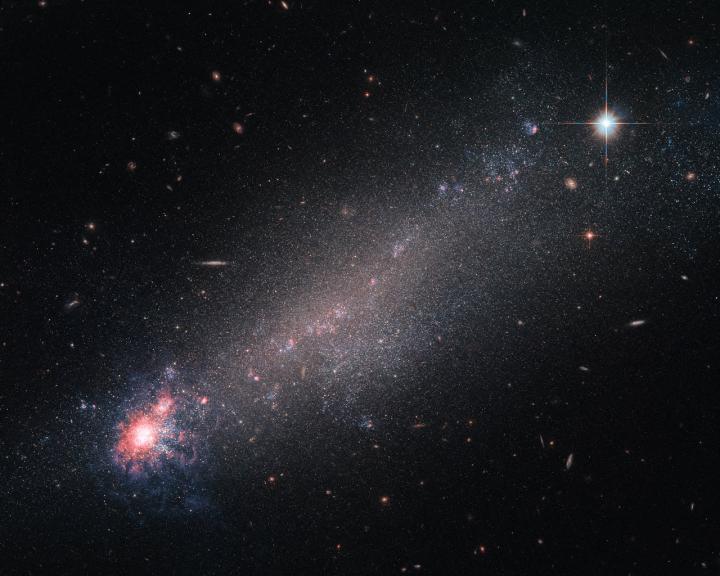
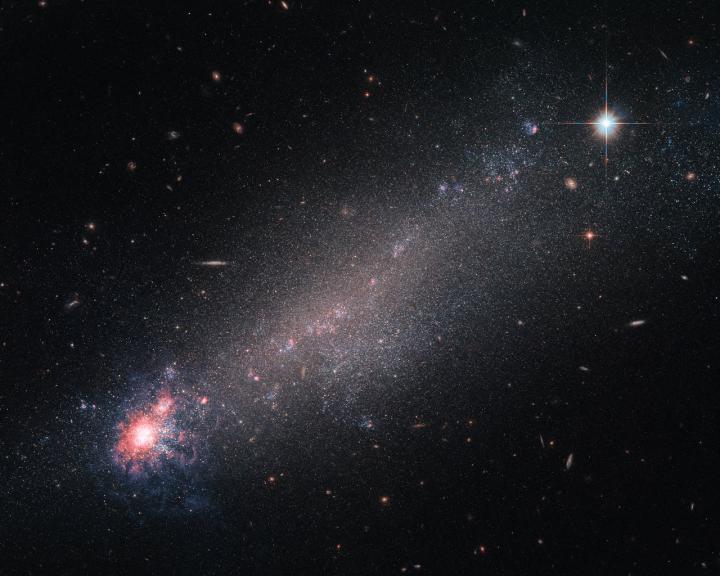
IMAGE

Credit: Image credit: ESA/Hubble & NASA

The lesser-known constellation of Canes Venatici (The Hunting Dogs), is home to a variety of deep-sky objects — including this beautiful galaxy, known as NGC 4861. Astronomers are still debating on how to classify it. While its physical properties — such as mass, size and rotational velocity — indicate it to be a spiral galaxy, its appearance looks more like a comet with its dense, luminous "head" and dimmer "tail" trailing off. Features more fitting with a dwarf irregular galaxy.

Although small and messy, galaxies like NGC 4861 provide astronomers with interesting opportunities for study. Small galaxies have lower gravitational potentials, which simply means that it takes less energy to move stuff about inside them than it does in other galaxies. As a result, moving in, around, and through such a tiny galaxy is quite easy to do, making them far more likely to be filled with streams and outflows of speedy charged particles known as galactic winds, which can flood such galaxies with little effort.

These galactic winds can be powered by the ongoing process of star formation, which involves huge amounts of energy. New stars are springing into life within the bright, colorful 'head' of NGC 4861 and ejecting streams of high-speed particles as they do so, which flood outwards to join the wider galactic wind. While NGC 4861 would be a perfect candidate to study such winds, recent studies did not find any galactic winds in it.

###

Media Contact

Rob Gutro
[email protected]
@NASAGoddard

http://www.nasa.gov/goddard

############

Story Source: Materials provided by Scienmag

Share12Tweet8Share2ShareShareShare2

Related Posts

Quasi-Bound States Boost Quantum Well Photoresponse — Technology and Engineering

Quasi-Bound States Boost Quantum Well Photoresponse

July 4, 2026

Lysine Pyruvylation Links Glycolysis to Epigenetics

July 4, 2026

Multiphysics Coupling: Single vs. Multiple DeepONet Branches

July 4, 2026

Personalized Neoantigen Dendritic Cell Vaccine in Glioblastoma

July 4, 2026
Please login to join discussion

POPULAR NEWS

  • Detection of EDCs in Breast Milk and Infant Urine Up to Six Months Highlights Early Exposure Risks

    77 shares
    Share 31 Tweet 19
  • Saying Goodbye to PGY-6: Pediatric Fellowship Realities

    103 shares
    Share 41 Tweet 26
  • New Drug Candidate Developed at McMaster Shows Potential for Treating Brain Cancer

    58 shares
    Share 23 Tweet 15
  • KTU Researchers Explore Ultrasound’s Role in Enhancing Blood Flow Beyond Diagnostics

    53 shares
    Share 21 Tweet 13

About

We bring you the latest biotechnology news from best research centers and universities around the world. Check our website.

Follow us

Recent News

Quasi-Bound States Boost Quantum Well Photoresponse

Lysine Pyruvylation Links Glycolysis to Epigenetics

Multiphysics Coupling: Single vs. Multiple DeepONet Branches

Subscribe to Blog via Email

Success! An email was just sent to confirm your subscription. Please find the email now and click 'Confirm' to start subscribing.

Join 83 other subscribers
  • Contact Us

Bioengineer.org © Copyright 2023 All Rights Reserved.

Welcome Back!

Login to your account below

Forgotten Password?

Retrieve your password

Please enter your username or email address to reset your password.

Log In
No Result
View All Result
  • Homepages
    • Home Page 1
    • Home Page 2
  • News
  • National
  • Business
  • Health
  • Lifestyle
  • Science

Bioengineer.org © Copyright 2023 All Rights Reserved.