


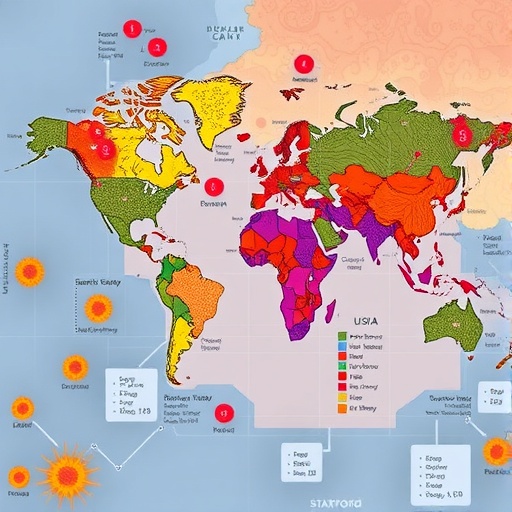
In a groundbreaking study poised to reshape our understanding of human biology, researchers from the Stanford School of Medicine have unveiled compelling evidence that both ethnicity and geographic environment intricately influence the human molecular landscape. This unprecedented analysis delves deep into the interplay between genetic ancestry and environmental exposure, illuminating foundational aspects of metabolism, immunity, gut microbiota composition, and biological aging processes across diverse global populations.
Published in the prestigious journal Cell, the study represents one of the most comprehensive molecular profiling efforts on a global scale. By harnessing cutting-edge multiomics methodologies—including lipidomics, proteomics, metabolomics, and microbiome analysis—the researchers constructed a nuanced molecular atlas that captures the distinct signatures imprinted by ethnic heritage and current geographical residence on the human body at the cellular and systems levels.
The cohort comprised 322 healthy adults with European, East Asian, and South Asian ancestries, who were uniquely selected from a shared social setting—a conference—to control for lifestyle variability. Participants were living across different continents, notably Asia, Europe, and North America. This cohort design enabled the disentanglement of genetic influences from environmental factors, a challenge that has long complicated population biochemical studies.
One of the salient revelations from the data indicates that certain molecular profiles are tightly linked to ethnic background irrespective of geographic relocation. For example, individuals of South Asian descent exhibited heightened molecular markers indicative of pathogen exposure, suggesting consistent immune environment interactions rooted in genetic predisposition. Conversely, participants with European heritage showed enriched gut microbial diversity and elevated circulating metabolites closely associated with cardiovascular risk, phenomena that remained stable even when residing outside their ancestral continent.
Conversely, geographic relocation exerted pronounced effects on metabolic networks and lipid pathways, as the study documented systematic shifts in cholesterol homeostasis, bile acid metabolism, and arachidonic acid derivatives, contingent on the participants’ current habitation. Notably, these geographic signatures were accompanied by selective modifications of the gut microbial ecosystem, highlighting the dynamic responsiveness of host-microbiota interactions to environmental context.
The investigation also elucidated intriguing associations between biology’s intrinsic aging mechanisms and geography. Biological age—a molecularly derived estimation reflecting cellular and tissue functional states—varied in counterintuitive ways. East Asians residing outside Asia displayed accelerated biological aging relative to their counterparts living within Asia, whereas Europeans living outside Europe exhibited a relative deceleration of their biological clock. These findings invoke compelling hypotheses regarding the influence of diet, lifestyle factors, and microbiome compositions in modulating cellular senescence and longevity trajectories.
Delving into mechanistic insights, the research identified a novel molecular axis linking a critical telomerase gene—central to chromosome end maintenance and cellular replicative lifespan—with an understudied gut microbe, Oscillospiraceae UCG-002. This relationship appears to be mediated through sphingomyelin, a bioactive lipid known for its role in membrane architecture and intracellular signaling. Such discoveries underscore the potential for gut microorganisms to directly influence host aging pathways, offering fertile ground for future therapeutic innovations targeting microbiome modulation.
The extensive open-access dataset derived from this research presents an invaluable resource for advancing precision medicine. By detailing how ethnic genetic architecture and environmental exposures combine to shape molecular phenotypes, the study lays the foundation for more equitable healthcare interventions—targeting diagnostics, prognostics, and personalized treatment approaches sensitive to the nuanced biological variation that exists within and between populations.
Importantly, the collaborative nature of this research—with contributions spanning institutions across North America, Europe, and Asia—reflects the growing imperative to incorporate globally representative cohorts in biomedical research. Such inclusivity addresses historical biases in medical data that have hampered progress toward universally effective health solutions.
Funding for this multifaceted endeavor came from a diverse array of sources, underscoring widespread recognition of its scientific and public health significance. These include philanthropic families, national health agencies, scientific foundations, and interdisciplinary research institutes, all converging to support a vision of biology that honors human diversity in both heritage and lived experience.
This landmark study not only challenges simplified paradigms attributing biological variation solely to either genetics or environment but also emphasizes the necessity of integrated, systems-level approaches to unravel the complexity of human health. By charting the molecular contours shaped by ethnicity and geography, scientists are now better equipped to explore how these factors influence disease susceptibility, therapeutic responses, and the aging process across the globe.
As biomedical research moves into an era defined by multiomics and big data, such nuanced understanding is critical. Harnessing these insights promises to revolutionize how medicine caters to the complexities of human diversity—paving the way for tailored interventions and healthier lifespans worldwide.
Subject of Research: Cells
Article Publication Date: 14-May-2026
Journal: Cell
Keywords: Genetics, Human microbiota
Tags: biological aging molecular markersethnicity geographic molecular signaturesethnicity impact on metabolismgenetic ancestry and environmental exposureglobal multiomics human studygut microbiota composition across ethnicitieshuman molecular diversity and geographyimmunity molecular diversity researchlipidomics proteomics metabolomics integrationmulti-continent human molecular profilingpopulation biochemical variability controlStanford Medicine molecular atlas

