In the intricate dance of flight, hoverflies exhibit an extraordinary blend of speed, agility, and sensory precision that rivals even the most advanced aerial robots and human pilots. New research emerging from Flinders University offers a groundbreaking glimpse into how sexual dimorphism—the distinct physical and functional differences between males and females—shapes the sensorimotor transformations underpinning flight behaviors in these native pollinators. The findings unravel a delicate interplay between visual processing, neural dynamics, and biomechanical execution that governs how male and female hoverflies navigate their fast-paced environments.
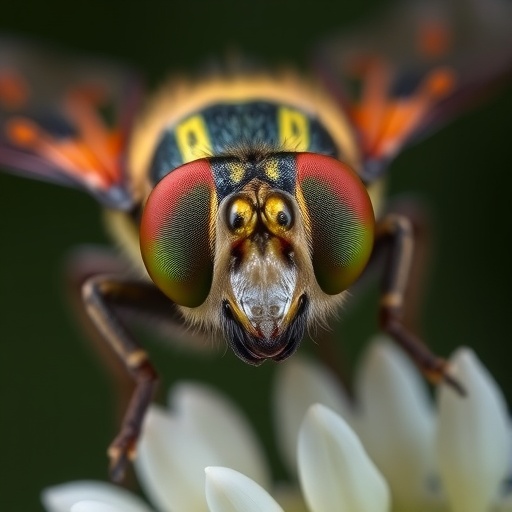
Male hoverflies are known to possess markedly larger eyes compared to their female counterparts, a feature that grants them enhanced visual capabilities for rapid detection and tracking during high-speed pursuits. This visual advantage is not superficial; it bestows males with faster photoreceptor responses—a neural advantage critical during fleeting courtship flights and territorial combats. The Flinders University-led team set out to decode how this anatomical dimorphism translates into varying neuronal and behavioral strategies by investigating the flies’ responses to optic flow stimuli—visual patterns that simulate self-motion and environmental displacement.
Crucially, the study revealed that neurons sensitive to optic flow in males and females exhibit sexually dimorphic velocity tuning. These neurons are attuned to processing the velocity of moving visual stimuli, forming a neural basis for how flight speed regulation and body orientation controls are achieved. Despite this neural disparity, direct recordings of wing beat amplitude during tethered flight showed no significant differences between sexes in response to identical stimuli, suggesting a complex sensorimotor integration process balancing neural input and motor output.
Optic flow serves as a fundamental sensory cue, allowing hoverflies to stabilize their flight trajectories and effectively maneuver around obstacles while foraging or evading predators. In males, this system is optimized for rapid acceleration and high-speed chases, facilitated by both the larger eye size and the more dynamic firing properties of their visual neurons. Conversely, females, often larger-bodied, engage in more stabilized cruising flight speeds, focusing on efficient navigation for feeding rather than territorial defense or courtship.
This research anchors its insights in the context of neuroethology, merging behavioral observations with in vivo neural recordings and advanced computational tracking techniques. By employing DeepLabCut—a deep learning-based motion tracking software—the team could precisely quantify wing beat amplitude, head angle fluctuations, and limb kinematics in tethered females exposed to controlled sideslip optic flow stimuli. The software tracked multiple body points simultaneously, illuminating the fine coordination among wings, head, and legs that collectively contribute to effective flight adjustments.
The sexual dimorphism highlighted in this sensorimotor transformation speaks to evolutionary pressures shaping hoverfly behavior. Males must rapidly detect and pursue mates or rivals within complex visual environments, necessitating heightened neural sensitivity to motion velocity. Females, in contrast, prioritize visual efficiency for foraging, which aligns with more stable flight patterns and sensory tuning. This divergence in sensory-motor faculties underscores how ecological demands mold neural circuits and biomechanics in sexually differentiated ways.
Furthermore, the study situates hoverflies as more than just pivotal pollinators—they become a model for understanding fundamental principles of sensorimotor integration applicable across species. The interplay of rapid photoreceptor signaling, downstream neural circuits encoding optic flow, and wing motor output reveals an elegant chain of information processing that ensures precise flight control. These insights could inspire innovations in robotics and human aviation, where efficient, adaptive navigation systems are paramount.
Co-senior author Professor Karin Nordström emphasized that while this sexual dimorphism in neural response is evident, the functional translation into behavior is multifaceted, involving compensatory mechanisms to maintain consistent motor outputs like wing beat amplitude. Additionally, Research Associate Sarah Nicholson pointed out that male hoverflies’ smaller body size relative to females affords them an advantage in acceleration and agility, complementing their enhanced visual systems for effective high-speed pursuits.
Senior co-author Dr. Yuri Ogawa highlighted the broader implications of these findings, noting that the neural architecture supporting these refined flight behaviors is a testament to millions of years of evolutionary optimization. As science continues to dissect how these visual and motor systems operate at cellular and network levels, the potential applications extend beyond biology to technological realms seeking to emulate such nuanced motion control.
This pioneering investigation, titled “Sexual dimorphism in sensorimotor transformation of optic flow,” was published as a peer-reviewed preprint in the prestigious journal eLife on April 30, 2026. It marks a significant step forward in unraveling how sex-specific neural and biomechanical traits drive distinct behavioral repertoires in an ecologically critical pollinator species.
The data uncovered not only provide a richer understanding of hoverfly ecology and neurobiology but also serve as a platform for future interdisciplinary research exploring the genetic and molecular underpinnings of these sex-specific neural circuit modifications. As engineers and biologists draw inspiration from these findings, the promise of bioinspired flight technologies moves closer to reality, offering drones and autonomous aerial vehicles the dexterity and speed exemplified by these remarkable insects.
Ultimately, this study invites us to marvel at the complexity hidden in seemingly simple creatures like hoverflies. Their flight is a symphony of sensory input, neural computation, and muscular output finely tuned by evolution to meet the demands of survival and reproduction. The sexually dimorphic strategies uncovered enrich our understanding of how brain, body, and environment converge to produce the extraordinary aerial performances witnessed in these native pollinators.
Subject of Research: Animals
Article Title: Sexual dimorphism in sensorimotor transformation of optic flow
News Publication Date: 30-Apr-2026
Web References:
– Flinders University Neuroscience: https://www.flinders.edu.au/people/karin.nordstrom
– Hoverfly Vision research group: https://hoverflyvision.weebly.com/
– eLife journal preprint: https://elifesciences.org/reviewed-preprints/109795#x-2146520021
– Research Google Drive with videos and data: https://drive.google.com/drive/folders/1Ny5yQzfofoprVydSGl2G9PKxNqnoVXya?usp=sharing
– YouTube video of female hoverfly response: https://youtu.be/00QdZnYBjog
References: DOI: 10.7554/eLife.109795.2
Image Credits: Flinders University
Keywords: hoverfly flight, sexual dimorphism, optic flow, sensorimotor transformation, photoreceptors, visual neuroscience, insect flight biomechanics, DeepLabCut tracking, neuroethology, pollinators, flight control, neural circuitry
Tags: biomechanical execution of insect flightFlinders University hoverfly studyhoverfly flight aerodynamicshoverfly visual processinginsect flight behavior researchmale vs female hoverfly eyesneural dynamics of hoverfliesneural velocity tuning in hoverfliesoptic flow response in insectssensorimotor transformation in flightsexual dimorphism in insectsvisual system adaptations in pollinators