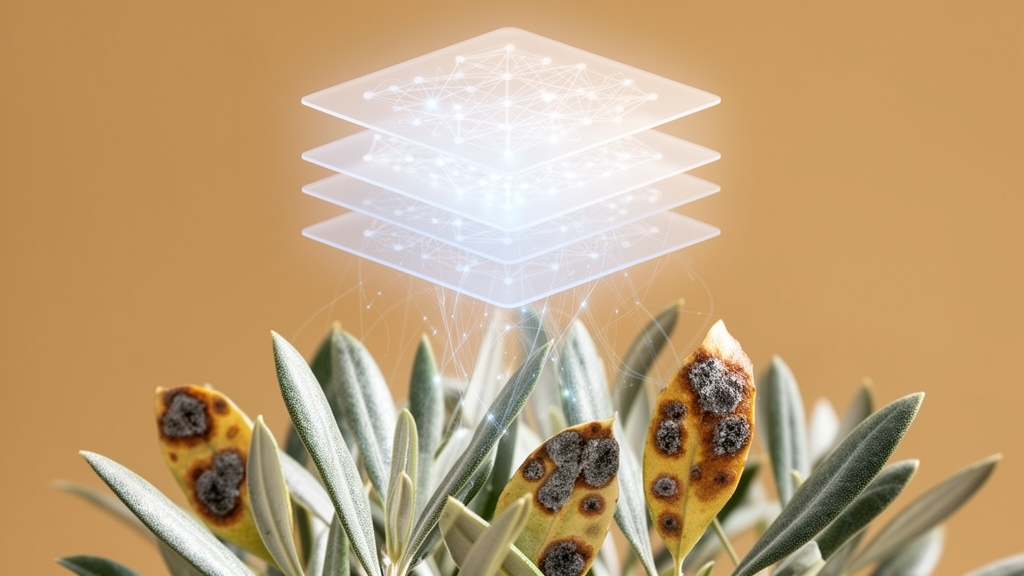
A stacking ensemble combining EfficientNet, ResNet and MobileNet classified olive leaf images with 97.21% accuracy in accepted research published in BMC Plant Biology. The system was tested on a publicly available dataset of 3,400 images representing three classes: healthy leaves, Aculus olearius and Olive Peacock Spot. On the hold-out test set, the ensemble also achieved a macro-averaged F1-score of 0.9720, a macro-averaged ROC-AUC of 0.9946 and a Cohen’s Kappa score of 0.9578.
The study compared four strategies for combining the predictions of the three transfer-learning models: weighted soft voting, unweighted soft voting, hard voting and stacking. Stacking delivered the best overall performance among the approaches evaluated. Model development and evaluation involved stratified five-fold cross-validation, while the final ensemble predictions were assessed on a separate hold-out test set after each base model had been trained and fine-tuned using the training data. The reported figures therefore describe an ensemble built from EfficientNet, ResNet and MobileNet rather than the performance of any one architecture in isolation.
Image preprocessing was intended to reduce environmental noise and improve the learning of disease-related features. The researchers separated leaves from their backgrounds through leaf–background segmentation and used rotation-based data augmentation to expand the range of examples seen during training. During cross-validation, augmentation was applied exclusively to the training folds rather than the validation folds, with the stated aims of increasing training diversity and reducing the effect of class imbalance. The supplied evidence does not provide class-specific sample counts, training-set performance or uncertainty intervals, so the aggregate results cannot establish that performance was uniform across all three image classes.
The research framework also incorporated Grad-CAM visualization, named in the study title alongside the ensemble method. The supplied findings do not report separate performance measures for these visualizations, meaning that the reported accuracy, F1-score, ROC-AUC and Kappa cannot be attributed to Grad-CAM alone. Instead, the clearest supported result is that the stacking ensemble combined the three base architectures effectively on the hold-out evaluation. The authors also caution that independent validation under diverse field conditions remains necessary before the approach can be considered for practical application, leaving its performance outside the public image dataset unresolved.
Subject of Research: Evaluation of ensemble deep learning methods for classifying olive leaf diseases from images
Article Title: Ensemble deep learning with Grad-CAM visualization for olive leaf disease classification
Article References: Coşkun, C., & Türk, Ö. (2026). Ensemble deep learning with Grad-CAM visualization for olive leaf disease classification. BMC Plant Biology. https://doi.org/10.1186/s12870-026-09881-0
Image Credits: AI Generated
DOI: 10.1186/s12870-026-09881-0
Keywords: olive leaf diseases, deep learning, ensemble learning, image classification, transfer learning, Grad-CAM, EfficientNet, ResNet, MobileNet, plant pathology, Ensemble, deep
News Source: Blake Davidson. (October 26, 2026). Stacking deep learning reaches 97.2% accuracy for olive disease images. Scienmag.