Crucial new technologies such as hydrogen production or carbon capture require new catalysts. Experiments show: It’s not just the material that matters, but also its atomic surface structure.
Credit: TU Wien
On the way to a CO2-neutral economy, we need to perfect a whole range of technologies – including the electrochemical extraction of hydrogen from water, fuel cells, or carbon capture. All these technologies have one thing in common: they only work if suitable catalysts are used. For many years, researchers have therefore been investigating which materials are best suited for this purpose.
At TU Wien and the Comet Center for Electrochemistry and Surface Technology CEST in Wiener Neustadt, a unique combination of research methods is available for this kind of research. Together scientists could now show: Looking for the perfect catalyst is not only about finding the right material, but also about its orientation. Depending on the direction in which a crystal is cut and which of its atoms it thus presents to the outside world on its surface, its behavior can change dramatically.
Efficiency or stability
“For many important processes in electrochemistry, precious metals are often used as catalysts, such as iridium oxide or platinum particles,” says Prof. Markus Valtiner from the Institute of Applied Physics at TU Wien (IAP). In many cases these are catalysts with particularly high efficiency. However, there are also other important points to consider: The stability of a catalyst and the availability and recyclability of the materials. The most efficient catalyst material is of little use if it is a rare metal, dissolves after a short time, undergoes chemical changes or becomes unusable for other reasons.
For this reason, other, more sustainable catalysts are of interest, such as zinc oxide, even though they are even less effective. By combining different measuring methods, it is now possible to show that the effectiveness and the stability of such catalysts can be significantly improved by studying how the surface of the catalyst crystals is structured on an atomic scale.
It all depends on the direction
Crystals can have different surfaces: “Let’s imagine a cube-shaped crystal that we cut in two,” says Markus Valtiner. “We can cut the cube straight through the middle to create two cuboids. Or we can cut it exactly diagonally, at a 45-degree angle. The cut surfaces that we obtain in these two cases are different: Different atoms are located at different distances from each other on the cut surface. Therefore, these surfaces can also behave very differently in chemical processes”.
Zinc oxide crystals are not cube-shaped, but form honeycomb-like hexagons – but the same principle applies here, too: Its properties depend on the arrangement of the atoms on the surface. “If you choose exactly the right surface angle, microscopically small triangular holes form there, with a diameter of only a few atoms,” says Markus Valtiner. “Hydrogen atoms can attach there, chemical processes take place that support the splitting of water, but at the same time stabilize the material itself”.
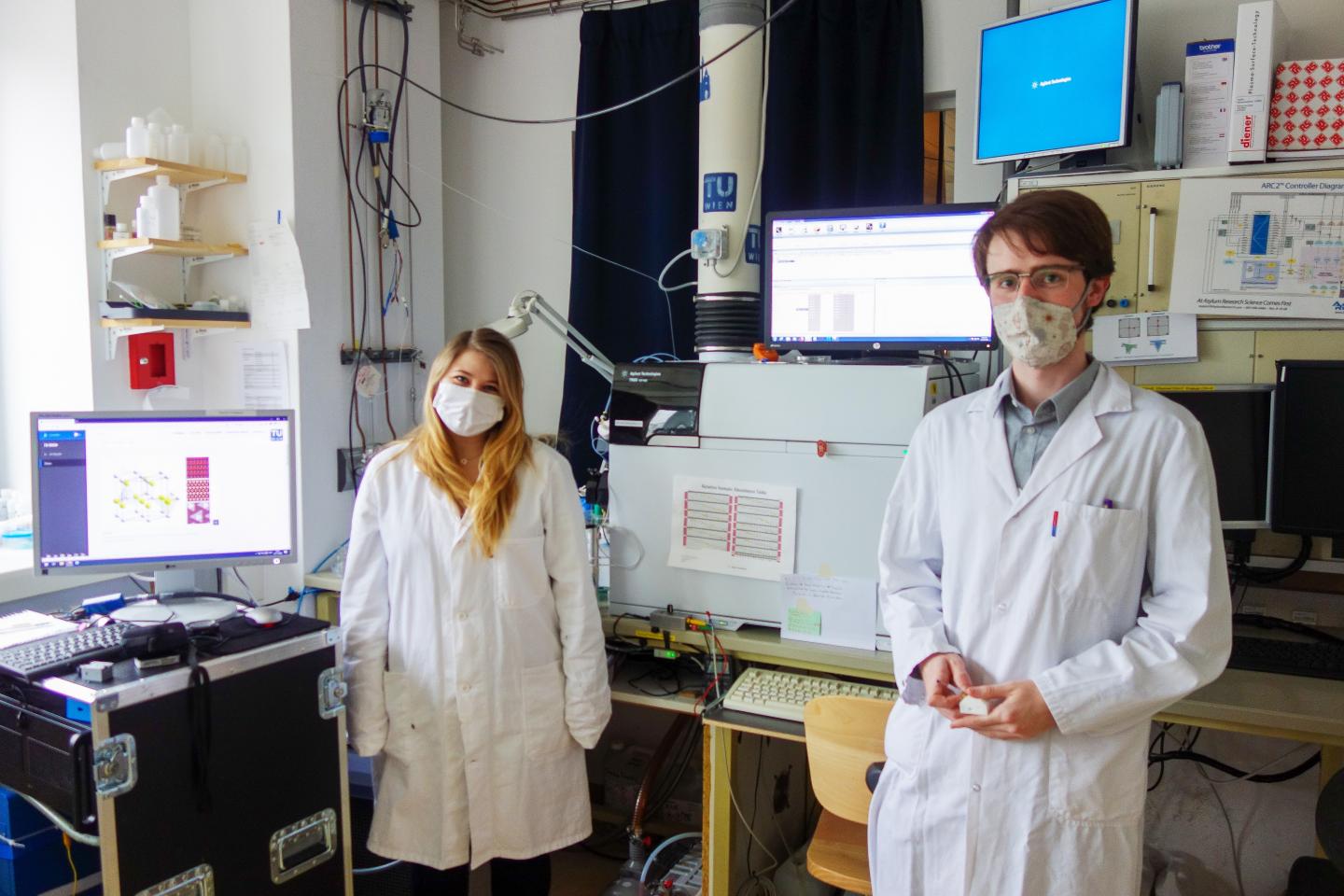
The research team has now been able to prove this stabilization for the first time: “At the catalyst surface, water is split into hydrogen and oxygen. While this process is in progress, we can take liquid samples and examine whether they contain traces of the catalyst,” explains Markus Valtiner. “To do this, the liquid must first be strongly heated in a plasma and broken down into individual atoms. Then we separate these atoms in a mass spectrometer and sort them, element by element. If the catalyst is stable, we should hardly find any atoms from the catalyst material. Indeed, we could not detect any decomposition of the material at the atomic triangle structures when hydrogen was produced”. This stabilizing effect is surprisingly strong – now the team is working on making zinc oxide even more efficient and transferring the physical principle of this stabilization to other materials.
Unique research opportunities for energy system transformation
Atomic surface structures have been studied at TU Wien for many years. “At our institute, these triangular structures have first been demonstrated and theoretically explained years ago, and now we are the first to demonstrate their importance for electrochemistry,” says Markus Valtiner. “This is because we are in the unique situation here of being able to combine all the necessary research steps under one roof – from sample preparation to simulation on supercomputers, from microscopy in ultra-high vacuum to practical tests in realistic environments.”
“This collaboration of different specialties under one roof is unique, and our great advantage to be able to be a global leader in research and teaching in this field,” says Carina Brunnhofer, student at the IAP.
“Over the next ten years, we will develop stable and commercially viable systems for water splitting and CO2 reduction based on methodological developments and a fundamental understanding of surface chemistry and physics,” says Dominik Dworschak, the first author of the recently published study. “However, at least a sustainable doubling of the current power output must be achieved in parallel,” Markus Valtiner notes. “We are therefore on an exciting path, on which we will only achieve our climate targets through consistent, cross-sector research and development.
###
Contact
Prof. Markus Valtiner
Institute for Applied Physics
TU Wien
+43 1 58801 134 40
[email protected]
Media Contact
Florian Aigner
[email protected]
Original Source
https:/
Related Journal Article
http://dx.