A low-cost approach improves cell-free biotechnology’s utility for bio-manufacturing and portability for field applications
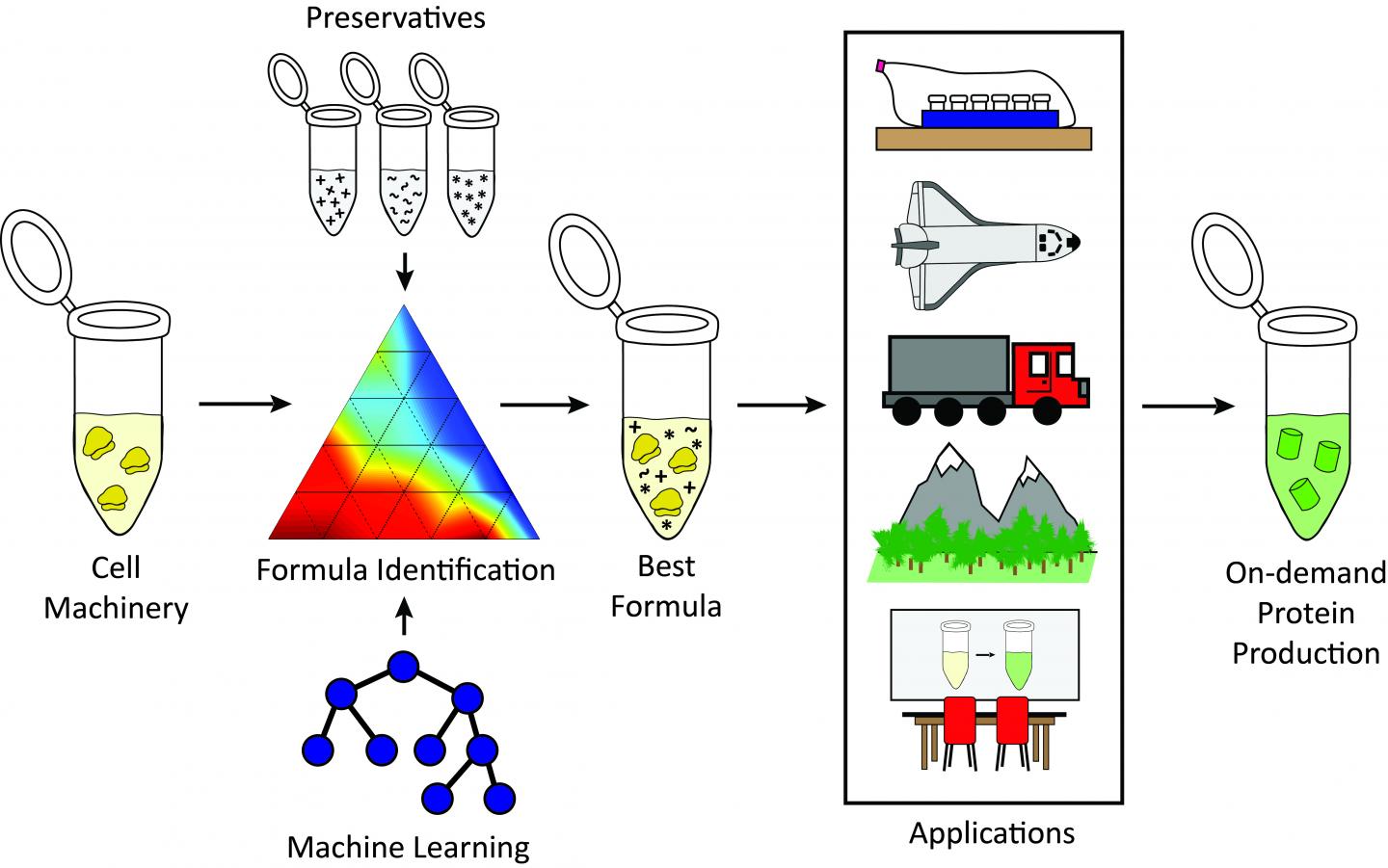
Credit: Nicole Gregorio
Researchers at California Polytechnic State University have developed a low-cost approach that improves cell-free biotechnology’s utility for bio-manufacturing and portability for field applications.
Cell-free protein synthesis (CFPS) is a biotechnology that harnesses active cellular machinery in a test tube without the presence of living cells, allowing researchers to directly access and manipulate biochemical processes. Scientists and engineers are looking to utilize cell-free biotechnology for numerous applications including on-demand biomanufacturing of biomaterials and therapeutics, point-of-care diagnostics of disease biomarkers and environmental pollutants, and transformative biochemical education platforms.
Cell-free biotechnology researchers have already made many of these applications a reality in the lab, but getting them to work in the field, clinic and classroom is more difficult. The cellular machinery extracted for use in cell-free biotechnology contains biomolecules such as proteins and RNAs, which break down at warmer temperatures, greatly limiting the shelf life of the cellular machinery. Transporting it from one laboratory to another or taking it out of the lab for field applications requires refrigeration to maintain its activity. Being tethered to the “cold chain” is a fundamental limit to meeting cell-free biotechnology’s potential.
Inspired by storage optimizations of biological materials like cow’s milk, researchers have previously extended the shelf life of extracts by freeze-drying them, resulting in a product similar to powdered milk that can be stored at room temperature for extended time periods. However, unlike powdered milk, freeze-dried cellular machinery cannot be stored for more than a few days without continual loss of activity. Researchers at California Polytechnic State University have discovered low-cost preservatives that allow freeze-dried cellular machinery to retain full activity when stored at room temperature for up to two weeks.
To accomplish this, a team of undergraduate student researchers pursued an interdisciplinary approach led by professors Javin Oza, Katharine Watts and Pratish Patel. As published in the journal ACS Synthetic Biology, researchers selected 10 preservatives with four distinct mechanisms of action and systematically identified the best performers, which were then tested in combinations of two or three. This approach allowed the researchers to identify combinations of preservatives that could maintain the full productivity of the cellular machinery for two weeks at room temperature. Researchers also discovered that certain combinations of preservatives could enhance the protein-producing capacity of the cellular machinery nearly two-fold.
Researchers demonstrated that the utility of any given preservative for stabilizing biological materials is highly context dependent. To help overcome this limitation, their data was used to develop a machine learning algorithm to allow other users to identify preservative formulations that are ideal for their specific application of the cell-free biotechnology. Access to the machine learning algorithm through a user-friendly interface will soon be available to the public on http://www.
These advances represent a step toward unlocking the potential for cell-free biotechnology applications. More information about this work can be found in the publication entitled “Unlocking applications of cell-free biotechnology through enhanced shelf-life and productivity of E. coli extracts.”
###
Media Contact
Javin P. Oza
[email protected]
805-756-2265
Related Journal Article
http://dx.