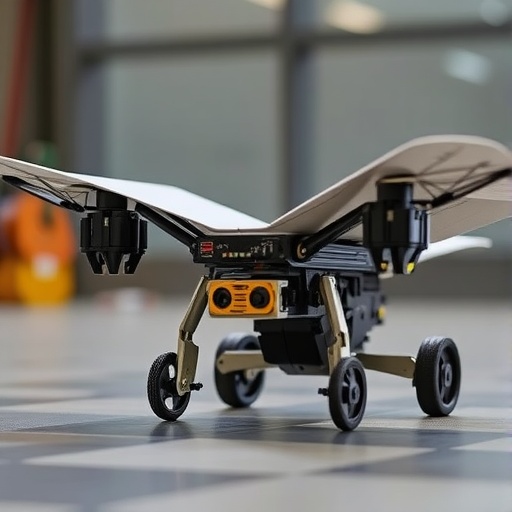
Flapping-wing micro aerial vehicles are turning one of nature’s most efficient flight strategies into a new class of robotic technology. Inspired by birds, bees, and dragonflies, these lightweight machines generate lift by rapidly beating their wings rather than spinning exposed propellers. Their compact bodies, hovering ability, and potential to maneuver through narrow spaces could make them valuable for infrastructure inspection, disaster response, environmental monitoring, and industrial safety. Yet the same wing-driven mechanics that give these robots exceptional agility also make them unusually difficult to control, particularly when wind or other disturbances suddenly push them off course.
Researchers at Chiba University in Japan have now identified a hidden feature of flapping-wing flight that can severely limit a robot’s ability to recover from disturbances. Specially appointed Assistant Professor Abner Asignacion and Dr. Satoshi Suzuki, from the university’s Graduate School of Engineering, investigated the flight dynamics of a commercially available flapping-wing micro aerial vehicle. Their study shows that the robot does not always move immediately in the direction commanded by its controller. In some cases, it first drifts in the opposite direction before beginning the intended motion, a counterintuitive response known in control engineering as non-minimum-phase behavior.
This phenomenon is more than a temporary flight quirk. It creates a fundamental limit on how aggressively a control system can respond. When a robot is hit by a gust of wind, its onboard controller must estimate the disturbance and generate corrective commands quickly enough to restore its position. A faster response might appear desirable, but if the robot initially moves in the wrong direction, excessive corrective action can amplify the error rather than remove it. The result may be oscillation, instability, or a loss of hovering control. For a robot weighing only a few grams, even a small modeling error or delayed response can have a significant effect on its position.
To address this challenge, the Chiba University team developed a bandwidth-constrained disturbance observer. A disturbance observer is a control-system component that estimates forces or movements not directly commanded by the operator, such as wind gusts, aerodynamic interference, or unmodeled changes in the vehicle’s dynamics. Once the disturbance is estimated, the controller can compensate for it. In the new approach, however, the observer’s bandwidth—the speed at which it reacts to changes—is deliberately limited to account for the robot’s non-minimum-phase behavior. This prevents the system from responding faster than the vehicle can safely and accurately follow.
The researchers evaluated the method using a 103-gram Flapping Nimble+ robot, a commercially available vehicle designed for hovering flight. During the experiments, the robot was instructed to move repeatedly back and forth along a horizontal axis while maintaining its vertical hovering position. The commands covered frequencies from 0.08 hertz, representing slow movement, to 0.8 hertz, representing moderately rapid movement. By comparing the commanded trajectories with the robot’s actual motion, the team was able to characterize the vehicle’s dynamic response and determine how control behavior differed between horizontal directions.
The results revealed a pronounced non-minimum-phase response along the robot’s X-axis. When commanded to move horizontally, the vehicle initially shifted slightly in the opposite direction, forcing the controller to work within a narrow stability margin. The researchers then varied the disturbance observer’s response speed to identify the most effective compromise. With a slow observer, the robot remained stable but was less capable of rejecting disturbances. With a fast observer, disturbance compensation improved, but the vehicle began to oscillate. An intermediate bandwidth provided the most reliable performance, allowing the robot to counter external forces without triggering unstable motion.
When the optimized disturbance observer was applied across multiple movement directions, the robot’s X-axis position error fell by 53.1 percent. Its overall three-dimensional position error decreased by approximately 28 percent. These improvements are particularly significant for small autonomous aircraft, which often operate close to walls, ceilings, machinery, or people, where even minor deviations can lead to collisions. By recognizing that the robot’s dynamics impose a limit on control speed, the researchers were able to improve flight stability without relying solely on more powerful actuators or faster computation.
The findings could help expand the role of flapping-wing robots beyond laboratory demonstrations. Conventional drones are highly capable, but their propellers can be hazardous in confined environments and their size may prevent them from reaching narrow or cluttered locations. A stable flapping-wing vehicle could eventually inspect pipes, machinery, buildings, and damaged infrastructure, or search disaster sites where access is difficult for human responders. The technology may also support environmental sensing in delicate habitats and monitoring inside factories, where precise hovering is essential. “The control method proposed in this study enables FW-MAVs to fly more stably, even in environments subject to disturbances,” Asignacion says.
The study was made available online on June 4, 2026, and is scheduled for publication in Volume 175 of Control Engineering Practice on October 1, 2026. The researchers say future work will continue to examine robust control and autonomous flight for bio-inspired aerial vehicles operating in challenging environments. By combining an understanding of aerodynamic behavior with carefully limited control bandwidth, the team has shown that the path to more capable flying robots may not be simply to react faster, but to react at precisely the right speed.
Subject of Research: Flapping-wing micro aerial vehicle position control and disturbance rejection
Article Title: Bandwidth-constrained disturbance observer design for position control of flapping-wing MAVs with non-minimum-phase dynamics
Web References: Chiba University news; Assistant Professor Abner Asignacion; Dr. Satoshi Suzuki
References: Abner Asignacion and Satoshi Suzuki, Control Engineering Practice. DOI: 10.1016/j.conengprac.2026.107099
Image Credits: Assistant Professor Abner Asignacion and Dr. Satoshi Suzuki, Chiba University, Japan
Keywords
Flapping-wing micro aerial vehicle, bio-inspired robotics, disturbance observer, non-minimum-phase dynamics, robust control, autonomous flight, drone technology, position control, Chiba University, aerial robotics
Tags: adaptive control strategies for flapping-wing MAVsbio-inspired drone controlcontrol engineering in flapping-wing flightdisaster response drone stability challengesdisturbance rejection in micro dronesenvironmental monitoring with micro dronesFlapping-wing micro aerial vehiclesinsect-inspired flying robot stabilitynon-minimum-phase flight dynamicsreaction delay in bio-inspired aerial robotsrobotic insect flight mechanicswind disturbance mitigation in flapping-wing robots