• HOME
  • NEWS
  • EXPLORE
    • CAREER
      • Companies
      • Jobs
    • EVENTS
    • iGEM
      • News
      • Team
    • PHOTOS
    • VIDEO
    • WIKI
  • BLOG
  • COMMUNITY
    • FACEBOOK
    • INSTAGRAM
    • TWITTER
Friday, May 15, 2026
BIOENGINEER.ORG
No Result
View All Result
  • Login
  • HOME
  • NEWS
  • EXPLORE
    • CAREER
      • Companies
      • Jobs
        • Lecturer
        • PhD Studentship
        • Postdoc
        • Research Assistant
    • EVENTS
    • iGEM
      • News
      • Team
    • PHOTOS
    • VIDEO
    • WIKI
  • BLOG
  • COMMUNITY
    • FACEBOOK
    • INSTAGRAM
    • TWITTER
  • HOME
  • NEWS
  • EXPLORE
    • CAREER
      • Companies
      • Jobs
        • Lecturer
        • PhD Studentship
        • Postdoc
        • Research Assistant
    • EVENTS
    • iGEM
      • News
      • Team
    • PHOTOS
    • VIDEO
    • WIKI
  • BLOG
  • COMMUNITY
    • FACEBOOK
    • INSTAGRAM
    • TWITTER
No Result
View All Result
Bioengineer.org
No Result
View All Result
Home NEWS Science News Chemistry

Squid-inspired robots might have environmental, propulsion applications

Bioengineer by Bioengineer
October 1, 2019
in Chemistry
Reading Time: 2 mins read
0
IMAGE
Share on FacebookShare on TwitterShare on LinkedinShare on RedditShare on Telegram

Scientists studied fluid mechanics to simulate and build a squidlike robot that’s fast, quiet and hard to see.
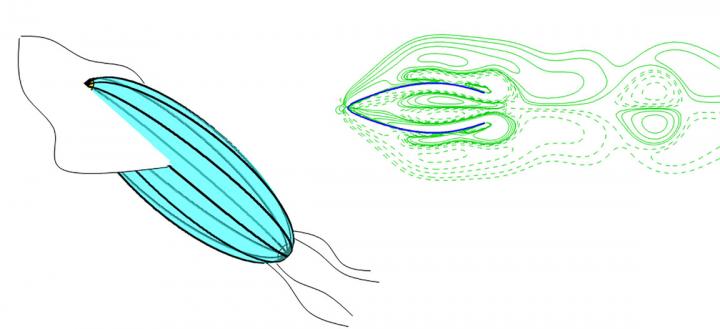
IMAGE

Credit: Qiang Zhu

WASHINGTON, D.C., October 1, 2019 — Inspired by the unique and efficient swimming strategy of cephalopods, scientists developed an aquatic robot that mimics their form of propulsion.

These high-speed, squidlike robots are made of smart materials, which make them hard to detect — an advantage that has potential military reconnaissance and scientific applications — while maintaining a low environmental footprint.

Physicists Xiaobo Bi and Qiang Zhu used numerical simulations to illustrate the physical mechanisms and fluid mechanics of a squid’s swimming method, which uses intermittent bursts through pulsed jet propulsion. By using this form of locomotion, the new device can achieve impressive speeds, just like its animal inspiration. Bi and Zhu discuss their work in this week’s Physics of Fluids, from AIP Publishing.

When swimming, these squidlike machines suck water into a pressure chamber and then eject it. The soft-bodied device could be used as a platform for environmental monitoring by simultaneously using this feature to test water samples as it swims.

“In addition to the 2D and 3D numerical simulations presented in this article, we are working with an interdisciplinary team to build a prototype of the mechanical device, to perform both straight-line swimming and maneuvers,” Zhu said. “This project will combine fluid dynamics, control, smart materials and robotic design.”

The device could be used as either a stand-alone swimmer or as a propeller of an underwater vehicle.

The researchers have not yet been able to maintain speeds that can last for more than a few cycles due to turbulence and instabilities, but they are working on ways to overcome this. Zhu hopes this research will provide a starting point for more sophisticated modeling and experimental studies to develop robots like their creation.

###

The article, “Fluid-structure investigation of a squid-inspired swimmer,” is authored by Xiaobo Bi and Qiang Zhu. The article will appear in Physics of Fluids on Oct. 1, 2019 (DOI: 10.1063/1.5119243). After that date, it can be accessed at https://aip.scitation.org/doi/10.1063/1.5119243.

ABOUT THE JOURNAL

Physics of Fluids is devoted to the publication of original theoretical, computational, and experimental contributions to the dynamics of gases, liquids, and complex or multiphase fluids. See https://aip.scitation.org/journal/phf.

Media Contact
Larry Frum
[email protected]

Related Journal Article

http://dx.doi.org/10.1063/1.5119243

Tags: Biomechanics/BiophysicsChemistry/Physics/Materials SciencesMechanical EngineeringRobotry/Artificial IntelligenceTechnology/Engineering/Computer Science
Share12Tweet8Share2ShareShareShare2

Related Posts

Smart Hydrogels Revolutionize Information Security with Photo-Patterning and Multi-Stimuli Responsive Structural Colors — Chemistry

Smart Hydrogels Revolutionize Information Security with Photo-Patterning and Multi-Stimuli Responsive Structural Colors

May 15, 2026
Scientists Overcome Longstanding Challenge in Measuring Semiconductor Defects — Chemistry

Scientists Overcome Longstanding Challenge in Measuring Semiconductor Defects

May 14, 2026

Wall Design Highlights Deaf and Hard-of-Hearing Experience at #ASA190

May 14, 2026

New Method Finds More Efficient Route Between Earth and Moon Than Ever Before

May 14, 2026
Please login to join discussion

POPULAR NEWS

  • Research Indicates Potential Connection Between Prenatal Medication Exposure and Elevated Autism Risk

    843 shares
    Share 337 Tweet 211
  • New Study Reveals Plants Can Detect the Sound of Rain

    729 shares
    Share 291 Tweet 182
  • Salmonella Haem Blocks Macrophages, Boosts Infection

    62 shares
    Share 25 Tweet 16
  • Breastmilk Balances E. coli and Beneficial Bacteria in Infant Gut Microbiomes

    58 shares
    Share 23 Tweet 15

About

We bring you the latest biotechnology news from best research centers and universities around the world. Check our website.

Follow us

Recent News

Axonic Spine Synapses Trigger Action Potentials, Direct Signals

New Study Uncovers Why Breast Cancer Becomes More Lethal with Age

Study Reveals Heat-Based Therapy Reshapes Brain Networks in Epilepsy

Subscribe to Blog via Email

Enter your email address to subscribe to this blog and receive notifications of new posts by email.

Join 82 other subscribers
  • Contact Us

Bioengineer.org © Copyright 2023 All Rights Reserved.

Welcome Back!

Login to your account below

Forgotten Password?

Retrieve your password

Please enter your username or email address to reset your password.

Log In
No Result
View All Result
  • Homepages
    • Home Page 1
    • Home Page 2
  • News
  • National
  • Business
  • Health
  • Lifestyle
  • Science

Bioengineer.org © Copyright 2023 All Rights Reserved.