University of Iowa researchers find tiny pollen particles remain airborne for hours after rains
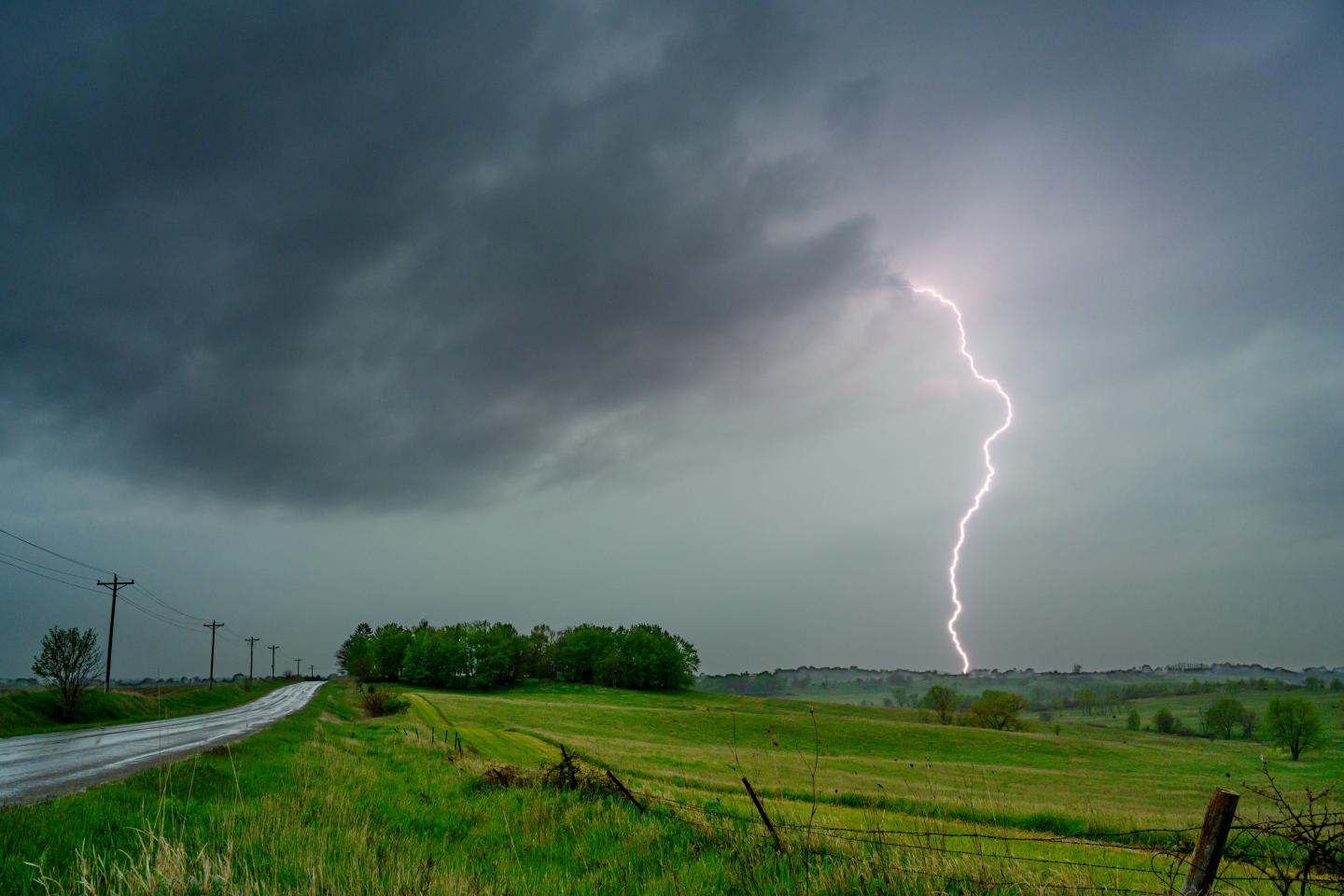
Credit: Tim Schoon, University of Iowa
Springtime rains can be a surprising source of pollen.
University of Iowa researchers report that tree pollen fragments remain in the air for as many as 11 hours after heavy rains, and those granules can make their way deep into the lungs, potentially exacerbating allergies. The researchers base their findings on first-time direct measurements of pollen fragment concentrations during and after spring rains of varying severity in spring, 2019.
“Our results show that while pollen grains decrease substantially during rain, peak concentrations of submicron pollen fragments occur during rain events and then persist for several hours,” says Elizabeth Stone, associate professor in the Department of Chemistry and corresponding author on the paper, published online in the journal Environmental Science & Technology Letters. “People who are sensitive to pollen in season should avoid going outdoors during rain events, especially thunderstorms, and for several hours afterward.”
Pollen grains are pretty hardy, but they can rupture when subject to high humidity. This can happen during rains when a storm’s updraft carries the grains to the cloud base, where humidity is quite high. The fragments then are shot back toward the surface by falling rain and the storm’s downdraft.
The main difference between pollen and pollen fragments is, predictably, their size: Intact pollen grains are larger, at 20 to 100 microns, and settle to the ground. Pollen fragments, at less than 2.5 microns in size, do not settle readily and often remain aloft.
Stone and her team decided to test the results of previous research by directly measuring pollen from rain events in Iowa City, Iowa, between April 17 and May 31, 2019. This period of time, in prime tree pollen season, included light rains, thunderstorms, and even a severe weather event punctuated by a storm that spawned a tornado. In all, the researchers recorded rain on 28 days.
“Our study shows clearly that rain decreases intact pollen concentrations. But it can also increase pollen fragments,” says Stone, who’s also affiliated with the Department of Chemical and Biochemical Engineering at Iowa. “The interesting thing about the pollen fragments is the really high concentrations only last for a short period of time, primarily when it’s raining and during the peak of the storm.”
The researchers say pollen fragment concentrations remain elevated from 2.5 to 11 hours after a rain, the longer times associated with the heaviest rains.
Stone and her team measured the highest concentration of pollen fragments during a morning storm on May 18, with a peak concentration at 1.3 million pollen fragments per cubic meter of air. The next highest measured concentration was on May 24, with 960,000 pollen fragments per cubic meter of air.
“People who are susceptible or have allergies to pollen in season should consider rain events and especially thunderstorms to be a potential source of allergenic particles that could have negative respiratory impacts on them,” Stone says. “My advice would be to stay indoors during and in the hours following rains and thunderstorms in the pollen season that they’re allergic to.”
###
The study, “Characterization of atmospheric pollen fragments during springtime thunderstorms,” was published online on May 6.
Contributing authors include Dagen D. Hughes, Chamari Mampage, Lillian Jones, and Zehui Liu, all from the Department of Chemistry at Iowa.
The U.S. National Science Foundation funded the research.
Media Contact
Richard Lewis
[email protected]
Original Source
https:/
Related Journal Article
http://dx.