Credit: © MPI CPfS
Superconductivity is a complete loss of electrical resistance. Superconductors are not merely very good metals: it is a fundamentally different electronic state. In normal metals, electrons move individually, and they collide with defects and vibrations in the lattice. In superconductors, electrons are bound together by an attractive force, which allows them to move together in a correlated way and avoid defects.
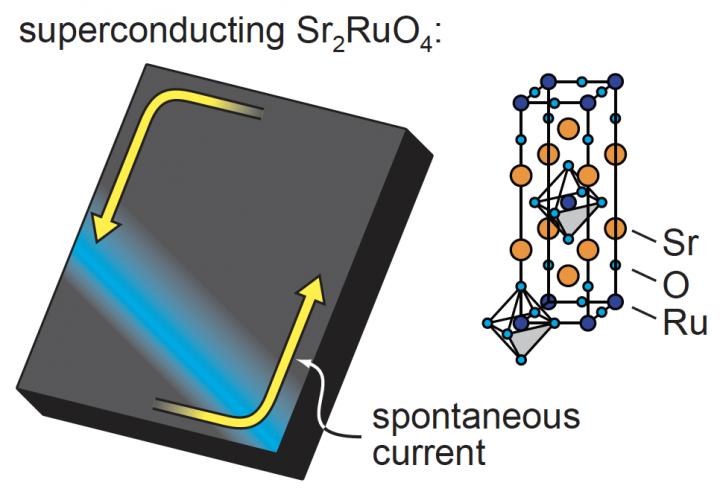
In a very small number of known superconductors, the onset of superconductivity causes spontaneous electrical currents to flow. These currents are very different from those in a normal metal wire: they are built into the ground state of the superconductor, and so they cannot be switched off. For example, in a sheet of a superconducting material, currents might appear that flow around the edge, as shown in the figure.
This is a very rare form of superconductivity, and it always indicates that the attractive interaction is something unusual. Sr2RuO4 is one famous material where this type of superconductivity is thought to occur. Although the transition temperature is low – Sr2RuO4 superconducts only below 1.5 Kelvin – the reason why it superconducts at all is completely unknown. To explain the superconductivity in this material has become a major test of physicists’ understanding of superconductivity in general. Theoretically, it is very difficult to obtain spontaneous currents in Sr2RuO4 from standard models of superconductivity, and so if they are confirmed then a new model for superconductivity – an attractive force that is not seen in other materials – might be required.
The way that these electrical currents are detected is subtle. Subatomic particles known as muons are implanted into the sample. The spin of each muon then precesses in whatever magnetic field exists at the muon stopping site. In effect, the muons act as sensitive detectors of magnetic field, that can be placed inside the sample. From such muon implantation experiments it has been found that spontaneous magnetic fields appear when Sr2RuO4 becomes superconducting, which shows that there are spontaneous electrical currents.
However, because the signal is subtle, researchers have questioned whether it is in fact real. Onset of superconductivity is a major change in the electronic properties of a material, and maybe this subtle additional signal appeared because the measurement apparatus was not properly tuned.
In this work, researchers at the Max Planck Institute for Chemical Physics of Solids, the Technical University of Dresden, and the Paul Scherrer Institute (Switzerland) have shown that when uniaxial pressure is applied to Sr2RuO4, the spontaneous currents onset at a lower temperature than the superconductivity. In other words, the transition splits into two: first superconductivity, then spontaneous currents. This splitting has not been clearly demonstrated in any other material, and it is important because it shows definitively that the second transition is real. The spontaneous currents must be explained scientifically, not as a consequence of imperfect measurement. This may require a major re-write of our understanding of superconductivity.
###
Media Contact
Clifford Hicks
[email protected]
Original Source
https:/
Related Journal Article
http://dx.