Every year, the world brews billions of cups of coffee, and almost all of the spent grounds end up in landfills, where they slowly decompose and release methane. A team of food scientists in China has now demonstrated a way to transform this ubiquitous waste stream into something far more valuable: fluorescent carbon nanoparticles that can be woven into food packaging films, giving them powerful antioxidant and light-activated antibacterial capabilities. The study, published in Food Chemistry: X, describes how coffee ground-derived carbon dots were incorporated into electrospun nanofiber membranes made from zein, a renewable corn protein, and polyvinylidene fluoride, a robust synthetic fluoropolymer known as PVDF.
The research addresses a persistent challenge in modern food supply chains. Even with advances in processing and logistics, food products remain vulnerable to spoilage through oxidation and the proliferation of pathogenic microorganisms, leading to quality deterioration, shortened shelf life, and potential safety risks. Packaging materials that can actively scavenge destructive free radicals and suppress bacterial growth have therefore become a major focus of food science. Electrospun nanofiber membranes are particularly attractive candidates because their high surface-to-volume ratio, breathability, and capacity for controlled release of active substances make them ideal platforms for functional additives.
The choice of materials reflects a deliberate balancing act. Zein is abundant, renewable, and biodegradable, with excellent film-forming ability and biocompatibility, but films made from it alone are brittle and mechanically weak. PVDF, by contrast, is a semi-crystalline fluoropolymer offering excellent barrier properties, thermal stability, and mechanical strength, and it improves the chain entanglement of spinning solutions, making electrospinning easier. Combining the two polymers mitigates the brittleness of protein-based films while retaining a substantial bio-based component. The missing ingredient was a functional filler that could add antioxidant and antibacterial activity without compromising the composite structure, and that is where the coffee grounds came in.
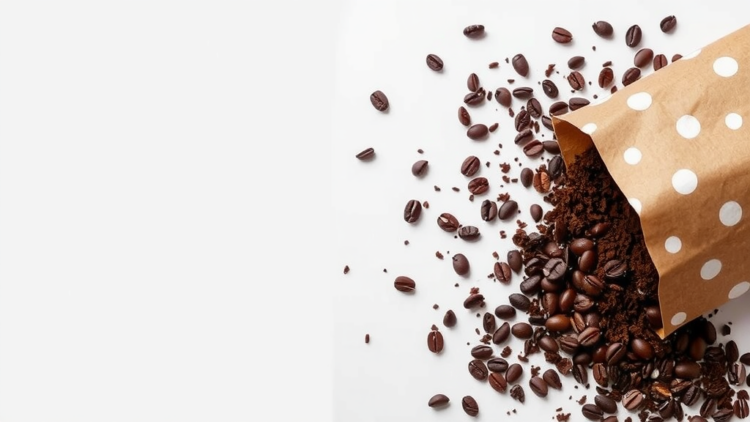
To make the carbon dots, the researchers dried waste coffee residue from a franchise café, dispersed two grams of the powder in water, and sealed it in an autoclave at 200 degrees Celsius for six hours in a hydrothermal reaction. The resulting dark brown dispersion was filtered through microporous membranes, dialyzed for 24 hours to remove low-molecular-weight impurities, and freeze-dried into a solid powder. Transmission electron microscopy revealed quasi-spherical particles ranging from 0.91 to 3.00 nanometers in diameter, with an average of 1.88 nanometers, well dispersed without aggregation. Lattice fringes with an interplanar spacing of about 0.21 nanometers indicated locally ordered carbon domains embedded in a largely disordered framework, a structure typical of carbon dots.
Spectroscopic analysis painted a detailed picture of the nanoparticles’ chemistry. X-ray photoelectron spectroscopy showed the dots were composed of roughly 70 percent carbon, 6 percent nitrogen, and 24 percent oxygen, with the carbon core containing sp2 and sp3 hybridization and the surface decorated with hydroxyl, carbonyl, and carboxyl groups. Nitrogen was present in pyridinic, pyrrolic, and graphitic forms, making these nitrogen-doped carbon dots with good water solubility. Optically, the dots absorbed strongly in the ultraviolet and emitted blue fluorescence at 430 nanometers when excited at 350 nanometers, with emission that shifted depending on the excitation wavelength, a hallmark of carbon dots with multiple surface defect states serving as emissive sites.
The functional performance of the dots proved impressive. In radical-scavenging assays, the DPPH inhibition rate climbed from less than 1 percent to 93.41 percent as the concentration rose to 128 micrograms per milliliter, accompanied by a visible color change from dark purple to yellow. Similar concentration-dependent activity was recorded against ABTS radicals. The mechanism, the authors suggest, involves hydrogen atom transfer, electron transfer, or both, driven by the abundant surface functional groups. More striking was the antibacterial behavior: under illumination from a full-spectrum LED lamp, the dots inhibited Staphylococcus aureus and Escherichia coli in a concentration-dependent manner, while activity in the dark remained limited. Electron spin resonance spectroscopy confirmed that light exposure triggered the generation of superoxide and hydroxyl radicals, but no detectable singlet oxygen, pointing to a Type I radical-mediated photodynamic pathway rather than the singlet-oxygen-dominated Type II route.
With the dots characterized, the team electrospun composite membranes containing 0, 1, 3, 5, and 7 percent CG-CDs by weight relative to the total polymer mass, using a solution of 15 percent total polymer at a 1:1 zein-to-PVDF ratio in a dimethylformamide and acetone solvent mixture. Scanning electron microscopy showed smooth, continuous, bead-free fibers at all loadings, though average fiber diameter increased gradually with higher dot content. The researchers attribute this to molecular associations between the dots’ surface groups and the polymer matrix, which raised solution viscosity and chain entanglement while charge shielding effects weakened the electric-field stretching of the jet, allowing fibers to solidify before they could be drawn thinner.
The structural and physical consequences of doping were systematic and, in places, surprising. Fourier transform infrared spectroscopy confirmed that the primary chemical structures of both polymers were preserved, while X-ray diffraction showed that the characteristic alpha-phase crystal structure of PVDF remained intact at all loadings, with crystalline ordering actually sharpening up to 5 percent before broadening at 7 percent, likely due to local aggregation of the dots. Thermogravimetric analysis revealed slightly improved thermal stability at moderate loadings, as interfacial interactions restricted polymer segment mobility. Water contact angles fell from about 118 degrees for the undoped membrane to roughly 85 degrees at 7 percent, shifting the surface from hydrophobic to hydrophilic thanks to the dots’ oxygen-containing groups. Mechanical testing exposed a clear trade-off: tensile strength dropped from about 12 megapascals to 6, while elongation at break rose from roughly 45 percent to 72 percent, meaning the membranes became more flexible and extensible at the cost of strength, possibly because thicker fibers slip more easily within the network during deformation.
The functional payoff was substantial. DPPH scavenging by the membranes rose from negligible levels to more than 90 percent at the highest loading, and ABTS radical reduction followed the same trend, confirming that the antioxidant capacity of the dots survived the electrospinning process. Under light irradiation, the composite membranes showed substantially enhanced antibacterial activity against both bacterial strains compared with dark conditions, consistent with the ROS-generating capability confirmed by electron spin resonance. Gram-positive S. aureus proved more susceptible than Gram-negative E. coli, likely because the outer membrane of E. coli provides an additional protective barrier against oxidative attack. Notably, Caco-2 intestinal cell viability exceeded 90 percent when exposed to extracts of even the highest-loaded membrane, offering preliminary evidence that the materials are cytocompatible and plausible candidates for food-contact use.
The study’s broader significance lies in its demonstration of a circular-economy pathway for active packaging: a waste product that cafés discard daily becomes the functional heart of a multifunctional material. By systematically mapping how loading level controls fiber diameter, crystallinity, wettability, thermal behavior, mechanics, and light-responsive antibacterial performance, the researchers have provided a design framework for tuning such membranes to specific applications. The authors caution that practical packaging performance and food-contact safety still require further evaluation, and a possible photothermal contribution to the antibacterial effect remains to be investigated. But the core result stands: coffee grounds, carbon dots, and electrospun proteins can be combined into smart packaging that fights oxidation and bacteria with nothing more than light.
Subject of Research: Coffee ground-derived carbon dots incorporated into zein/PVDF electrospun nanofiber membranes for antioxidant and photodynamic antibacterial food packaging
Article Title: Coffee ground-derived carbon dots reinforced zein/PVDF electrospun nanofiber membranes with antioxidant and photodynamic antibacterial activities
Article References: Coffee ground-derived carbon dots reinforced zein/PVDF electrospun nanofiber membranes with antioxidant and photodynamic antibacterial activities. (n.d.). https://doi.org/10.1016/j.fochx.2026.104414
Image Credits: AI Generated
DOI: 10.1016/j.fochx.2026.104414
Keywords: carbon dots, coffee grounds, electrospinning, zein, PVDF, nanofibers, antioxidant, photodynamic antibacterial, food packaging, biomass waste, reactive oxygen species, food safety
Cite Scienmag News
APA MLA Chicago
Bethany Barker. (September 12, 2026). Spent Coffee Grounds Turned Into Carbon Dots That Boost Antibacterial Food Packaging. Scienmag. https://scienmag.com/spent-coffee-grounds-turned-into-carbon-dots-that-boost-antibacterial-food-packaging/
Bethany Barker. “Spent Coffee Grounds Turned Into Carbon Dots That Boost Antibacterial Food Packaging.” Scienmag, 12 September 2026, https://scienmag.com/spent-coffee-grounds-turned-into-carbon-dots-that-boost-antibacterial-food-packaging/. Accessed 12 September 2026.
Bethany Barker. “Spent Coffee Grounds Turned Into Carbon Dots That Boost Antibacterial Food Packaging.” Scienmag. September 12, 2026. https://scienmag.com/spent-coffee-grounds-turned-into-carbon-dots-that-boost-antibacterial-food-packaging/
Copy citation Download RIS
Tags: antioxidantantioxidant properties of coffee ground-derived nanoparticlesbio-based nanofiber membranesbiomass wastecarbon dotscarbon dots for antibacterial food packagingcoffee groundscoffee waste recyclingconverting coffee waste into functional nanomaterialselectrospinningelectrospun nanofiber technologyenvironmental impact of coffee wastefood packagingfood preservation and shelf life extensionfood safetyinnovative applications of carbon nanoparticles in food safetylight-activated antimicrobial packagingnanofibersphotodynamic antibacterialPVDFreactive oxygen speciessustainable food packaging materialsuse of zein and PVDF in food packagingzein