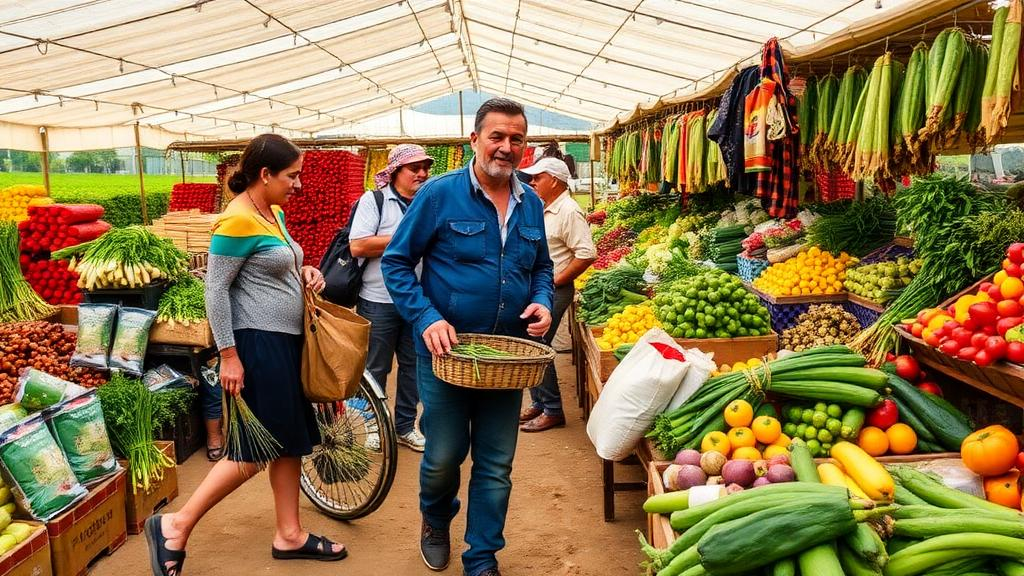
Spanish consumers overwhelmingly believe that smallholder farmers are paid unfairly for their produce, yet that sympathy collapses the moment they are asked to pay more or change their own shopping habits. That is the central, uncomfortable finding of a qualitative study published in Agricultural and Food Economics, which examined whether ordinary food purchasers would embrace e-marketplaces—online platforms where consumers can order fresh produce directly from small farmers—as a tool for cutting intermediaries out of the agri-food chain. The research, conducted within a European Union project involving partners from Italy, France, Spain and Tunisia, set out to identify consumer interest in buying fresh food directly from smallholders through such platforms, and the answer it uncovered was, in the authors’ words, one of low acceptance.
The study took a deliberately qualitative approach. Because Spanish consumers are largely unfamiliar with e-marketplace platforms for food and real-world examples remain scarce in the market, the researchers organized six focus group sessions in Badajoz, a city of roughly 150,000 inhabitants in south-eastern Spain. In total, 41 people took part, every one of them the main or joint decision maker for food purchasing in their household. Sessions lasted around two and a half hours, involved between 5 and 12 participants each, and were recruited through snowball and convenience sampling to obtain a heterogeneous mix of ages, genders, household sizes and income levels. Participants were shown images of organic labels, real websites demonstrating how consumer groups, food box systems and smallholder e-marketplaces work, and a video about tree-sponsoring schemes, before the transcripts were analyzed using content analysis, keywords-in-context and discourse analysis.
On the question of fair prices, the participants were unanimous. All of them were aware that farmers do not receive fair prices for what they produce, and that this threatens the financial viability of their farms. Quite a few blamed large distribution channels and the abundance of intermediaries, with most equating the problem with big retail chains retaining an excessive share of the final price. This image of unfair prices, the researchers note, has been shaped largely by news coverage. Yet with some exceptions, participants admitted they do not consider the issue when they actually buy food. Around 60 percent said they buy fruit and vegetables in supermarkets and hypermarkets for one reason alone: convenience. The remaining 40 percent preferred local shops, valuing proximity, personal service and confidence in quality.
Perhaps most striking was the participants’ conviction that they, as consumers, have no power over the problem. Statements such as “individual actions have no influence at all” and “a boycott would be very complicated” recurred across the sessions. Only one participant accepted that theoretical consumer power exists—in the form of buying directly from the farmer—but judged it impractical and expensive. The authors interpret this as low perceived consumer efficacy, a belief that personal choices cannot influence agricultural systems, and they argue that government policies at regional, national and European levels should include information and training campaigns to empower consumers.
When the discussion turned to direct purchasing from farmers, a clear divide emerged. Participants with experience of buying directly—typically people with family or holiday ties to the countryside—praised the superior flavour and quality of the food, with one saying of a tomato that it was “going to taste of tomato, even if it looks less than perfect,” and another preferring trust in the farmer over a supermarket label. But the largest group, which had never bought directly, cited accessibility as the main barrier, admitting they would not drive around looking for farmers. Around 40 percent of participants had heard of consumer groups or food box systems, but only one of the participants had ever been a customer of a box scheme, and only about a third expressed any willingness to try one under certain conditions.
The barriers to box systems were specific and repeated: the volume of produce that must be purchased, the fixed and unpredictable contents of the boxes, the inability to choose individual items, and high prices. For fresh food, the desire to personally inspect and select items proved fundamental—participants wanted to look at, touch and pick up the fruit they were buying, something a delivered box cannot offer. Concerns about food waste added to the resistance, particularly among smaller households. All participants accepted that selling directly would give the smallholder a higher margin than selling to an intermediary, but only one participant offered a non-financial motivation for joining such a scheme, framing the purchase as an act of solidarity rather than a price-driven choice.
The e-marketplace concept fared little better, despite a promising start. When researchers first explained the concept with a real example, most participants reacted positively. But once they saw actual producers, prices and minimum order sizes, opinions turned sharply negative, with a clear majority saying they had little or no willingness to buy through the platform. Criticism centered on high end prices compared with physical shops—one participant flatly refused fruit at seven euros a kilo before hearing anything else about the platform—alongside minimum order quantities, single-product baskets, the impossibility of choosing specific pieces, and delivery times that require planning ahead rather than immediate purchase. Several consumers attributed the high final prices to transport costs, and some concluded the system was only for wealthy families or the deeply committed.
Even the environmental argument backfired. Without being asked, some participants argued that home-delivery platforms generate a larger carbon footprint than a single trip to a hypermarket, and that the channel is “no more environmentally friendly than a hypermarket.” Access to a wider range of organic foods did not increase willingness to register either, a finding the authors connect to the participants’ low awareness of organic food: almost 70 percent did not recognize the significance of official organic labels, and most did not consider the certification credible, with several simply defining organic products as “the more expensive ones.” The most positive responses concerned trust and information: participants appreciated photos, videos and producer details that put “a face and image” to the farmer, though several still trusted personal service more, and they suggested adding customer review sections. Sponsoring or adopting trees, animals or plots of land was, with a couple of exceptions, dismissed as a marketing ploy.
From these results, the authors conclude that cultural change is required before an e-marketplace can succeed with the average consumer, since habits around seeing, choosing and immediately obtaining fresh food cannot be changed in the short or medium term. However, they argue, barriers specific to the platforms themselves can be managed by their promoters. Their recommendations include refocusing platforms to serve businesses such as restaurants and small shops alongside end consumers, introducing smaller baskets for small households and multi-product formats, involving transport companies as active partners to cut costs, using geolocation to highlight nearby producers, and emphasizing personal benefits—freshness and quality—over environmental messaging in communications. Complementary measures include order videos, live-streaming by farmers, return or compensation systems, user reviews, instant-response chat and first-order promotions.
The authors are careful to frame the scope of their findings. As an exploratory pilot study, the results cannot be generalized to regions with different agri-food distribution chains, and the participants lived in a small, non-industrial city close to rural areas, so future research should include consumers in large cities. They also note that 93 percent of participants held higher education degrees, an exceptionally well-educated sample that may skew attitudes toward digital technology and sustainability. Socio-demographic profile did not appear to affect the overall result of low acceptance, though household size and income seemed to play a determining role in intention, unlike gender, age or education. The team proposes that the identified variables could now be tested in a quantitative consumer survey, and that parallel studies should examine the attitudes of smallholders themselves as potential sellers on these platforms.
Subject of Research: Consumer perceptions of e-marketplaces for buying fresh food directly from smallholder farmers
Article Title: Fresh food consumers and e-marketplaces for smallholders: an analysis of perceptions and attitudes
Article References: Chamorro-Mera, A., García-Gallego, J. M., Martínez-Jiménez, M., & Rubio-Lacoba, S. (2026). Fresh food consumers and e-marketplaces for smallholders: an analysis of perceptions and attitudes. Agricultural and Food Economics, 14(1), Article 66. https://doi.org/10.1186/s40100-026-00510-w
Image Credits: AI Generated
DOI: 10.1186/s40100-026-00510-w
Keywords: e-marketplaces, smallholders, fresh food, alternative food networks, focus groups, consumer attitudes, disintermediation, Spain, food supply chains, organic food, e-commerce, direct sales
News Source: Alan Morgan. (October 30, 2026). Spanish Shoppers Back Farmers in Theory but Shun Smallholder E-Marketplaces. Scienmag.