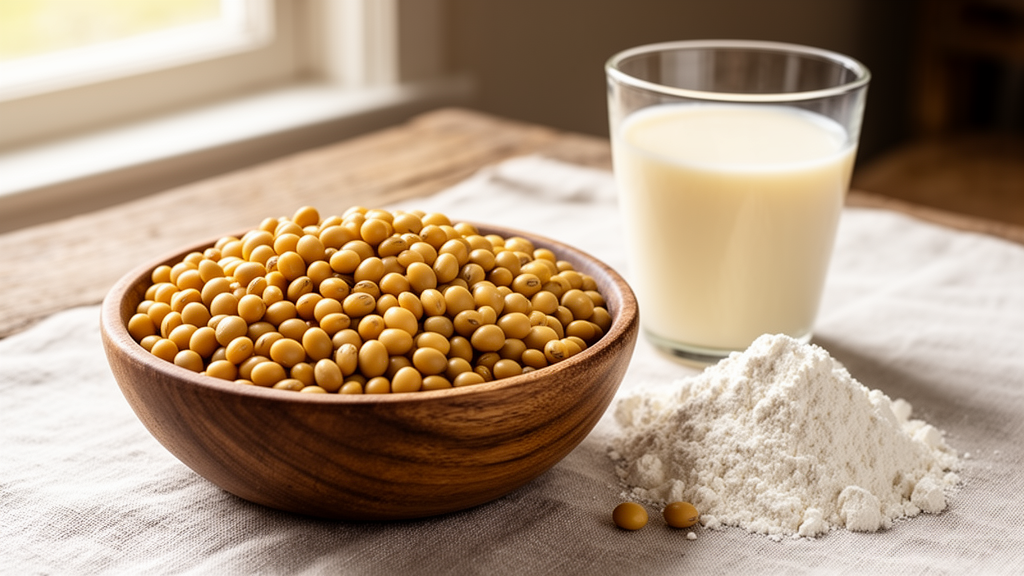
Soybeans are packed with vitamin B1 and vitamin B6, but most of that nutritional value disappears when they are turned into the highly processed protein powders behind modern plant-based meats, according to a new analytical study published in Food Production, Processing and Nutrition. Using a purpose-built mass spectrometry method, researchers quantified individual forms of these vitamins across soybeans, soy protein concentrates and isolates, soymilk and soy-based infant formula, and found that manufacturing can strip away 84 to 94 percent of the vitamin content.
Because vitamins B1 and B6 cannot be synthesised by humans and must come from the diet, the composition of these increasingly popular ingredients matters for the growing number of people shifting toward plant-based eating.
Measuring these vitamins accurately is harder than it sounds. Vitamin B6 is not a single compound but a family of related molecules, called vitamers, that differ sharply in how well the human body can use them. Pyridoxine (PN), pyridoxamine (PM) and pyridoxal (PL) are readily absorbed, whereas pyridoxine-5′-beta-D-glucoside (PNG), a glycosylated form common in plants, has roughly half the bioavailability of PN. Most conventional assays measure only total vitamin B6 after hydrolysis, which can either overestimate the amount the body can actually access or miss glycosylated forms entirely. The new method, combining strong cation exchange extraction with SelexION differential ion mobility separation on a triple quadrupole mass spectrometer, allowed the team to quantify thiamine (vitamin B1) and individual B6 vitamers, including PNG and pyridoxamine-5′-phosphate (PMP), intact and without enzymatic or high-temperature hydrolysis.
The analytical team validated the method carefully, using stable isotope labelled internal standards to correct for extraction losses and matrix effects, and confirmed linear calibration curves across the tested ranges. Recovery was reasonable for most target compounds, although pyridoxal, pyridoxal-5′-phosphate and several other vitamers showed poor recovery and were excluded. The researchers noted that the main advantage of the ion mobility approach was not greater sensitivity compared with an earlier method developed for beer, but improved selectivity, which reduces background noise and the risk of false positives in complex food matrices.
When applied to commercial soybeans, the method revealed a vitamin profile dominated by the less bioavailable PNG. Soybeans contained 3.9 to 7.1 micrograms of PNG per gram and 1.0 to 4.9 micrograms of thiamine per gram, with roughly ten-fold lower levels of PN and twenty-fold lower levels of PM and PMP. Overall, PNG accounted for about 84 percent of the total quantified vitamin B6. Since human bioavailability of PNG is approximately half that of PN, the authors estimate that the effective bioavailability of vitamin B6 from soybeans is around 58 percent, a figure consistent with older uptake studies. By their calculation, roughly 339 grams of dry soybeans would be needed to meet the recommended daily intake of vitamin B6 for women, and about 386 grams for men, with similar amounts required for thiamine.
The contrast with processed soy protein was stark. Soy protein concentrates and isolates contained 84 to 94 percent less vitamin B1 and B6 than the raw beans. Loss was greatest for PNG, with the protein extracts retaining only about 5 percent of soybean levels, followed by thiamine, PM and PN at 12, 15 and 16 percent respectively. The proportions shifted as well: PNG fell from 84 percent of total B6 in soybeans to about 48 percent in concentrates and 50 percent in isolates. The researchers calculated that 3.5 kilograms of SPC or 2.2 kilograms of SPI would be required to reach the vitamin B6 recommended intake for women, and 7.3 or 2.5 kilograms respectively for adequate thiamine.
Notably, vitamin levels varied enormously between individual protein products, with some containing fifty times less vitamin than soybeans and others only five times less, even though the researchers had no information about how each powder was manufactured. When they compared vitamin content to measurable processing indicators, they found that pH and the protein solubility index were positively correlated with PNG, PN and thiamine levels. Because a high pH signals exposure to alkaline treatment during protein extraction, the authors suggest that more extreme alkaline processing may loosen protein structures and strengthen their binding to less polar vitamins, improving retention. Isolates, which undergo alkaline treatment more routinely, contained significantly more vitamins than concentrates. The finding hints that manufacturers could preserve more vitamins by choosing gentler methods that limit exposure to heat, light and degrading conditions, though the authors caution that firm conclusions require direct knowledge of the production processes.
Soymilk told a very different story. Non-fortified soymilk showed vitamin levels similar to soybeans, suggesting that traditional soymilk production largely retains endogenous vitamins, and it vastly outperformed almond and oat milk, which contained almost no vitamin B1 or B6. Within the non-fortified samples, the freshest product, made three hours before purchase, had the highest vitamin levels, while an ultra-heat-treated (UHT) soymilk had the lowest and contained no detectable PNG or PMP, indicating that heat treatment degrades these nutrients. Two soymilk samples and the infant formulas were clearly fortified with pyridoxine and thiamine, showing elevated levels of only those vitamers, and the measured amounts generally matched or slightly exceeded manufacturer declarations, a common practice to guarantee minimum content until expiry.
The infant formula comparison carried particular weight for the Singapore-based team, where soy formula consumption is high. Both soy and cow milk formulas contained high PN and thiamine from fortification, and far more thiamine than the inadequately fortified soy formula implicated in infant deaths in 2003, but they lacked the PM, PMP and PNG found in soybeans and the PM and PMP found in breast milk. The authors note that fortification with PN and thiamine remains essential for all infant formulas, and that the consequences of differing vitamer profiles for infant development deserve further study. They also addressed safety concerns about excess B6, which can cause neuropathy at high doses, calculating that more than three litres of the most fortified soymilk would be needed to reach even 6 milligrams per day, making overconsumption through soymilk unlikely.
The broader message is that not all plant-based foods are nutritionally equivalent to the whole ingredients they derive from. Soybeans and traditional soy foods are genuinely rich in B1 and B6, but industrial processing into protein isolates and concentrates removes most of these vitamins, and fortification replaces only PN and thiamine, not the full spectrum of vitamers whose roles are still poorly understood. Because PNG is less bioavailable than PN, diets heavy in soy may deliver less usable vitamin B6 than total intake figures suggest. The authors argue that evaluating the quality of plant-based products requires assessing complete vitamer profiles rather than total vitamin content alone, and they call for more research into how PNG and other vitamers affect vitamin status in populations with low-meat and low-milk diets.
Subject of Research: Quantification of vitamin B1 and B6 vitamer profiles in soybeans, soy protein products and soymilk using differential ion mobility mass spectrometry
Article Title: Quantification of B6 and B1 vitamers in soybeans, soy-protein and soymilk using a targeted differential ion-mobility mass spectrometry LCMS methodology
Article References: Watkins, O. C., Häuslein, C., Shu, W., Morsten, S., Poirier, C., Alpers, T., Becker, T., Park, J., Calvo-Baltanás, V., & Rychlik, M. (2026). Quantification of B6 and B1 vitamers in soybeans, soy-protein and soymilk using a targeted differential ion-mobility mass spectrometry LCMS methodology. Food Production, Processing and Nutrition, 8(1), Article 68. https://doi.org/10.1186/s43014-026-00416-6
Image Credits: AI Generated
DOI: 10.1186/s43014-026-00416-6
Keywords: vitamin B1, vitamin B6, soybeans, soy protein isolate, soymilk, pyridoxine glucoside, thiamine, bioavailability, food processing, mass spectrometry, plant-based diet, fortification
News Source: Daisy Hatcher. (October 29, 2026). Soybeans Are Rich in B Vitamins, but Processing Strips Most of Them Away. Scienmag.