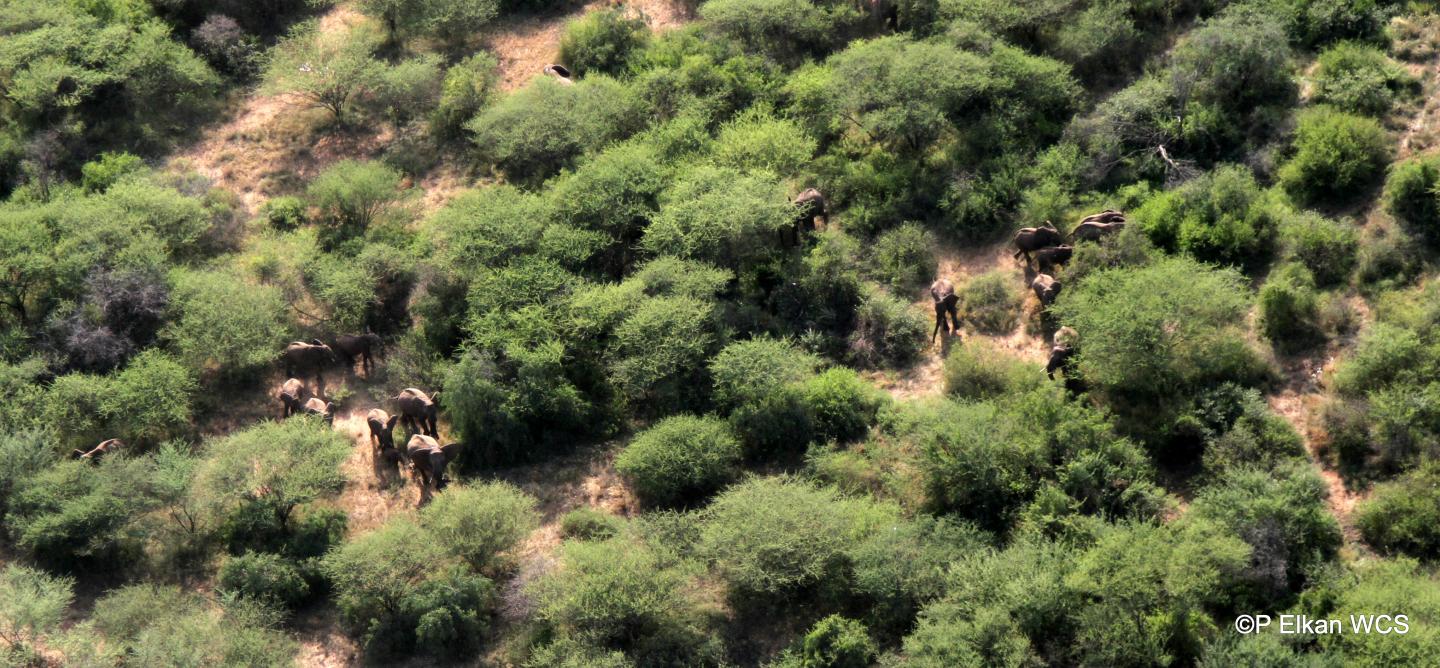
Credit: (c)P.Elkan/WCS
JUBA, SOUTH SUDAN, May 24, 2017 — The first aerial assessment of the impact of South Sudan's current civil war on the country's wildlife and other natural resources shows that significant wildlife populations have so far survived, but poaching and commercial wildlife trafficking are increasing, as well as illegal mining, timber harvesting and charcoal production, the Wildlife Conservation Society (WCS) said in a report issued today.
Wildlife in South Sudan, which is home to the world's second-largest land mammal migration, includes species of global importance, such as elephant, giraffe, lion, and hippopotamus. WCS conducted the aerial survey in 2015-16 as part of a project funded by the U.S. Agency for International Development (USAID) and part of the Great Elephant Census©, funded by philanthropist and Microsoft cofounder Paul G. Allen. WCS previously conducted aerial surveys of South Sudan's wildlife and protected areas in 2007, 2008, 2009-10 and 2013.
The 2015-16 aerial survey covered the areas of Boma, Badingilo, Nimule, Southern, and Shambe National Parks, and the proposed Loelle protected area. A combination of aerial survey methods (systematic surveys and recce surveys) were employed with a total of 17,934 km flown (98 hours of flight time) and an estimated 20,845 sq. km surveyed systematically. The survey confirmed a minimum of 730 elephants in the surveyed zone. However, about 50 percent of previously documented important wildlife areas — including the northern part of South Sudan's vast wetland, the Sudd — were inaccessible due to conflict, preventing a comprehensive assessment.
Earlier surveys and applied research conducted by WCS and the South Sudan Wildlife Service estimated an elephant population of some 2,300 in the country prior to the civil war, which began in December 2013, down from an estimated 79,000 in the 1970's. Elephants face continued and expanded threats. Giraffe are in very low numbers–down from some 13,000 in the early 1980's to only hundreds remaining now and at risk of local extinction. Migratory tiang and other antelopes are vulnerable due to annual migration between Badingilo National Park and the Sudd.
The survey documented northern giraffe Kordofan subspecies in Shambe National Park area and hippopotamus and Uganda kob in Nimule National Park. Endangered northern giraffe Nubian subspecies, reedbuck, common eland, Beisa oryx, ostrich and wild dog were observed in Badingilo, Boma, and Loella areas. The white-eared kob and Mongalla gazelle were found to be the most dominant species in Badingilo and Boma. Important transboundary conservation linkages between South Sudan and neighbouring Ethiopia, Kenya and Uganda were also documented.
Hon. Jemma Nunu Kumba, Minister, Ministry of Wildlife Conservation and Tourism stated: "These surveys are important for our country as they show the world that South Sudan is still home for many iconic wildlife species. However, some of these species have become endangered. I want to appeal to the people of South Sudan to take special care in protecting these endangered animals so that the next generation will continue to benefit from their presence. These animals serve and will serve as an import source of ecotourism for the country."
"The United States Government is supporting wildlife conservation in South Sudan because it is a priceless resource for the people of South Sudan and our shared global heritage," said USAID South Sudan Mission Director Jeffrey Bakken. "Our assistance has helped provide employment opportunities, helped resolve local conflicts and promoted knowledge sharing with local communities about the importance and benefits of protecting their wildlife heritage. South Sudan's wildlife and natural resources can directly contribute to peace and sustainable development."
Said Cristián Samper, WCS President and CEO: "There is still hope for wildlife in South Sudan even as conflict rages on. But there must be actions taken, including strengthening protected areas, to ensure the protection of South Sudan's natural heritage which is vital for wildlife and communities alike. Healthy wildlife populations and well managed Parks can improve livelihoods and security, and stabilize the region."
###
Visit: newsroom.wcs.org Follow: @WCSNewsroom. For more information: 347-840-1242.
http://www.facebook.com/wcs.southsudan
Media Contact
John Delaney
[email protected]
718-220-3275
@TheWCS
http://www.wcs.org
############
Story Source: Materials provided by Scienmag