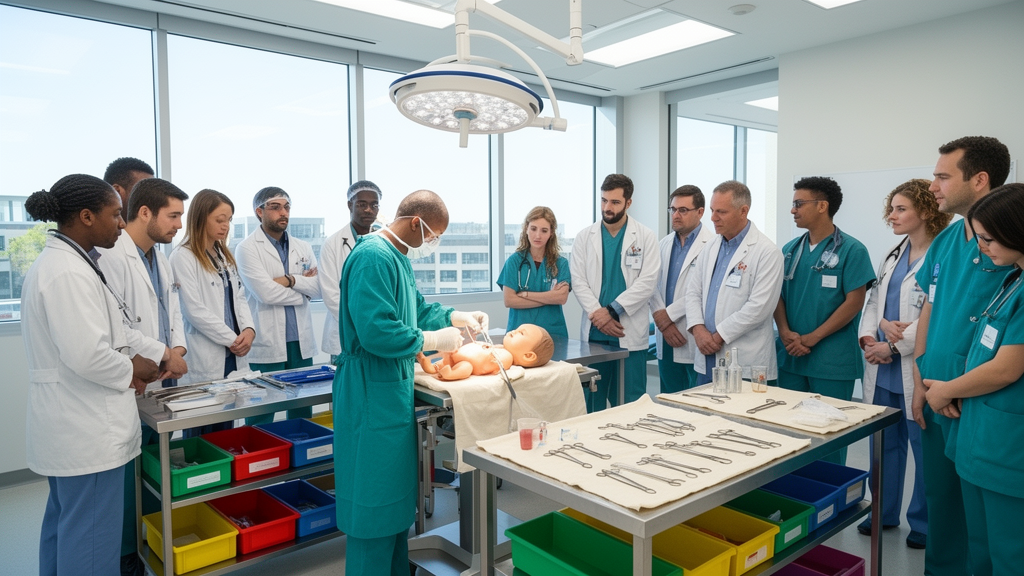
A policy review published in Frontiers in Medicine outlines an educational framework designed to embed environmental sustainability, resource stewardship, and ecological health literacy into paediatric surgical training within low-to-middle income countries. Developed by academic clinicians at the University of Cape Town and the Red Cross War Memorial Children’s Hospital in South Africa, the initiative addresses an absence of formal environmental pedagogy across medical curricula. Healthcare systems globally generate substantial ecological damage, yet surgical training programs in developing nations frequently operate under acute operational and budgetary pressures prioritizing immediate clinical interventions over long-term environmental planning. By leveraging the United Nations Educational, Scientific and Cultural Organization Education Pillars for Sustainable Development, the authors demonstrate how paediatric surgical departments can incorporate environmental principles into existing lectures, bedside tutorials, and operating theatre instruction. The resulting framework emphasizes that surgical decision-making must extend beyond immediate procedural outcomes to account for ecological footprints, clinical waste, and the interplay between environmental factors and paediatric congenital anomalies.
The environmental footprint of modern healthcare represents an urgent public health concern, with clinical services responsible for approximately five percent of total global greenhouse gas emissions. Furthermore, surgical theatres generate between seven and thirty percent of total hospital waste, with single-use plastic consumables, disposable drapes, gowns, and sterile packaging representing between twenty and seventy percent of all discarded hospital materials. Although low-to-middle income facilities maintain an established ethos of frugality necessitated by fiscal constraints, the adoption of single-use stapling and electrosurgical instruments has expanded plastic waste. Academic clinicians argue that this surge in consumable medical equipment demands targeted educational interventions teaching trainee surgeons how clinical consumption patterns degrade natural ecosystems and accelerate environmental disruption.
Surgical training structures in South Africa provide a distinct institutional landscape for introducing these sustainable development models across varying levels of seniority. Undergraduate students at the regional teaching facility encounter paediatric surgery during an eight-week fifth-year rotation, though dedicated clinical exposure totals under two weeks through combined tutorials, bedside seminars, and digital resources. In contrast, qualifying as a specialist paediatric surgeon requires completing medical school, a mandatory clinical internship, community service, and at least five additional years of university-affiliated hospital residency. Trainees must also complete a Master of Medicine mini-thesis, compile an operative logbook, undergo continuous workplace assessments, and complete intensive theoretical exit examinations. Despite this progression, dedicated didactic lectures average only three hours per week within the academic division, and formal instructional content examining the intersection of environmental degradation and paediatric pathology remains minimal. The review highlights this shortfall, advocating for environmental integration that maximizes limited didactic hours while utilizing apprenticeships and clinical mentorship to model ecological accountability.
To organize sustainable pedagogical change without overburdening existing training schedules, the educational framework adapts the five UNESCO Education Pillars for Sustainable Development, encompassing awareness, knowledge, attitude, skills, and active participation. These dimensions span cognitive, socio-emotional, and practical behavioral domains, moving beyond standard lectures to encourage holistic transformation across individuals, institutional systems, and community health networks. Rather than presenting sustainability as an isolated theoretical concept, the curriculum contextualizes environmental challenges within daily operative and clinical dilemmas, helping trainees recognize that pro-environmental choices align with clinical safety, quality care, and resource equity. By introducing guided critical discussions during ward rounds, journal clubs, and surgical audits, educators can challenge traditional paternalistic teaching models and encourage students to actively appraise clinical habits. This pedagogical design bridges the gap between individual pro-environmental beliefs and measurable institutional practice, ensuring that junior doctors cultivate lifelong competence in sustainable clinical resource management.
The authors utilize gastroschisis, a severe congenital abdominal wall defect requiring emergency neonatal stabilization, as a foundational case study to illustrate the relationship between surgical services, socioeconomic conditions, and the surrounding environment. While high-income healthcare systems have largely transitioned to bedside sutureless non-operative reduction techniques that allow approximately two-thirds of infants to avoid neonatal general anaesthesia and lower mechanical ventilation demands, local institutional barriers prevent widespread adoption of this protocol. In the South African setting, the tertiary hospital operates as a free-standing facility receiving neonates transferred from off-site maternity centers. Prolonged transit times and delayed arrivals often cause acute bowel compromise, requiring surgeons to perform operative defect enlargement to prevent intestinal ischaemia before definitive closure can occur. These logistical realities compel infants into operating rooms, expanding procedural consumption, intensive care utilization, and overall hospital expenditure, which directly illustrates to surgical residents how systemic infrastructure limitations drive up economic costs and clinical carbon footprints.
Gastroschisis also provides an effective educational vehicle for examining environmental teratology and contrasting disease epidemiology between global regions. Animal experimental models have linked at least twenty-two separate teratogens to the development of gastroschisis, while human epidemiological investigations indicate that approximately ten percent of mothers carrying affected fetuses report significant prior exposure to petroleum byproducts. The birth defect disproportionately affects younger, socially marginalized teenage mothers, offering opportunities to discuss environmental justice and chemical exposures. Notably, documented incidence rates in South Africa range between 0.07 and 2.1 cases per 10,000 live births, remaining lower than rates of 3 to 4 per 10,000 live births reported in the United Kingdom and the United States. While high-income nations have witnessed stabilizing or declining incidence over recent decades, African populations experience steadily rising case volumes. Trainees analyzing these divergent trends are encouraged to investigate whether dissimilar patterns reflect maternal teratogen exposures, regional genetic profiles, or limitations in baseline epidemiological tracking systems.
The clinical management of neonates with abdominal wall defects further highlights the complex operational and toxicological trade-offs inherent in resource-constrained surgical care. Commercial preformed silastic silo bags designed for gradual visceral reduction remain prohibitively expensive or entirely unavailable in many resource-limited facilities, prompting surgeons to construct improvised coverings using intravenous fluid bags, known as Bogota bags, or female condoms. While these innovative solutions succeed in preserving neonatal life, polyvinyl chloride intravenous containers leach plasticizing phthalates directly into exposed visceral membranes. Academic educators stress that trainee surgeons must learn to appraise these critical material trade-offs, encouraging interdisciplinary biochemical investigations to evaluate whether lining makeshift coverings with inert polyethylene films can limit acute chemical transfer when safer medical-grade silicone devices cannot be procured.
Beyond procedural materials, the review highlights critical gaps in clinical research regarding climatic influences on surgical recovery, surgical infections, and inpatient nutrition. Pediatric surgery textbooks frequently omit discussions regarding climate-disease dynamics, even though elevated ambient temperatures in tropical and subtropical regions promote cutaneous bacterial proliferation. Research from high-income jurisdictions links warmer weather patterns to significant surges in gram-negative central venous catheter infections, yet corresponding infection data from under-resourced hospitals in warm climates remains sparse.
The institutional setting at Red Cross War Memorial Children’s Hospital demonstrates practical engineering and operational adjustments that illustrate sustainable healthcare management in practice. The medical center has curtailed utility expenditures by mounting photovoltaic solar arrays over hospital parking facilities, refitting indoor lighting with energy-efficient light-emitting diode fixtures, and installing timer controls on wall-mounted boiling water dispensers. Water conservation initiatives have introduced restricted-flow faucets and promoted alcohol-based antiseptic hand rub protocols over conventional water basins. Complementing these engineering adjustments, departments can employ low-cost laparoscopic practice models constructed from locally sourced recycled materials and introduce a Green Preoperative Checklist modified from the standard World Health Organization audit to prompt surgical teams to delay opening unnecessary consumables and deactivate unused theatre lighting.
At the policy level, the authors address the regulatory landscape surrounding the reprocessing of single-use medical equipment and identify overarching limitations in existing surgical sustainability research. While resource limitations lead facilities to re-sterilize disposable items using ethylene oxide gas, domestic authorities like the South African Health Products Regulatory Authority classify the reprocessing of single-use devices as malpractice, contrasting with United States frameworks recognizing that regulated reprocessing carries low clinical risk. Furthermore, manufacturer modifications increasingly integrate electronic lockouts to prevent secondary use, driving up procurement costs and medical waste. The review notes that current paediatric sustainability frameworks rely heavily on data extrapolated from adult surgical fields and high-income countries, as locally specific carbon calculations and pedagogical outcome metrics remain unmeasured. To overcome these constraints, the authors emphasize that training programs must equip junior surgeons with advocacy, research, and negotiation skills, enabling clinicians to collaborate across government agencies, industry partners, and academic institutions to establish durable, environmentally responsible surgical systems.
Subject of Research: Integration of environmental sustainability and resource management into paediatric surgical education
Article Title: Environmental sensitization, advocacy and resource-management training in a resource-limited paediatric surgical educational setting
Article References: Arnold, M., Lazarus, J., & Cox, S. G. (2026). Environmental sensitization, advocacy and resource-management training in a resource-limited paediatric surgical educational setting. Frontiers in Medicine, 13, Article 1823289. https://doi.org/10.3389/fmed.2026.1823289
Image Credits: AI Generated
DOI: 10.3389/fmed.2026.1823289
Keywords: paediatric surgery, environmental sustainability, surgical education, resource-limited setting, gastroschisis, carbon footprint, medical waste, UNESCO EPSD, teratogens, surgical checklists, operating theatre emissions, low-to-middle income countries, single-use medical devices, phthalate exposure, healthcare sustainability, South Africa, clinical training, medical curriculum
News Source: Harold Sullivan. (November 14, 2026). South African Framework Integrates Environmental Sustainability Into Paediatric Surgical Training Programs. Scienmag.