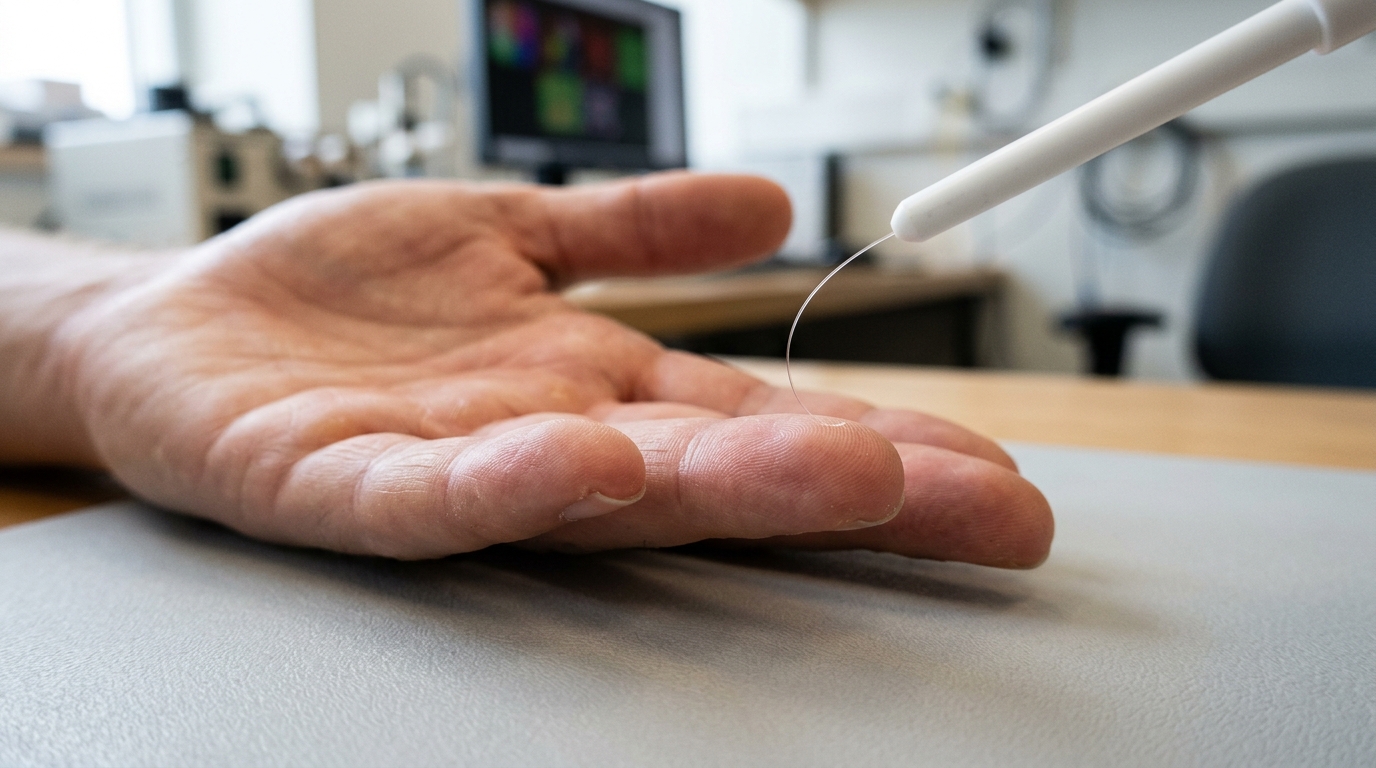
A prospective clinical study investigating quantitative sensory testing has revealed that concurrent visual stimulation significantly elevates tactile detection thresholds across the human hand, reducing measured light-touch sensitivity in healthy adults. When thirty-two healthy participants completed active von Frey filament testing while watching an unrelated muted video on a computer monitor, their overall mean tactile detection threshold reached 130.4 ± 51.4 milligram-force, a statistically significant increase compared with the baseline average of 110.5 ± 38.6 milligram-force recorded under blindfolded conditions. Non-parametric paired analysis confirmed this systematic condition-dependent shift with a Wilcoxon signed-rank test value of p = 0.0026, accompanied by a median threshold shift from 104.1 milligram-force blindfolded to 142.6 milligram-force during visual distraction. In a linear mixed-effects model accounting for repeated finger-level measurements, visual stimulation increased detection thresholds by 19.8 milligram-force, with a 95 percent confidence interval spanning 11.2 to 28.5 milligram-force. Twenty-two of the thirty-two volunteers exhibited higher thresholds during visual stimulation, demonstrating an independent perceptual effect unaffected by baseline values.
The accurate clinical assessment of light-touch sensation provides critical diagnostic information for identifying peripheral nerve disorders, most notably compressive neuropathies including carpal tunnel syndrome and Guyon canal syndrome. Because light-touch is typically the earliest sensory modality compromised during chronic nerve compression, reliable sensory measurements are necessary for establishing early diagnoses, monitoring recovery, and evaluating surgical interventions. Historically, clinicians have relied on conventional Semmes-Weinstein monofilaments; however, these manual tools suffer from substantial examiner-dependent variability, fluctuating application velocities, and coarse force gradations. Standard nylon monofilament sets deliver force only in discrete, discontinuous steps starting near 8 milligram-force, whereas electronic esthesiometers typically provide a 100 milligram-force floor with coarse 50 to 100 milligram-force steps. These physical constraints have long obscured subtle, condition-dependent sensory shifts. Consequently, whether ambient environmental distractions systematically alter measured tactile sensitivity has remained uncertain, highlighting the clinical necessity for automated, high-precision tactile esthesiometers capable of delivering standardized mechanical stimuli under controlled testing conditions.
To overcome the limitations inherent in manual monofilaments, researchers utilized an active von Frey system that delivers continuous mechanical force to the fingertip using a D’Arsonval movement actuator. This semi-automated device operates across a continuous force range of 1 to 400 milligram-force in fine 1-milligram-force increments, yielding an exceptionally low mean force error of 0.469 milligram-force. Thresholds were determined using an automated bisection staircase algorithm rather than fixed, arbitrary force intervals. Each trial originated from a randomized initial force of 200 ± 40 milligram-force, spanning 160 to 240 milligram-force. When participants detected the contact and pressed a response switch within two seconds, the applied force was halved; otherwise, force increased toward 400 milligram-force until reaching threshold convergence. Methodological validation showed that calculating the mean of the middle three measurements out of five trials achieved an intraclass correlation coefficient of 0.798, substantially exceeding the five-trial average reliability of 0.408 by minimizing initial adaptation and terminal fatigue.
The study recruited thirty-two healthy adult volunteers, comprising twenty-four men and eight women, with an overall mean age of 29.8 ± 4.3 years and a range between 25 and 45 years. All individuals were enrolled under institutional review board approval with documented written consent following rigorous eligibility screening. Exclusion criteria eliminated prospective participants with any history of peripheral neuropathy, diabetes mellitus, cervical radiculopathy, prior upper-extremity nerve trauma, or known systemic neurological disorders, ensuring an entirely healthy physiological baseline. Hand dominance screening classified thirty participants as right-handed, alongside one left-handed male and one ambidextrous female. While previous active von Frey trials had intentionally omitted visual stimuli to determine baseline performance norms, this study deliberately examined how visual input interacts with tactile perception. The demographic composition allowed investigators to analyze sensory modulation across healthy cutaneous nerve territories without confounding effects from underlying neuromuscular pathology, nerve degeneration, or structural limb damage.
Sensory evaluations followed a highly standardized testing protocol to prevent postural artifacts and unintended limb movement during stimulus delivery. Participants remained seated comfortably with feet flat, hips and knees flexed to 90 degrees, elbow flexed to 90 degrees, and the forearm pronated over a stabilizing wrist bolster. Testing evaluated four fingertip pads: the left index finger (L2), left fifth finger (L5), right index finger (R2), and right fifth finger (R5), mapping median and ulnar nerve territories respectively. Participants were evaluated sequentially, beginning under a blindfolded condition requiring instructed eye closure, followed by a visual-stimulation block where subjects watched a muted flash video displayed on a computer screen. Testing followed a fixed anatomical order across fingers, interposing ten-minute resting intervals between individual finger trials and a one-hour rest interval between experimental blocks. The middle three of five sequential trials per site were retained for statistical computation.
Primary statistical analyses confirmed that task-irrelevant visual stimulation produced marked, consistent elevations in light-touch thresholds compared to blindfolded testing. The participant-level mean threshold across all four sites rose from 110.5 ± 38.6 milligram-force blindfolded to 130.4 ± 51.4 milligram-force during video exposure, reflecting an average increase of 19.8 milligram-force. Non-parametric evaluation confirmed statistical significance at p = 0.0026, while the linear mixed-effects model corroborated an identical 19.8 milligram-force increase with p < 0.001 and a 95 percent confidence interval spanning 11.2 to 28.5 milligram-force. Overall, 69 percent of participants exhibited higher thresholds during visual stimulation. Furthermore, Spearman correlation analysis showed no association between an individual’s baseline blindfolded threshold and the magnitude of their threshold elevation (rho = 0.15, p = 0.40). This lack of correlation confirmed that the observed threshold shift was not driven by regression toward the mean, demonstrating a genuine, systematic modulation of quantitative tactile detection.
Anatomical comparisons during visual stimulation revealed distinct threshold differences across finger pads and corresponding peripheral nerve distributions. During video exposure, mean thresholds registered 134.0 ± 59.7 milligram-force on the left index finger, 125.7 ± 58.2 milligram-force on the left fifth finger, 143.1 ± 63.8 milligram-force on the right index finger, and 118.7 ± 48.3 milligram-force on the right fifth finger. Across both hands, index finger pads in the median nerve territory exhibited higher thresholds than fifth finger pads in the ulnar nerve territory (p < 0.001). While the difference between the right index and right fifth fingers proved statistically significant, the left-hand comparison was not. An exploratory interaction model suggested a larger threshold increase in the index finger than the fifth finger (+28.8 versus +10.8 milligram-force, p = 0.040), though this effect lost significance after adjusting for side. Measurement reliability remained high during visual stimulation, achieving an overall intraclass correlation coefficient of 0.722.
Analyses of hand dominance and biological sex highlighted important patterns in tactile processing and baseline sensitivity. After excluding the ambidextrous participant, blindfolded testing revealed significantly higher thresholds in the dominant hand compared to the non-dominant hand (120.1 ± 49.7 versus 103.5 ± 34.4 milligram-force, p = 0.018). Under visual stimulation, however, this lateralized difference diminished substantially, yielding nearly identical thresholds of 134.5 ± 55.9 milligram-force and 130.3 ± 50.0 milligram-force (p = 0.504). Difference-in-differences analysis indicated an attenuation from a 16.6 milligram-force gap blindfolded to 4.2 milligram-force under visual stimulation (p = 0.050), though the mixed-effects interaction term was not statistically significant (p = 0.22). Regarding biological sex, male participants exhibited higher mean thresholds than females under both blindfolded (116.5 ± 40.7 versus 92.8 ± 26.1 milligram-force, p = 0.071) and visual conditions (137.5 ± 50.8 versus 109.1 ± 50.3 milligram-force, p = 0.193), consistent with anatomical differences in finger size and mechanoreceptor density.
Participant age demonstrated a statistically significant positive correlation with measured tactile thresholds under visual stimulation. Across the entire cohort, participant-level mean thresholds during visual stimulation correlated positively with age (Spearman rho = 0.439, p = 0.012). Finger-specific analyses revealed that index finger thresholds across both hands exhibited significant correlations with participant age, with the dominant index finger displaying the highest coefficient at rho = 0.421 (p < 0.05). In contrast, the fifth finger showed a significant correlation with age on the dominant right side (R5 p = 0.034; D5 p = 0.036), but only a marginally significant relationship on the non-dominant left side (L5 p = 0.086; ND5 p = 0.091). These findings align with earlier literature by Samain-Aupic and Tirrell showing age-related tactile threshold increases across specific nerve territories, demonstrating that chronological age and anatomical location remain critical covariates when interpreting sensory testing data in clinical populations.
The investigators concluded that visual stimulation introduces a systematic, centrally mediated measurement bias rather than reflecting true peripheral sensory impairment. In clinical practice, light-touch sensation represents the earliest modality compromised by compressive neuropathies; uncontrolled ambient visual distractors in busy outpatient clinics could artificially elevate thresholds, potentially masking subtle deficits or confounding serial assessments during postoperative recovery and rehabilitation. While prior conventional monofilament studies failed to detect visual effects, the fine continuous resolution of active von Frey esthesiometers successfully resolved these subtle perceptual shifts. Nevertheless, the authors noted several study limitations, including the modest sample size, unequal sex distribution, absence of finger size measurements, and potential environmental influences on filament elasticity. Additionally, because the protocol measured detection thresholds rather than utilizing a somatic signal detection task with catch trials, it could not formally differentiate altered sensory sensitivity from a shifted response criterion. Consequently, standardizing visual conditions through blindfolding or instructed eye closure remains essential for accurate quantitative sensory testing.
Subject of Research: Visual stimulation effects on quantitative tactile thresholds during active von Frey testing
Article Title: Effect of visual stimulation on quantitative light-touch assessment using the active von Frey filament test
Article References: Lee, H.-K., Lee, H.-J., Lee, J.-G., Lee, J. K., Kim, J., Yoon, J. P., & Choi, Y. (2026). Effect of visual stimulation on quantitative light-touch assessment using the active von Frey filament test. Discover Neuroscience, 21(1), Article 78. https://doi.org/10.1186/s13064-026-00307-z
Image Credits: AI Generated
DOI: 10.1186/s13064-026-00307-z
Keywords: active von Frey filament test, tactile detection threshold, light-touch sensation, visual stimulation, sensory testing protocols, peripheral nerve disorders, median nerve innervation, ulnar nerve territory, bisection staircase, D'Arsonval movement actuator, hand dominance asymmetry, multisensory tactile modulation, response criterion shift, serial sensory evaluation, linear mixed-effects model, Wilcoxon signed-rank test, intraclass correlation coefficient
News Source: Ophelia Keating. (November 17, 2026). Visual Distraction Reduces Quantitative Light Touch Sensitivity in Healthy Adult Hand Testing. Scienmag.