• HOME
  • NEWS
  • EXPLORE
    • CAREER
      • Companies
      • Jobs
    • EVENTS
    • iGEM
      • News
      • Team
    • PHOTOS
    • VIDEO
    • WIKI
  • BLOG
  • COMMUNITY
    • FACEBOOK
    • INSTAGRAM
    • TWITTER
Sunday, May 10, 2026
BIOENGINEER.ORG
No Result
View All Result
  • Login
  • HOME
  • NEWS
  • EXPLORE
    • CAREER
      • Companies
      • Jobs
        • Lecturer
        • PhD Studentship
        • Postdoc
        • Research Assistant
    • EVENTS
    • iGEM
      • News
      • Team
    • PHOTOS
    • VIDEO
    • WIKI
  • BLOG
  • COMMUNITY
    • FACEBOOK
    • INSTAGRAM
    • TWITTER
  • HOME
  • NEWS
  • EXPLORE
    • CAREER
      • Companies
      • Jobs
        • Lecturer
        • PhD Studentship
        • Postdoc
        • Research Assistant
    • EVENTS
    • iGEM
      • News
      • Team
    • PHOTOS
    • VIDEO
    • WIKI
  • BLOG
  • COMMUNITY
    • FACEBOOK
    • INSTAGRAM
    • TWITTER
No Result
View All Result
Bioengineer.org
No Result
View All Result
Home NEWS Science News Chemistry

Sound waves bypass visual limitations to recognize human activity

Bioengineer by Bioengineer
May 28, 2019
in Chemistry
Reading Time: 3 mins read
0
IMAGE
Share on FacebookShare on TwitterShare on LinkedinShare on RedditShare on Telegram

Privacy, environment restricts video camera use; sound can get around those concerns
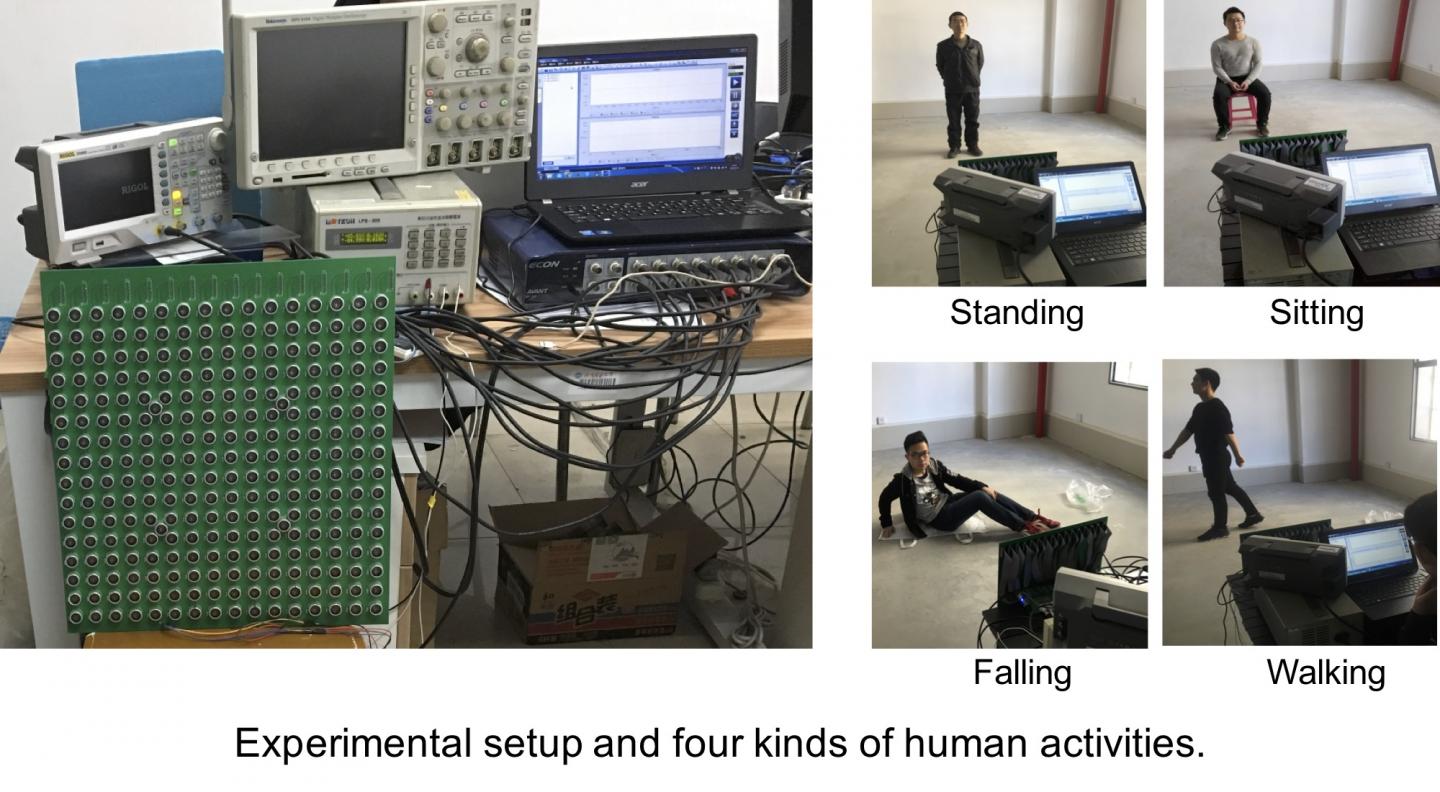
IMAGE

Credit: Xinhua Guo

WASHINGTON, D.C., May 28, 2019 — Video cameras continue to gain widespread use to monitor human activities for surveillance, health care, home use and more, but there are privacy and environmental limitations in how well they work. Acoustical waves, such as sounds and other forms of vibrations, are an alternative medium that may bypass those limitations.

Unlike electromagnetic waves, such as those used in radar, acoustical waves can be used not only to find objects but also to identify them. As described in a new paper in the May 28 issue of Applied Physics Letters, from AIP Publishing, the researchers used a two-dimensional acoustic array and convolutional neural networks to detect and analyze the sounds of human activity and identify those activities.

“If the identification accuracy is high enough, a large number of applications could be implemented,” said Xinhua Guo, associate professor at Wuhan University of Technology. “For example, a medical alarm system could be activated if a person falls at home and it is detected. Thus, immediate help could be provided and with little privacy leaked at the same time.”

By using a two-dimensional acoustic array with 256 receivers and four ultrasonic transmitters, the researchers were able to gather data related to four different human activities — sitting, standing, walking and falling. They used a 40-kilohertz signal to bypass any potential contamination from ordinary room noise and distinguish it from the identifying sounds.

Their tests achieved an overall accuracy of 97.5% for time-domain data and 100% for frequency-domain data. The scientists also tested arrays with fewer receivers (eight and four) and found them to produce results with lower accuracy of the human activity.

Guo said acoustic systems are a better detection device than vision-based systems because of the lack of widespread acceptance of cameras due to privacy issues. In addition, low lighting or smoke can also hamper vision recognition, but sound waves are not affected by those special environmental situations.

“In future, we will go on studying complex activity and situation of random positioning,” Guo said. “As we know, human activities are complicated, taking falling as an example, and can present in various postures. We are hoping to collect more datasets of falling activity to reach higher accuracy.”

Guo said they will be experimenting with various numbers of sensors and their effectiveness in detecting and determining human activities. He said there is an optimal number for the array that would make this viable for commercial and personal use in homes and buildings.

###

The article, “A single feature for human activity recognition using two-dimensional acoustic array,” is authored by Xinhua Guo, Rongcheng Su, Chaoyue Hu, Xiaodong Ye, Huachun Wu and Kentaro Nakamura. The article will appear in Applied Physics Letters on May 28, 2019 (DOI: 10.1063/1.5096572). After that date, it can be accessed at http://aip.scitation.org/doi/full/10.1063/1.5096572.

ABOUT THE JOURNAL

Applied Physics Letters features concise, rapid reports on significant new findings in applied physics. The journal covers new experimental and theoretical research on applications of physics phenomena related to all branches of science, engineering, and modern technology.

Media Contact
Larry Frum
[email protected]

Related Journal Article

http://dx.doi.org/10.1063/1.5096572

Tags: AcousticsAnthropologyChemistry/Physics/Materials SciencesMedicine/HealthPolicy/EthicsSocial/Behavioral ScienceTechnology/Engineering/Computer Science
Share12Tweet8Share2ShareShareShare2

Related Posts

Miniature Sensor Uses Light to Detect Touch — Chemistry

Miniature Sensor Uses Light to Detect Touch

May 8, 2026
Iron Minerals Determine Whether Dissolved Organic Matter Fuels Microbes or Becomes Long-Term Carbon Storage — Chemistry

Iron Minerals Determine Whether Dissolved Organic Matter Fuels Microbes or Becomes Long-Term Carbon Storage

May 8, 2026

Kate Evans Appointed Associate Lab Director for Biological and Environmental Systems Science at ORNL

May 8, 2026

Advancing Multiscale Modeling and Overcoming Operational Challenges in Autothermal COâ‚‚-to-Methanol Reactors

May 8, 2026
Please login to join discussion

POPULAR NEWS

  • Research Indicates Potential Connection Between Prenatal Medication Exposure and Elevated Autism Risk

    840 shares
    Share 336 Tweet 210
  • New Study Reveals Plants Can Detect the Sound of Rain

    727 shares
    Share 290 Tweet 181
  • Scientists Investigate Possible Connection Between COVID-19 and Increased Lung Cancer Risk

    68 shares
    Share 27 Tweet 17
  • Salmonella Haem Blocks Macrophages, Boosts Infection

    61 shares
    Share 24 Tweet 15

About

We bring you the latest biotechnology news from best research centers and universities around the world. Check our website.

Follow us

Recent News

Evaluating Digoxin Use in Patients with Symptomatic Rheumatic Heart Disease

Evaluating the Effectiveness and Safety of Digitalis Glycosides in Treating Heart Failure

Urdu Fall Risk Questionnaire Adapted for Elderly

Subscribe to Blog via Email

Enter your email address to subscribe to this blog and receive notifications of new posts by email.

Join 82 other subscribers
  • Contact Us

Bioengineer.org © Copyright 2023 All Rights Reserved.

Welcome Back!

Login to your account below

Forgotten Password?

Retrieve your password

Please enter your username or email address to reset your password.

Log In
No Result
View All Result
  • Homepages
    • Home Page 1
    • Home Page 2
  • News
  • National
  • Business
  • Health
  • Lifestyle
  • Science

Bioengineer.org © Copyright 2023 All Rights Reserved.