• HOME
  • NEWS
  • EXPLORE
    • CAREER
      • Companies
      • Jobs
    • EVENTS
    • iGEM
      • News
      • Team
    • PHOTOS
    • VIDEO
    • WIKI
  • BLOG
  • COMMUNITY
    • FACEBOOK
    • INSTAGRAM
    • TWITTER
Thursday, May 21, 2026
BIOENGINEER.ORG
No Result
View All Result
  • Login
  • HOME
  • NEWS
  • EXPLORE
    • CAREER
      • Companies
      • Jobs
        • Lecturer
        • PhD Studentship
        • Postdoc
        • Research Assistant
    • EVENTS
    • iGEM
      • News
      • Team
    • PHOTOS
    • VIDEO
    • WIKI
  • BLOG
  • COMMUNITY
    • FACEBOOK
    • INSTAGRAM
    • TWITTER
  • HOME
  • NEWS
  • EXPLORE
    • CAREER
      • Companies
      • Jobs
        • Lecturer
        • PhD Studentship
        • Postdoc
        • Research Assistant
    • EVENTS
    • iGEM
      • News
      • Team
    • PHOTOS
    • VIDEO
    • WIKI
  • BLOG
  • COMMUNITY
    • FACEBOOK
    • INSTAGRAM
    • TWITTER
No Result
View All Result
Bioengineer.org
No Result
View All Result
Home NEWS Science News Chemistry

Sonic Dirac points and the transition towards Weyl points

Bioengineer by Bioengineer
March 10, 2021
in Chemistry
Reading Time: 2 mins read
0
IMAGE
Share on FacebookShare on TwitterShare on LinkedinShare on RedditShare on Telegram

IMAGE

Credit: by Boyang Xie, Hui Liu, Hua Cheng, Zhengyou Liu, Jianguo Tian, and Shuqi Chen

Recently, the three-dimensional (3D) Dirac points and 3D Dirac semimetals have attracted tremendous attention in the field of topological physics. The 3D Dirac point is a fourfold band crossing in 3D momentum space, which can be view as the degeneracy of two opposite Weyl points. However, the 3D Dirac points can be described by the Z2 topological invariant other than the Chern number. The topological property of 3D Dirac point is not totally the same as Weyl point. Besides, the transition from Dirac points to Weyl points has not been experimentally studied in both photonic and acoustic systems so far. Therefore, the theoretical or experimental breakthrough of 3D Dirac points and the study on their transition is of great significance further research and application.

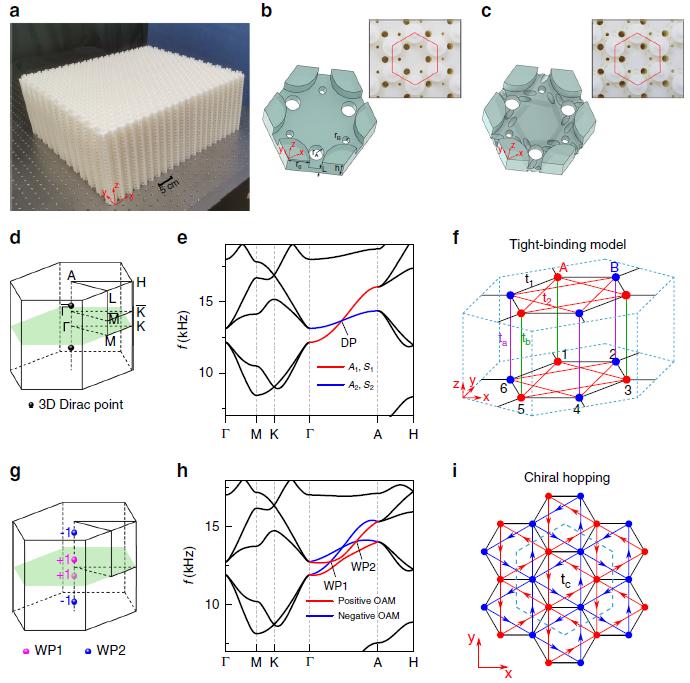
In a new paper published in Light Science & Application, a team of scientists, led by Professor Shuqi Chen from The Key Laboratory of Weak Light Nonlinear Photonics, School of Physics, Nankai University, China, and co-workers have achieved the theoretical and experimental realization of a pair of class I acoustic 3D Dirac points in a hexagonal sonic crystal and demonstrate how the exotic features of the surface states and interface states evolve in the transition towards Weyl points. The transition from two Dirac points to two pairs of Weyl points is realized by introducing chiral hopping into the Dirac sonic crystal. Correspondingly, the surface state dispersion evolves from connecting Dirac points to connecting Weyl points. Pseudospin-polarized helical states, which link the two Dirac points in momentum space, are created through particular interface design using sublattice pseudospin inversion.

The Dirac and Weyl sonic crystals were fabricated by 3D printing based on a layer-stacking strategy. Both the bulk and surface band structures are obtained, showing the topological feature in surface and interface states. The experiment results are consistent with the simulation results. These scientists summarize the principle results:

“We study the 3D Dirac sonic crystal for three purposes: (1) to realize a 3D Dirac point with band inversion in acoustics; (2) to realize the pseudospin-polarized interface states in acoustic semimetals; and (3) to experimentally study how the surface states act in the transition from Dirac points to Weyl points.”

“The helical states from 3D Dirac sonic crystal can be inherited by the Weyl sonic crystal, while more exotic interface states can arise with the chirality inversion.” they added.

“The presented pseudospin-polarized interface states and the chiral interface states correspond to different regions in momentum space and different frequencies, which may further inspire the design of topological devices using both kinds of interface states. We hope our work will inspire the design of weak topological insulators, the realization of acoustic hinge states, and the design of other 3D topological devices.” the scientists forecast.

###

Media Contact
Hua Cheng
[email protected]

Related Journal Article

http://dx.doi.org/10.1038/s41377-020-00416-2

Tags: Chemistry/Physics/Materials SciencesOptics
Share12Tweet8Share2ShareShareShare2

Related Posts

Advancing In Vivo and In Situ Monitoring: Science Bulletin Highlights Host-Based Antifouling Gold Nanotube Sensor for Selective Detection of Mechanically Sensitive Serotonin Release in Intestinal Mucosa — Chemistry

Advancing In Vivo and In Situ Monitoring: Science Bulletin Highlights Host-Based Antifouling Gold Nanotube Sensor for Selective Detection of Mechanically Sensitive Serotonin Release in Intestinal Mucosa

May 20, 2026
How Magnetic Orientation Could Influence the Building Blocks of Life — Chemistry

How Magnetic Orientation Could Influence the Building Blocks of Life

May 20, 2026

Breaking a 200-Year-Old Belief: Novel Surface Design Achieves Two Distinct Wetting States on One Substrate

May 20, 2026

Unveiling Sound Waves: Scientists Discover Hidden Behaviors in Acoustic Phenomena

May 20, 2026
Please login to join discussion

POPULAR NEWS

  • blank

    New Study Reveals Plants Can Detect the Sound of Rain

    733 shares
    Share 292 Tweet 183
  • ESMO 2025: mRNA COVID Vaccines Enhance Efficacy of Cancer Immunotherapy

    301 shares
    Share 120 Tweet 75
  • Research Indicates Potential Connection Between Prenatal Medication Exposure and Elevated Autism Risk

    846 shares
    Share 338 Tweet 212
  • Breastmilk Balances E. coli and Beneficial Bacteria in Infant Gut Microbiomes

    58 shares
    Share 23 Tweet 15

About

We bring you the latest biotechnology news from best research centers and universities around the world. Check our website.

Follow us

Recent News

Experts Warn of a Moral Crisis in Healthcare

Common Food Preservatives Associated with Elevated Blood Pressure and Increased Heart Disease Risk

Study Finds Reusable Catheters a Safe Option That Could Save the NHS Millions

Subscribe to Blog via Email

Enter your email address to subscribe to this blog and receive notifications of new posts by email.

Join 82 other subscribers
  • Contact Us

Bioengineer.org © Copyright 2023 All Rights Reserved.

Welcome Back!

Login to your account below

Forgotten Password?

Retrieve your password

Please enter your username or email address to reset your password.

Log In
No Result
View All Result
  • Homepages
    • Home Page 1
    • Home Page 2
  • News
  • National
  • Business
  • Health
  • Lifestyle
  • Science

Bioengineer.org © Copyright 2023 All Rights Reserved.