Every year, roughly half of the cloud condensation nuclei that seed the planet’s clouds are born not from dust or sea spray, but from a process so small it begins with just a handful of molecules snapping together in the air. This phenomenon, known as atmospheric new particle formation, remains one of the largest sources of uncertainty in climate models, according to the Intergovernmental Panel on Climate Change. Now, a team of computational chemists at Aarhus University in Denmark has taken a significant step toward understanding which organic molecules can genuinely drive this process, and their findings point to a surprisingly specific molecular feature: three carboxylic acid groups arranged on a flexible carbon backbone.
In a study published in the journal Aerosol Research, Astrid Nørskov Pedersen, Yosef Knattrup, and Jonas Elm investigated three oxygenated organic molecules, or OOMs, that have all been detected in real atmospheric measurements: 3-methyl-1,2,3-butanecarboxylic acid (MBTCA), carboxyheptanoic acid (CHA), and pinyl diaterpenylic ester (PDPE). Each of these molecules carries three carboxylic acid moieties, a structural motif that previous work had flagged as a promising candidate for nucleation. MBTCA forms from the oxidation of alpha-pinene, the familiar scent of pine forests, and has been observed in chamber experiments and field campaigns in the Sierra Nevada. PDPE is a large accretion product of alpha-pinene ozonolysis, found both in California and in the boreal forests of Hyytiälä, Finland. CHA was identified as a product of d-limonene photooxidation and detected in field studies in Hungary.
The central question the Aarhus team set out to answer is deceptively simple: can these molecules actually help form the initial molecular clusters from which atmospheric particles grow, or do they merely glom onto particles after those particles already exist? Despite decades of study, the exact structure of an organic molecule capable of driving nucleation has never been definitively identified. The sheer diversity of volatile organic compounds emitted into the atmosphere, combined with the labyrinth of possible oxidation pathways, has made this one of the most stubborn puzzles in atmospheric chemistry.
To tackle the problem, the researchers deployed a formidable computational arsenal. They first generated candidate cluster structures using the ABCluster algorithm with the CHARMM force field, then refined them through semi-empirical GFN1-xTB calculations and the CREST sampling code, which uses molecular dynamics and metadynamics to explore how flexible molecules can twist and fold. The most promising structures were then optimized with density functional theory at the ωB97X-D/6-31++G(d,p) level, and the final single-point energies were computed with the gold-standard DLPNO-CCSD(T0)/aug-cc-pVTZ method. This funnel-type workflow, automated with the JKCS toolchain, allowed the team to hunt down the global free energy minimum for clusters containing up to two organic molecules, two sulfuric acid molecules, and two nitrogen bases, with the bases spanning ammonia, methylamine, dimethylamine, and trimethylamine.
The thermochemical results revealed a clear hierarchy. Among the purely organic dimers, PDPE formed the most stable pair, with a binding Gibbs free energy even stronger than that of the well-studied sulfuric acid–dimethylamine dimer, a benchmark system known to nucleate efficiently. The reason, the authors argue, lies in molecular flexibility. PDPE’s long, supple backbone allows all three of its carboxylic acid groups to engage simultaneously in hydrogen bonds with its partner, fully exploiting its bonding potential. MBTCA and CHA, by contrast, have shorter or more branched backbones that restrict how many acid pairs can connect at once. This finding adds nuance to a recent study by Kähärä and colleagues, who had concluded that rigid molecules generally form more stable clusters; here, only PDPE shows a single internal hydrogen bond in its monomer form, and its flexibility turns out to be an asset rather than a liability.
When sulfuric acid and bases were introduced into the clusters, the picture became even more interesting. Adding these inorganic partners lowered the binding free energies by roughly 10 to 25 kilocalories per mole across all three organics. Dimethylamine emerged as the strongest-binding base for nearly all cluster sizes and compositions, consistent with its well-documented prowess in stabilizing sulfuric acid clusters. In the larger mixed clusters, PDPE displayed a remarkable structural strategy: two PDPE molecules wrapped around a core of sulfuric acid and dimethylamine, enclosing the inorganic species in a shell-like arrangement. These clusters approached or exceeded one nanometer in diameter, right at the lower limit of what experimental instruments can detect, making them tantalizing targets for laboratory verification.
Thermodynamics alone, however, does not guarantee that particles will actually form in the turbulent, dilute environment of the real atmosphere. To bridge that gap, the team fed their calculated binding free energies into the Atmospheric Cluster Dynamics Code, or ACDC, which solves the birth–death equations governing how clusters collide, grow, and evaporate. The simulations, run at 278.15 kelvin to mimic springtime boreal forest conditions, used a sulfuric acid concentration of one million molecules per cubic centimeter and varied the base concentrations across realistic lower and upper limits. The organic molecule concentrations ranged from zero to ten parts per trillion, the latter representing a deliberately generous upper bound.
The dynamic simulations delivered the study’s headline result: all three tricarboxylic acids enhanced cluster formation by two to three orders of magnitude in most systems containing one organic molecule, one sulfuric acid, and one base. The largest absolute formation potentials appeared in the sulfuric acid–dimethylamine–organic systems, where the enhancement was strikingly similar across all three organics, rising by two orders of magnitude as the organic concentration increased. The authors interpret this insensitivity to the specific molecule as evidence that the functional groups, rather than the identity of the whole molecule, are what matter most for cluster formation and growth. If that holds up, it could allow atmospheric modelers to lump diverse organic compounds into functional-group categories, dramatically simplifying how organic nucleation is represented in global climate simulations. Flux analysis reinforced the point: for systems with ammonia, methylamine, or dimethylamine, the organic molecule appeared in more than 90 percent of the clusters that grew past the simulation boundary.
The study is candid about its limitations. Because simulating growth all the way to climate-relevant particle sizes is computationally prohibitive, the team counted clusters as outgrowing at a modest size, which means the reported formation potentials should be read as upper limits on true nucleation rates. Sensitivity tests with different cluster boundaries confirmed that the enhancement factors were not artifacts of that choice, though the magnitudes may be somewhat overestimated. The authors also note that extending the calculations to clusters with three or four organic molecules could reveal whether organics can nucleate entirely on their own, without any inorganic help, and that mixed systems of different organic molecules might unlock additional geometric flexibility and expose further carboxyl groups for growth.
What makes this work resonate beyond the computational chemistry community is its implications for how we understand the climate system. Aerosols cool the planet both directly, by scattering sunlight, and indirectly, by brightening clouds, and roughly half of the cloud condensation nuclei in the global atmosphere trace their origin to new particle formation. In rural and forested regions, where organic vapors dominate over sulfuric acid, the tricarboxylic acids studied here may be quietly tipping the balance of when and where new particles are born. By pinpointing molecular flexibility and the tricarboxylic acid motif as key ingredients, the Aarhus team has given field researchers a concrete chemical signature to hunt for, and given climate modelers a principled basis for representing one of the atmosphere’s most elusive processes. The next chapter will belong to the experimentalists, who must now try to catch these nanometer-scale clusters in the act of forming, in laboratories and in the forests where the molecules themselves are made.
Subject of Research: Computational study of how tricarboxylic acids from biogenic volatile organic compound oxidation enhance atmospheric new particle formation with sulfuric acid and nitrogen bases
Article Title: Atmospheric new particle formation enhanced by tricarboxylic acids
Article References: Pedersen, A. N., Knattrup, Y., & Elm, J. (2026). Atmospheric new particle formation enhanced by tricarboxylic acids. Aerosol Research, 4(2), 397-411. https://doi.org/10.5194/ar-4-397-2026
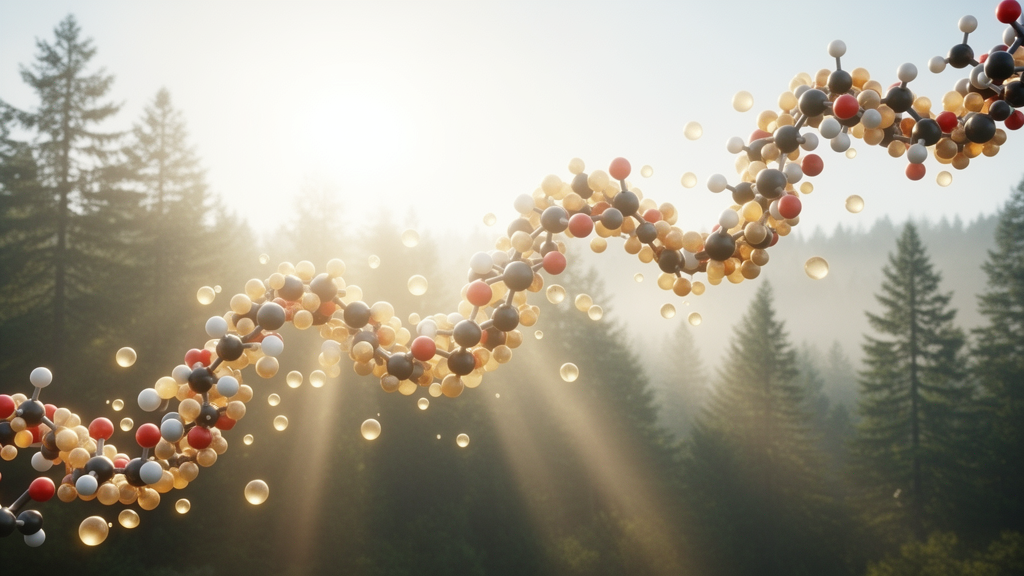
Image Credits: AI Generated
Keywords: new particle formation, aerosols, tricarboxylic acids, sulfuric acid, dimethylamine, quantum chemistry, secondary organic aerosol, alpha-pinene oxidation, cluster dynamics, climate, molecular flexibility, atmospheric chemistry
News Source: Russell Cooper. (October 9, 2026). Flexible forest molecules turbocharge the birth of atmospheric particles. Scienmag.