Kyoto, Japan — How could a human mother tell that her child is upset? Humans can distinguish the meanings of facial expressions of our fellow species either explicitly through speech or implicitly by context.
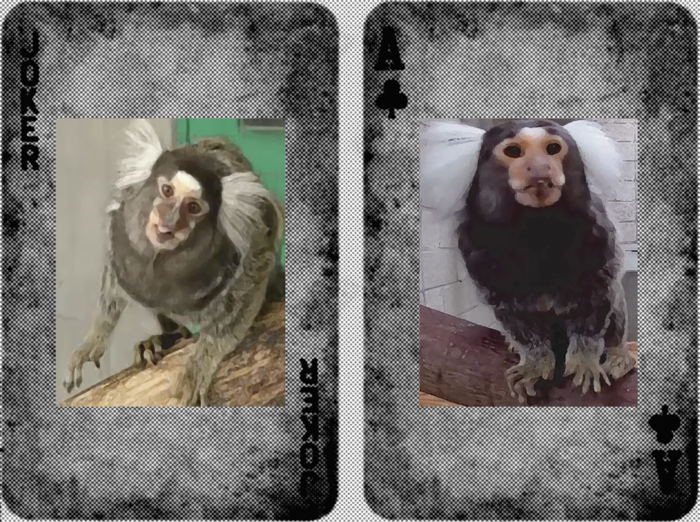
Credit: KyotoU/Catia Correia-Caeiro
Kyoto, Japan — How could a human mother tell that her child is upset? Humans can distinguish the meanings of facial expressions of our fellow species either explicitly through speech or implicitly by context.
When decoding animal expressions, however, we face the challenge of interpreting familiar characteristics in proper context. For example, when we see teeth-exposing smiles among other human beings, the correct emotion with which it is usually associated is joy, whereas for other primates it is quite possibly an expression of fear or submission.
A research team at Kyoto University has repurposed the human facial action coding system, or FACS, as a tool for cross-species systematic comparisons of facial muscles to help interpret the resulting expressions. Facial muscle contractions move portions of the skin, producing a set of visible appearance changes in the face.
In turn, these changes act as cues for specific movements which FACS helps to identify. FACS analyzes and classifies the visible movements made by facial muscles into so-called action units, or AU.
“Marmosets demonstrate socio-ecological characteristics and primitive facial musculature that would suggest facial mobility lower than other primates. But surprisingly, when we developed an adapted version of FACS, there was actually little difference,” says lead author Catia Correia-Caeiro.
The tool CalliFACS, named after the common marmosets, Callithrix jacchus, detected 33 facial movements, of which fifteen were AUs. This means that facial mobility in marmosets is lower than that in humans but similar to other primates studied, namely chimpanzees, orangutans, rhesus macaques, and gibbons.
It has come as a surprise that the common marmoset possesses an unexpectedly high number of facial movements. To the team, it suggests that facial expressions are more ancient and prevalent among social animals than previously thought.
CalliFACS has clearly shown us just how complex animal communication might be,” surmises the author.
According to Correia-Caeiro, the development of a FACS for the common marmoset as the first new world primate is significant. “This has furthered the expansion of research on the evolution of human communication and emotion by comparing us to a more distantly related primate in facial expression studies,” the author concludes.
###
The paper “CalliFACS: The Common Marmoset Facial Action Coding System” appeared 19 April 2022 in PLOS One, with doi: 10.1371/journal.pone.0266442
About Kyoto University
Kyoto University is one of Japan and Asia’s premier research institutions, founded in 1897 and responsible for producing numerous Nobel laureates and winners of other prestigious international prizes. A broad curriculum across the arts and sciences at both undergraduate and graduate levels is complemented by numerous research centers, as well as facilities and offices around Japan and the world. For more information please see: http://www.kyoto-u.ac.jp/en
Journal
PLoS ONE
DOI
10.1371/journal.pone.0266442
Method of Research
Observational study
Subject of Research
Animals
Article Title
CalliFACS: The common marmoset Facial Action Coding System
Article Publication Date
17-May-2022
COI Statement
The authors have declared that no conflicts of interest exist.