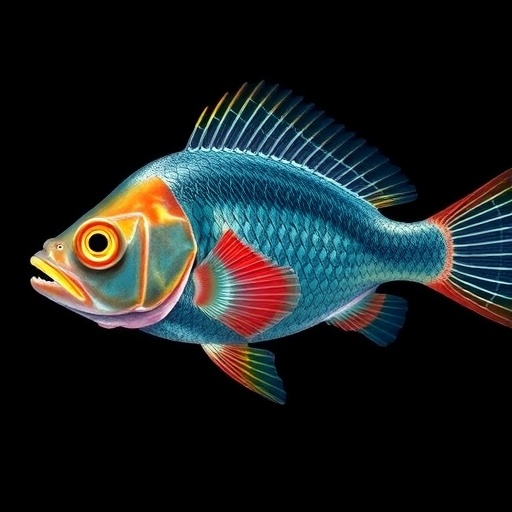
In a groundbreaking study set to redefine our understanding of vertebrate brain evolution, researchers have unveiled astonishing diversity in the brains of ray-finned fishes, a group encompassing the vast majority of the world’s fish species. This new research leverages advanced CT scanning technology to reveal the dramatic variety in brain size, shape, and complexity across these aquatic animals, which number approximately 35,000 species and inhabit environments as varied as deep ocean trenches, alpine mountain streams, and deserts. Despite their ecological significance and evolutionary success, the intricate details of fish neuroanatomy have remained largely unexplored—until now.
Rodrigo Figueroa, a postdoctoral researcher at Harvard University’s Department of Organismic and Evolutionary Biology, spearheaded this extensive investigation. Motivated by his doctoral work on fossilized ray-finned fish brains, Figueroa identified a glaring gap in neuroscientific research: the paucity of data on living fish brains outside a handful of model species, such as the zebrafish. This gap presented a critical obstacle to deciphering the evolutionary pathways of brain morphology in vertebrates. To address this, Figueroa initiated a large-scale project employing specialized CT scanning to meticulously document the internal cranial structures of 87 ray-finned fish species spanning more than 70 families.
The study’s revelations challenge long-standing assumptions about the relationship between brains and their enclosing skull cavities. Traditionally, it has been presumed, especially among mammals and reptiles, that the brain snugly occupies the internal skull space. Contrarily, the scan data divulged a startling decoupling of brain volume from cranial size in ray-finned fishes. A key metric, the Brain Endocast Coefficient—calculated as the ratio of brain volume to intracranial volume—exhibited extraordinary variability. Most mammals and reptiles display ratios approaching or exceeding 80%, but ray-finned fishes’ ratios typically lie around 40–50%, with some species having brains that occupy less than 5% of their skull cavities.
This deviation suggests that many fish possess large cranial spaces filled with cerebrospinal fluid, blood vessels, or even specialized tissues responsible for immune function and blood production. The presence of such tissues fundamentally alters our interpretation of endocasts—internal molds of skull cavities often used to infer brain morphology, particularly in paleontological contexts. Stephanie Pierce, a senior co-author and curator of vertebrate paleontology at Harvard’s Museum of Comparative Zoology, emphasized that for decades, the scientific community used endocast shapes as proxies for brain structure. However, the data from ray-finned fishes show this assumption can be misleading, underscoring the uncoupled evolutionary trajectories of brains and skulls in these species.
Environmental factors also play a critical role in shaping the brain-to-skull volume ratio observed across species. Statistical analyses within the study link this ratio to the depth at which fish live. Deep-sea species, whether dwelling in the dark ocean floor or the less explored water column, tend to exhibit smaller brains relative to their skull size compared to their shallow-water counterparts. This suggests that the evolutionary pressures of extreme environments, such as the high pressure and low light of the deep sea, could favor anatomical adaptations favoring protection and physiological regulation over brain size.
The protective function of the increased cranial space surrounding tiny brains may act like a biological shock absorber—meningeal tissues enveloping the brain provide a buffer against mechanical impacts or drastic pressure fluctuations. This biological configuration could represent an unrecognized evolutionary strategy for vertebrates living under challenging physical conditions, balancing the demands of neural function with physiological resilience.
Furthermore, the research unveiled intriguing ontogenetic patterns—how brain size relative to skull volume changes throughout an individual’s growth. For example, the bowfin fish exhibits nearly complete skull occupancy by the brain at hatchling stage, which declines sharply to roughly 20–30% in adults. Such drastic changes contrast starkly with more moderate developmental brain-to-skull ratios seen in birds and mammals. In the ancient coelacanth fish, the brain fills almost the entire cranial cavity during youth but shrinks dramatically to a mere 4% of intracranial space in mature individuals, illuminating evolutionary adaptations spanning hundreds of millions of years.
The implications of this study transcend ichthyology, offering a cautionary lens through which to evaluate neuroanatomical inferences based on fossils and extant vertebrates alike. Understanding that endocasts may fail as faithful representations of fish brain morphology necessitates a reevaluation of many historic fossil interpretations, a recalibration that could significantly alter evolutionary narratives involving vertebrate brain development.
Beyond challenging assumptions, the research suggests an astonishing array of neurological strategies underpinning the remarkable diversity and ecological dominance of ray-finned fishes. Since so much neuroscience focuses on a handful of species, this broader perspective urges the scientific community to reconsider the evolutionary flexibility of brain architectures. Do diverse brain morphologies drive ecological success, or do the demands and opportunities of varied environments sculpt brain evolution in these species? This vital question remains open, with this study paving the way for future work seeking to unravel these cause-and-effect relationships.
By harnessing museum collections and cutting-edge imaging, this research represents an important milestone, offering an unprecedented morphological map of fish neurodiversity. The findings clearly underscore that the highly conserved brain-to-skull relationships commonly observed in mammals and birds are the exceptions in the vertebrate lineage, not the standard. Understanding this diversity enriches our knowledge of brain evolution’s vast landscape, expanding concepts of what “normal” brain function and structure may entail.
Figueroa’s ambitious five-year initiative is only the first phase in what promises to be an immense and ongoing endeavor. Scanning 87 species out of tens of thousands is a monumental task, but the insights gained provide a compelling foundation for continued exploration. The study’s comprehensive approach, combining evolutionary biology, neuroscience, and paleontology, exemplifies interdisciplinary scholarship at its finest and opens avenues for understanding vertebrate adaptability and resilience on both micro and macro evolutionary scales.
In summary, this novel research unravels the complex and unconventional relationships between fish brain morphology and cranial anatomy, illuminating how environmental pressures, evolutionary history, and developmental trajectories interplay intricately. It challenges existing paradigms in vertebrate brain study and invites a broader reexamination of how brains evolve within protective structures. This deeper understanding of the ray-finned fishes’ neurological diversity not only reshapes ichthyological knowledge but provides a broader template for comparative neurobiology, with potential ripple effects spanning evolutionary theory, paleobiology, and even biomedical sciences.
Subject of Research: Not applicable
Article Title: The ray-finned fish blackbox: unprecedented morphological diversity and the interplay between brain and endocast.
News Publication Date: 6-May-2026
Web References: http://dx.doi.org/10.1098/rspb.2025.3277
Image Credits: Rodrigo Figueroa (PRSB 2026)
Keywords: ray-finned fishes, brain evolution, neuroanatomy, CT scanning, brain endocast coefficient, vertebrate neuroscience, evolutionary biology, cranial morphology, deep-sea fish, ontogeny, cerebrospinal fluid, comparative neuroanatomy
Tags: advanced imaging technology in biologybiodiversity of ray-finned fishesbrain morphology in aquatic animalscomparative neuroanatomy of fishescranial structures of fish speciesCT scanning in fish brainsecological adaptation of fish brainsevolutionary pathways of vertebrate brainsfish neuroanatomy researchlarge-scale fish brain studyray-finned fish brain diversityvertebrate brain evolution