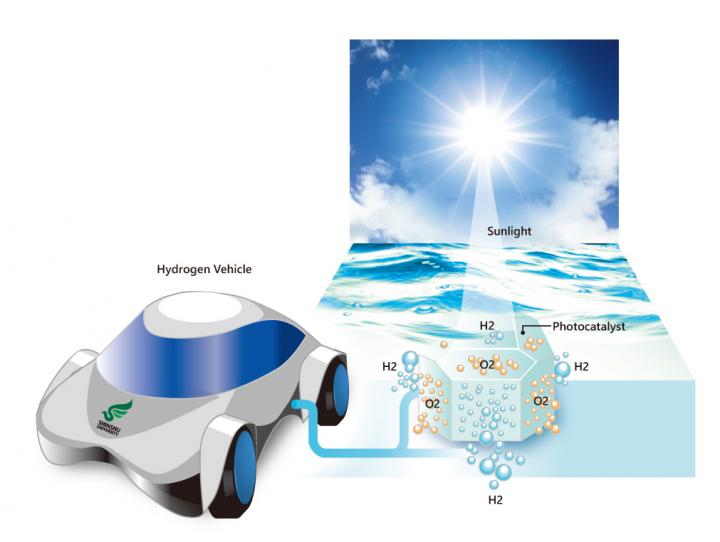
Credit: Copyright © 2020 The Office of Public Relations, Shinshu University
Pour yourself a glass of water and take a look at it. This water contains an abundant source of fuel, hydrogen. Hydrogen burns clean unlike petrol-based energy products. Sound too good to be true? Scientists in Japan successfully split water into hydrogen and oxygen using light and meticulously designed catalysts, and they did so at the maximum efficiency meaning there was almost no loss and undesired side reactions. This latest breakthrough in solar hydrogen production makes the likelihood of scalable, economically viable hydrogen production more than likely, paving the way for humanity to make the switch to clean energy.
Water splitting using catalysts and sunlight, called photocatalysis has been a promising method of achieving solar hydrogen production for decades. However, most previous attempts only yielded an external quantum efficiency of less than about 50% representing the difficulty in efficient catalyst design for real world use. The catalyst needed to be designed better so every absorbed photon from the light source is used to make hydrogen. The key to improving efficiency was strategic placement of the co-catalysts and preventing defects in the semiconductor.
Published in the May 27th issue of Nature, Tsuyoshi Takata of Shinshu University et al. broke through new frontiers in power production by using aluminum-doped strontium titanate as a photocatalyst, whose properties have been extensively studied and therefore the best understood. They choose co-catalysts rhodium for hydrogen with chromium oxide, and cobalt-oxide for oxygen, by fine-tuning them to engage in only desired reactions. This method made possible for the reaction to have no recombination losses.
These new findings open the doors to achieve scalable and economically viable solar hydrogen production. Their design strategies succeeded in reducing defects that lead to near perfect efficiency, and knowledge obtained will be applied to other materials with intense visible light absorption. More work is still needed before we can run our cars on hydrogen, because this study focused on the use of ultraviolet light and abundant visible light from the sun remained unused. However, this great breakthrough has made that possibility no longer too good to be true, but in theory, just a matter of time. Hopefully it will encourage scientists, researchers and engineers to engage in this field, bringing the use of solar hydrogen power that much closer.
###
More information can be found on Photocatalytic water splitting with a quantum efficiency of almost unity on Nature Volume 581, May 28 2020.
This study was a part of the NEDO project, supported by JSPS KAKENHI.
Acknowledgements: This work was primarily supported by the Artificial Photosynthesis Project of the New Energy and Industrial Technology Development Organization (NEDO) and partly supported by JSPS KAKENHI grant number JP19K05669, JP16K06862. A part of this work was conducted at the Advanced Characterization Nanotechnology Platform of the University of Tokyo, supported by “Nanotechnology Platform” of the Ministry of Education, Culture, Sports, Science and Technology (MEXT), Japan (grant number JPMXP09A-19-UT-0023). We are grateful to M. Yamaguchi and Y. Kuromiya at the University of Tokyo for the preparation and evaluation of photocatalysts.
Author contributions: T.T. conceived the photocatalyst design and performed the photocatalytic reactions. T.H. synthesized Al-doped SrTiO3. J.J. and Y.S. performed quantum efficiency measurements. M.N. and N.S. performed electron microscopy measurements. V.N. and K.S. performed electrical simulations. K.D. supervised the project. T.T., T.H. and K.D. wrote the manuscript with input from all authors.
Media Contact
Hitomi Thompson
[email protected]
Related Journal Article
http://dx.