• HOME
  • NEWS
  • EXPLORE
    • CAREER
      • Companies
      • Jobs
    • EVENTS
    • iGEM
      • News
      • Team
    • PHOTOS
    • VIDEO
    • WIKI
  • BLOG
  • COMMUNITY
    • FACEBOOK
    • INSTAGRAM
    • TWITTER
Thursday, June 25, 2026
BIOENGINEER.ORG
No Result
View All Result
  • Login
  • HOME
  • NEWS
  • EXPLORE
    • CAREER
      • Companies
      • Jobs
        • Lecturer
        • PhD Studentship
        • Postdoc
        • Research Assistant
    • EVENTS
    • iGEM
      • News
      • Team
    • PHOTOS
    • VIDEO
    • WIKI
  • BLOG
  • COMMUNITY
    • FACEBOOK
    • INSTAGRAM
    • TWITTER
  • HOME
  • NEWS
  • EXPLORE
    • CAREER
      • Companies
      • Jobs
        • Lecturer
        • PhD Studentship
        • Postdoc
        • Research Assistant
    • EVENTS
    • iGEM
      • News
      • Team
    • PHOTOS
    • VIDEO
    • WIKI
  • BLOG
  • COMMUNITY
    • FACEBOOK
    • INSTAGRAM
    • TWITTER
No Result
View All Result
Bioengineer.org
No Result
View All Result
Home NEWS Science News

Solar cell design with over 50 percent energy-conversion efficiency

Bioengineer by Bioengineer
April 24, 2017
in Science News
Reading Time: 2 mins read
0
Share on FacebookShare on TwitterShare on LinkedinShare on RedditShare on Telegram
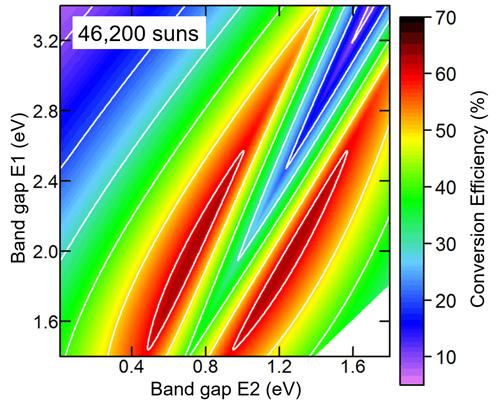
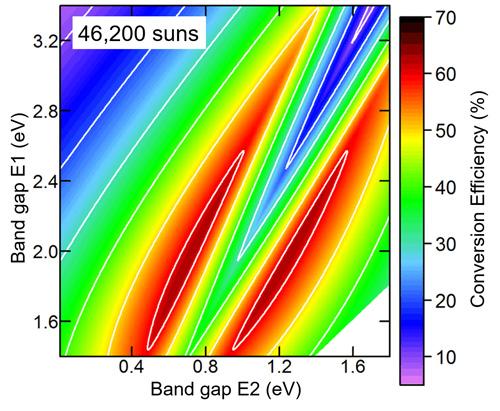
IMAGE

Credit: Kobe University

Solar cells convert the sun's energy into electricity by converting photons into electrons. A new solar cell design could raise the energy conversion efficiency to over 50% by absorbing the spectral components of longer wavelengths that are usually lost during transmission through the cell.

These findings were published on April 6 in the online edition of Nature Communications.

This research was carried out by a team led by Professor KITA Takashi and Project Assistant Professor ASAHI Shigeo at the Kobe University Graduate School of Engineering.

In theory, 30% energy-conversion efficiency is the upper limit for traditional single-junction solar cells, as most of the solar energy that strikes the cell passes through without being absorbed, or becomes heat energy instead. Experiments have been taking place around the world to create various solar cell designs that can lift these limitations on conversion efficiency and reduce the loss of energy. The current world record is at 46% percent for a 4-junction solar cell. If the energy-conversion efficiency of solar cells surpasses 50%, it would have a big impact on the cost of producing electricity.

In order to reduce these large energy losses and raise efficiency, Professor Kita's research team used two small photons from the energy transmitted through a single-junction solar cell containing a hetero-interface formed from semiconductors with different bandgaps. Using the photons, they developed a new solar cell structure for generating photocurrents. As well as demonstrating theoretical results of up to 63% conversion efficiency, it experimentally achieved up-conversion based on two photons, a mechanism unique to this solar cell. The reduction in energy loss demonstrated by this experiment is over 100 times more effective compared to previous methods that used intermediate bands.

The team will continue to design solar cells, and assess their performance based on conversion efficiency, working towards a highly efficient solar cell for low-cost energy production.

###

Media Contact

Eleanor Wyllie
[email protected]
@KobeU_Global

http://www.kobe-u.ac.jp/en/

############

Story Source: Materials provided by Scienmag

Share12Tweet8Share2ShareShareShare2

Related Posts

Tracking Lanthanide-Labeled Microplastics in Plants

June 25, 2026

POSTECH Researchers Slash Cost of Reconstituted Cell-Free Systems by 95%

June 25, 2026

AI and Physics Collaborate to Design Advanced Hydrogen Storage Materials

June 25, 2026

Natural Hallucinogens: Evolution’s Ecological Tools, Not Mere Chemical Byproducts

June 25, 2026
Please login to join discussion

POPULAR NEWS

  • Saying Goodbye to PGY-6: Pediatric Fellowship Realities

    103 shares
    Share 41 Tweet 26
  • Multi-Hospital Study Reveals Long Covid Burden Is Twice as High as Current Estimates

    92 shares
    Share 36 Tweet 23
  • Detection of EDCs in Breast Milk and Infant Urine Up to Six Months Highlights Early Exposure Risks

    77 shares
    Share 31 Tweet 19
  • New Drug Candidate Developed at McMaster Shows Potential for Treating Brain Cancer

    58 shares
    Share 23 Tweet 15

About

We bring you the latest biotechnology news from best research centers and universities around the world. Check our website.

Follow us

Recent News

Tracking Lanthanide-Labeled Microplastics in Plants

POSTECH Researchers Slash Cost of Reconstituted Cell-Free Systems by 95%

AI and Physics Collaborate to Design Advanced Hydrogen Storage Materials

Subscribe to Blog via Email

Success! An email was just sent to confirm your subscription. Please find the email now and click 'Confirm' to start subscribing.

Join 82 other subscribers
  • Contact Us

Bioengineer.org © Copyright 2023 All Rights Reserved.

Welcome Back!

Login to your account below

Forgotten Password?

Retrieve your password

Please enter your username or email address to reset your password.

Log In
No Result
View All Result
  • Homepages
    • Home Page 1
    • Home Page 2
  • News
  • National
  • Business
  • Health
  • Lifestyle
  • Science

Bioengineer.org © Copyright 2023 All Rights Reserved.