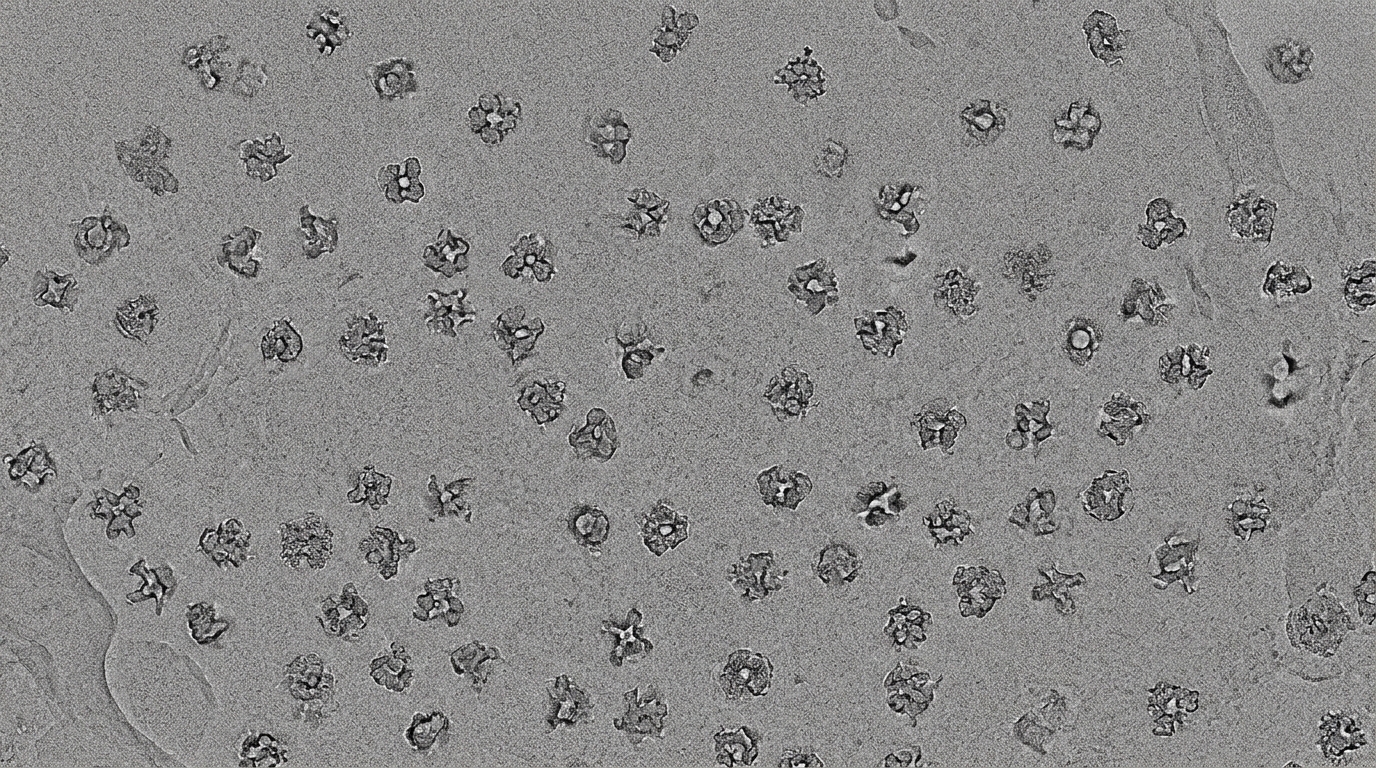
Single-particle cryo-electron microscopy faces a stubborn problem: it must build three-dimensional pictures of macromolecules from thousands of two-dimensional projection images whose orientations are unknown. A study published in BMC Bioinformatics introduces Soft-Voting, a framework designed to make one of the field’s core orientation-estimation strategies more reliable when images are dominated by noise. The work addresses common line-based angular reconstruction, which infers projection orientations from pairwise common lines, and targets the low signal-to-noise ratios typical of cryo-EM experiments.
Common lines are the shared directions that appear when two projection images of the same structure are compared. In principle, detecting these lines between pairs of projections reveals how each image is oriented relative to the others, allowing a 3D structure to be assembled. In practice, the authors note, reliable common line detection remains challenging at the low signal-to-noise ratios typical of cryo-EM experiments, where genuine geometric signals can be buried beneath measurement noise.
The paper identifies a specific weakness in existing voting-based approaches. These methods either assign equal weight to all votes or apply hard binary thresholds, thereby discarding valuable confidence information and limiting orientation estimation accuracy. In other words, a marginal common line candidate and a highly trustworthy one can contribute identically to the final orientation decision, or a threshold can exclude uncertain evidence altogether, wasting information that might have helped under difficult imaging conditions.
Soft-Voting replaces binary vote weighting with continuous confidence weighting. For each projection pair, the method constructs a consensus histogram of candidate dihedral angles using information from all remaining projections, with each vote weighted according to the reliability of its supporting common lines. Rather than forcing a yes-or-no judgment on every candidate, the framework lets the strength of the evidence determine how much each observation counts, so that consistent, high-confidence common lines accumulate weight while weak ones contribute little.
The resulting common-line reliability scores are then used to construct pairwise weights for spherical embedding, a step that enables globally consistent orientation recovery. By encoding how much trust each pairwise orientation estimate deserves, the embedding stage can integrate many pairwise relationships into a global assignment of projection directions, reducing the risk that a few noisy estimates distort the entire reconstruction.
The authors evaluated the approach on a synthetic dataset, EMD-33026, with signal-to-noise ratios ranging from 1 down to 1/16. Across this range, Soft-Voting generally achieved lower orientation errors than existing common line-based methods, with the advantage especially pronounced under low-SNR conditions. This pattern fits the design intent: when noise is severe, discarding confidence information hurts most, and continuous weighting has the most room to help.
Real-data tests followed on three cryo-EM datasets: EMPIAR-10028, EMPIAR-10328, and EMPIAR-10455. On these, Soft-Voting produced competitive ab initio reconstructions, judged by Fourier shell correlation against reference maps. Ab initio reconstruction means building a 3D map from the projection data alone, without an initial model, which is precisely the setting where orientation estimation errors propagate most strongly into the final structure.
The conclusions drawn are measured. The results indicate that Soft-Voting can improve common-line assessment and the robustness of cryo-EM angular reconstruction, particularly under challenging low-SNR conditions. The evidence combines controlled synthetic benchmarks, where orientation errors can be measured directly against known ground truth, with real datasets assessed through reconstruction quality metrics, giving complementary views of the method’s performance.
For structural biology, the significance lies in what orientation accuracy enables. Better common line assessment feeds into more dependable initial models, which in turn support downstream refinement and map interpretation. By showing that continuous confidence weighting outperforms equal-weight and hard-threshold voting schemes on both synthetic and real data, the study offers a practical refinement to a long-standing family of orientation estimation methods, one that extracts more value from the same noisy projection images that cryo-EM experiments already collect.
Subject of Research: A confidence-weighted common line assessment method for cryo-EM angular reconstruction
Article Title: Soft-voting for robust common line assessment in cryo-EM angular reconstruction
Article References: Wang, X., Xu, Y., Zheng, H., Lin, X., & Lu, Y. (2026). Soft-voting for robust common line assessment in cryo-EM angular reconstruction. BMC Bioinformatics. https://doi.org/10.1186/s12859-026-06721-8
Image Credits: AI Generated
DOI: 10.1186/s12859-026-06721-8
Keywords: cryo-EM, common line, angular reconstruction, soft voting, orientation estimation, low SNR, ab initio reconstruction, spherical embedding, single-particle analysis, structural biology, Soft-voting, robust
News Source: Gregory Coleman. (November 7, 2026). Soft voting sharpens cryo-EM orientation recovery at low signal. Scienmag.