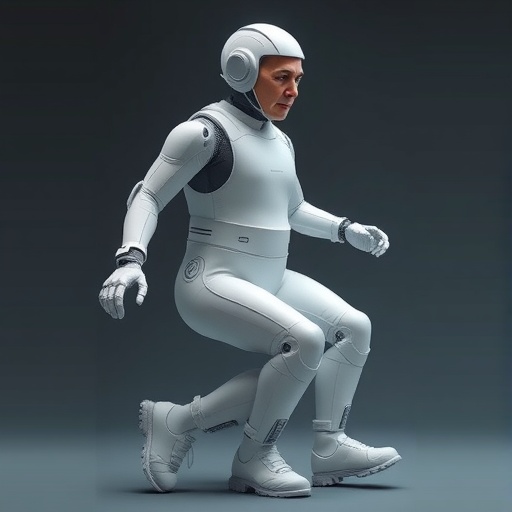
Older adults often lose mobility not only because of slower walking, but because everyday movements like standing up become disproportionately difficult. In a new study published in Nature Communications, researchers report that a wearable “soft robotic suit” can make sit-to-stand transitions smoother and improve subsequent walking efficiency—two linked abilities that strongly influence independence.
The team focused on the moment when a person shifts from sitting to upright posture, a task that requires precise coordination of joints, balance control, and timely muscle activation. Small delays or inefficiencies during this phase can force compensatory strategies, increasing fatigue and reducing stability during the first steps of walking.
Unlike rigid exoskeletons, the soft robotic suit uses compliant materials designed to interact comfortably with the body. By delivering targeted assistance through soft, wearable actuation, the system aims to support lower-limb mechanics during the transition—effectively reducing the biomechanical “cost” of standing up.
To evaluate performance, participants’ movement timing and gait-related measures were tracked before and after using the suit. The analysis emphasized not just whether people could stand and walk, but how efficiently they did it, including the quality of the transition and the stability of early walking patterns.
The researchers found that the suit enhanced sit-to-stand transitions in older adults, indicating improved coordination and reduced disruption in movement flow. Importantly, these gains carried over into walking: participants showed better walking efficiency, suggesting that optimizing the hardest part of the sequence can improve what comes next.
This is a notable result because early gait after rising is often where balance control is most vulnerable. A more efficient transition likely helps preserve posture and alignment at the start of locomotion, lowering the likelihood of corrective steps.
The study also underscores a broader design principle for mobility aids: assisting a single critical subtask can propagate benefits through the whole behavioral chain. Rather than targeting walking alone, the suit’s assistance at stand-up may set up the nervous system and musculoskeletal system for a more stable, economical gait.
With an emphasis on comfort and practical usability, soft robotic wearables could become an adaptable tool for rehabilitation and daily support. If further testing confirms long-term benefits and real-world durability, such systems may help older adults stay mobile without relying on heavier, more restrictive hardware.
Subject of Research: Mobility enhancement in older adults using a soft robotic suit
Article Title: Enhancing sit-to-stand transitions and walking efficiency in older adults with a soft robotic suit
Article References: Zhang, X., Tricomi, E., Stefanakis, M. et al. Enhancing sit-to-stand transitions and walking efficiency in older adults with a soft robotic suit. Nat Commun 17, 6540 (2026). https://doi.org/10.1038/s41467-026-75528-1
DOI: https://doi.org/10.1038/s41467-026-75528-1
Image Credits: AI Generated
Tags: balance control and stability in aging populationsbiomechanical assistance with compliant materialsbiomechanics of sit-to-stand transition in older adultsenhancing independence through robotic mobility aidsimproving gait smoothness and stabilitymuscle activation during sit-to-stand with soft assistive devicesreducing muscular effort in elderly gaitsoft exosuit to improve walking efficiencysoft robotic suit for elderly mobilitytargeted lower-limb support for older adultswearable assistive technology for sit-to-standwearable robotics for fall prevention