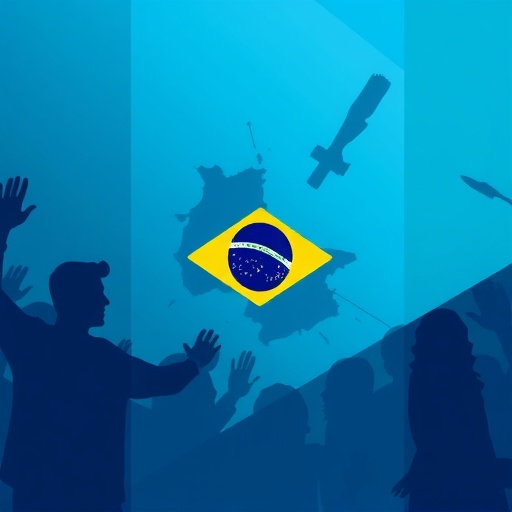
In recent years, the global political landscape has witnessed unprecedented levels of polarization, with societies increasingly divided along ideological lines. The 2022 Brazilian elections, a defining moment in Latin America’s political history, offer a vivid case study of how sociopolitical polarization can both shape and be shaped by the flow of information—and misinformation. A groundbreaking study published in Nature Communications dissects the intricate dynamics of polarization in Brazil’s electoral context, revealing how perception and misperception interact to influence public opinion and political behavior.
The investigation, led by Petherick, Ramos, and Furst, deploys sophisticated computational models to simulate the evolution of sociopolitical polarization and measure the impact of interventions that seek to correct misperceptions. Brazil’s 2022 elections, marked by intense ideological clashes and a highly fragmented media environment, provide fertile ground for exploring how strategic communication and misinformation affect the electorate’s collective mindset.
Central to the study is the application of agent-based modeling, a technique that represents individuals as autonomous “agents” who exchange information, adapt beliefs, and influence one another within social networks. This approach allows the researchers to capture micro-level interactions that aggregate into macro-level phenomena, such as widespread polarization. By modeling the Brazilian electoral society as a network of interacting agents, the study shines light on the nonlinear processes that drive opinion polarization, including echo chamber effects, confirmation bias, and the feedback loops that amplify division.
One of the most striking findings concerns the persistence and resilience of polarized opinion clusters even in the face of corrective information. The research demonstrates that interventions aimed at debunking false beliefs or presenting factual information often fall short, and in some cases, inadvertently reinforce existing divisions. This counterintuitive phenomenon, sometimes dubbed the “backfire effect,” arises when individuals confront information that conflicts with deeply held worldviews, leading them to double down rather than reconsider their stance.
Moreover, the study highlights the role of perception gaps and misperceptions—situations where individuals systematically overestimate or underestimate the prevalence of opposing views within society. Such misperceptions fuel mistrust and heighten animosities, creating fertile ground for social fragmentation. The modeling results suggest that closing perception gaps can theoretically reduce polarization, but doing so requires carefully tailored strategies that acknowledge the complex psychological underpinnings of belief formation.
Intriguingly, the authors explore the potential of “misperception-correcting information,” which seeks not only to convey accurate facts but to recalibrate individuals’ estimation of others’ views. By simulating hypothetical campaigns that provide feedback on the actual distribution of opinions, the study uncovers nuanced dynamics. In well-connected and heterogeneous networks, these campaigns can attenuate polarization, whereas in fragmented or highly homophilous networks, the effects are less pronounced and may exacerbate discord.
The Brazilian context, with its rich diversity and vibrant but polarized media landscape, exemplifies the challenges facing democracies in the age of social media. The proliferation of disinformation, combined with algorithm-driven echo chambers, intensifies the polarization spiral. The study’s results underscore the importance of understanding not just factual accuracy but the social perception dynamics that mediate political attitudes and behaviors.
Policy implications stem naturally from these findings. The authors caution against simplistic applications of fact-checking or debunking initiatives without accounting for the broader social cognitive landscape. Instead, they advocate for multifaceted against misperception, enhancing cross-group interaction, and fostering media literacy to empower citizens to critically assess information sources.
Technically, the study leverages a large dataset reflecting opinion distributions, network structures, and behavioral parameters calibrated against empirical surveys conducted during and after the 2022 elections in Brazil. This grounding in real-world data lends robustness to the simulations, enabling confident extrapolation to potential future scenarios.
Further methodological innovation includes integrating psychological theories of motivated reasoning and social identity to better capture why individuals resist correcting misinformation. Incorporating these theories into computational frameworks represents a frontier in computational social science, bridging quantitative modeling and qualitative insights.
This interdisciplinary synthesis opens venues for future research wherein politically salient events are analyzed not solely as discrete occurrences but as temporal processes embedded within feedback loops of social influence and information dynamics. The findings invite scholars and practitioners alike to rethink approaches to mitigating polarization, moving beyond information provision toward reshaping the social environments in which beliefs are formed.
Moreover, the study sets a precedent for comparative analyses across different political contexts, suggesting that while the Brazilian case is distinctive, the underlying mechanisms may apply more broadly. Comparative modeling could reveal conditions under which misperception-correcting interventions might succeed or fail, guiding localized strategies.
In essence, this work reframes polarization as a dynamic, emergent property of interacting individual beliefs and social perceptions, sensitive to the architecture of information networks and cognitive biases. As democratic societies wrestle with deep divisions, understanding this interplay is crucial to designing resilient political systems and informed citizenries.
Given the accelerating dissemination of information via social media platforms, the urgency of such understanding cannot be overstated. The Brazilian 2022 elections, dissected here with unprecedented computational rigor, serve as a timely warning and an analytical blueprint for navigating the fraught terrain of modern electoral politics.
The research ultimately reveals that combatting sociopolitical polarization requires nuanced interventions attuned to human psychology and network dynamics rather than simplistic fact-checking models. It highlights the necessity of fostering empathy, cross-partisan dialogue, and structural inclusivity to bridge divides.
By providing a detailed map of how misperceptions warp social consensus and how corrective information flows affect public opinion, this study arms policymakers, civic organizations, and media platforms with critical knowledge. This knowledge is imperative for designing scalable, sustainable efforts to preserve democratic cohesion amid the challenges posed by misinformation and entrenched polarization.
In summary, Petherick and colleagues’ study offers a cutting-edge, technically grounded, and socially relevant examination of polarization around the 2022 Brazilian elections. Their insights demonstrate the complex interdependence of information dynamics, social networks, and cognitive biases, pointing the way toward more effective interventions in polarized societies worldwide.
Subject of Research: Dynamics of sociopolitical polarization and the effects of misperception-correcting information during the 2022 Brazilian elections.
Article Title: Dynamics of sociopolitical polarization and effects of misperception-correcting information around the 2022 Brazilian elections.
Article References:
Petherick, A., Ramos, G.A., Furst, R. et al. Dynamics of sociopolitical polarization and effects of misperception-correcting information around the 2022 Brazilian elections. Nat Commun 17, 4862 (2026). https://doi.org/10.1038/s41467-026-72990-9
Image Credits: AI Generated
DOI: https://doi.org/10.1038/s41467-026-72990-9
Tags: 2022 Brazilian electoral analysisagent-based modeling of political behaviorcomputational models of polarizationcorrecting political misperceptionsdynamics of electoral polarizationideological divides in Latin Americainfluence of social networks on votingmisinformation and public opinionmisinformation impact on electionspolitical fragmentation in Brazilsociopolitical polarization in Brazilstrategic communication in elections