New Research Reveals How Socioeconomic and Geographic Factors Shape Liver Cancer Survival Outcomes
Emerging evidence underscores the profound influence of socioeconomic conditions and healthcare accessibility on the survival prospects of patients diagnosed with primary liver cancers, including hepatocellular carcinoma (HCC) and intrahepatic cholangiocarcinoma (iCCA). A groundbreaking study conducted within the French network of cancer registries offers pivotal insights into how these external factors mediate patient outcomes, underscoring a critical intersection between social determinants and oncological prognosis.
Liver cancer remains a formidable global health challenge, characterized by poor survival rates and limited therapeutic advancements. HCC, arising from hepatocytes, and iCCA, originating from the intrahepatic bile ducts, represent two predominant histological subtypes of primary liver cancer. Despite advances in diagnostic imaging and systemic therapies, patient prognosis remains dismal, prompting researchers to investigate beyond biological variables to the socioeconomic and geographic contexts in which patients reside.
The research cohort comprised 6,137 patients diagnosed between 2013 and 2015, with rigorous follow-up extending until mid-2018. By analyzing this extensive dataset, researchers aimed to disentangle how deprivation and access to healthcare resources impact the net survival — a measure adjusting for background mortality — of individuals afflicted with HCC or iCCA. Two novel indices, the European Deprivation Index and the Spatial Accessibility Multiscalar (SCALe) index, served as quantitative proxies to assess socioeconomic status and spatial access to care, respectively.
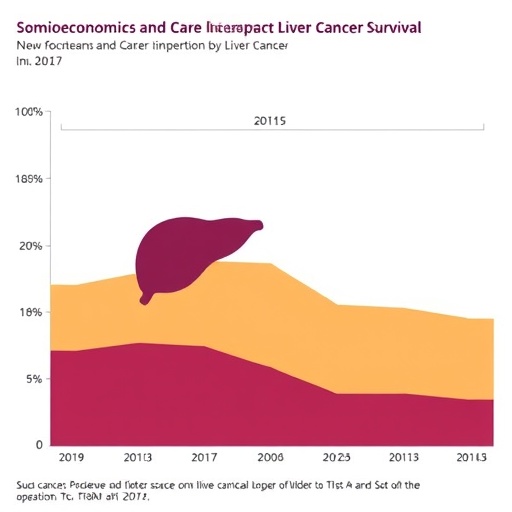
Intriguingly, survival outcomes differed significantly between cancer subtypes and across demographic groups. Men and women diagnosed with HCC exhibited five-year net survival rates of approximately 20%, suggesting that despite treatment advances, only a minority endure beyond this temporal threshold. Conversely, iCCA manifested a starkly reduced five-year survival rate of around 10% for both sexes, highlighting its inherently aggressive biology and diagnostic latency.
One of the most compelling findings of this study is the identification of a socioeconomic gradient affecting men with HCC. Specifically, those residing in the most socioeconomically deprived areas faced a 16% increase in excess mortality risk compared to counterparts in more privileged regions. This gradient persisted even after adjusting for clinical variables, implying that poverty, social disadvantage, and associated systemic barriers materially impair survival outcomes among this subgroup.
In contrast, socioeconomic status did not show a statistically significant survival impact among women with HCC or patients with iCCA. Instead, geographic access emerged as a crucial determinant for these patients. Women with HCC who endure greater difficulty reaching healthcare services experienced a 36% heightened risk of mortality, and a similar pattern was evident in women suffering from iCCA, who faced a 37% increased mortality risk if residing in the most isolated quintile.
These observed sex-specific disparities provoke urgent questions about the underlying mechanisms. Potential explanations include differing health-seeking behaviors, variations in disease biology, or gendered patterns in social support and healthcare navigation. Furthermore, physical remoteness from specialized oncological centers may delay diagnosis and limit timely interventions, compounding survival disadvantages.
From a methodological perspective, this study harnessed flexible parametric survival models integrating multidimensional penalized splines, allowing for sophisticated hazard estimation that accounts for non-linear effects and complex interactions between variables. Such analytical rigor enhances the validity of the findings and sets a precedent for future epidemiological investigations focusing on social determinants of health in oncology.
The broader implications of this research are profound. Firstly, it demonstrates that survival disparities in liver cancer are not solely attributable to tumor biology or individual clinical features but are also shaped decisively by the social and spatial environment. Secondly, it signals the necessity for health policymakers to adopt an equity lens when designing cancer care infrastructure, ensuring underserved populations gain equitable access to early detection and effective treatments.
Moreover, these findings advocate for integrating social deprivation and travel burden assessments into clinical risk stratification tools, which could refine prognostic accuracy and inform tailored patient management strategies. A multidisciplinary approach encompassing social services, community outreach, and healthcare system reforms is paramount to bridge existing gaps.
This investigation stands at the forefront of personalized medicine that transcends molecular profiling to embrace a wider ecological perspective. By elucidating how external social and geographic factors concretely shape cancer outcomes, it offers a blueprint for targeted interventions aimed at ameliorating survival inequities in one of the world’s deadliest cancers.
Importantly, the differential impacts observed between men and women highlight the need for gender-responsive cancer control strategies. Addressing unique barriers faced by women, such as transportation limitations or caregiving responsibilities that hinder healthcare access, could improve survival trajectories. For men, strategies mitigating social deprivation, including education, economic support, and community engagement, may be pivotal.
In sum, this research bridges a critical knowledge gap by quantitatively linking socioeconomic deprivation and spatial healthcare isolation to survival in HCC and iCCA patients. Its revelations call for a concerted, systemic response uniting medical innovation with social policy reforms to enhance outcomes for vulnerable liver cancer populations.
As liver cancer incidence continues to climb globally, harnessing insights from social epidemiology alongside biomedical science will become increasingly vital. Studies such as this illuminate pathways not only to improve survival metrics but also to foster health equity and social justice within oncological care. The future of effective cancer treatment lies in holistic approaches that consider the full spectrum of influences on patient health, from cellular pathology to societal structures.
Subject of Research: The impact of socioeconomic environment and accessibility to healthcare services on survival rates in patients with hepatocellular carcinoma (HCC) and intrahepatic cholangiocarcinoma (iCCA).
Article Title: The socioeconomic environment and access to care affect the survival of patients with hepatocellular carcinoma and intrahepatic cholangiocarcinoma.
Article References:
Chaigneau, T., Dejardin, O., Nguyen, T.T.N. et al. The socioeconomic environment and access to care affect the survival of patients with hepatocellular carcinoma and intrahepatic cholangiocarcinoma. BMC Cancer (2025). https://doi.org/10.1186/s12885-025-15174-w
Image Credits: Scienmag.com
DOI: https://doi.org/10.1186/s12885-025-15174-w
Tags: advancements in liver cancer therapiescancer mortality and socioeconomic conditionscancer registries and research in Francegeographic disparities in cancer outcomesHepatocellular carcinoma prognosisimpact of healthcare accessibility on cancerintrahepatic cholangiocarcinoma patient survivalrole of deprivation in health outcomessocial determinants of health in oncologysocioeconomic factors and liver cancer survivalsocioeconomic status and cancer treatmentsurvival rates of liver cancer patients