• HOME
  • NEWS
  • EXPLORE
    • CAREER
      • Companies
      • Jobs
    • EVENTS
    • iGEM
      • News
      • Team
    • PHOTOS
    • VIDEO
    • WIKI
  • BLOG
  • COMMUNITY
    • FACEBOOK
    • INSTAGRAM
    • TWITTER
Monday, August 10, 2026
BIOENGINEER.ORG
No Result
View All Result
  • Login
  • HOME
  • NEWS
  • EXPLORE
    • CAREER
      • Companies
      • Jobs
        • Lecturer
        • PhD Studentship
        • Postdoc
        • Research Assistant
    • EVENTS
    • iGEM
      • News
      • Team
    • PHOTOS
    • VIDEO
    • WIKI
  • BLOG
  • COMMUNITY
    • FACEBOOK
    • INSTAGRAM
    • TWITTER
  • HOME
  • NEWS
  • EXPLORE
    • CAREER
      • Companies
      • Jobs
        • Lecturer
        • PhD Studentship
        • Postdoc
        • Research Assistant
    • EVENTS
    • iGEM
      • News
      • Team
    • PHOTOS
    • VIDEO
    • WIKI
  • BLOG
  • COMMUNITY
    • FACEBOOK
    • INSTAGRAM
    • TWITTER
No Result
View All Result
Bioengineer.org
No Result
View All Result
Home NEWS Science News Chemistry

Social development of infants unaffected by COVID-19 pandemic

Bioengineer by Bioengineer
July 13, 2022
in Chemistry
Reading Time: 3 mins read
0
Analyzing gaze behavior
Share on FacebookShare on TwitterShare on LinkedinShare on RedditShare on Telegram

Health issues and loss, social isolation and mental health problems – the pandemic has had a drastic effect on our society. But how have the youngest members of society been coping with these changes? Researchers at the University of Zurich have found that the presence of parents and caregivers is enough to mitigate the pandemic’s negative effects on the social development of infants.
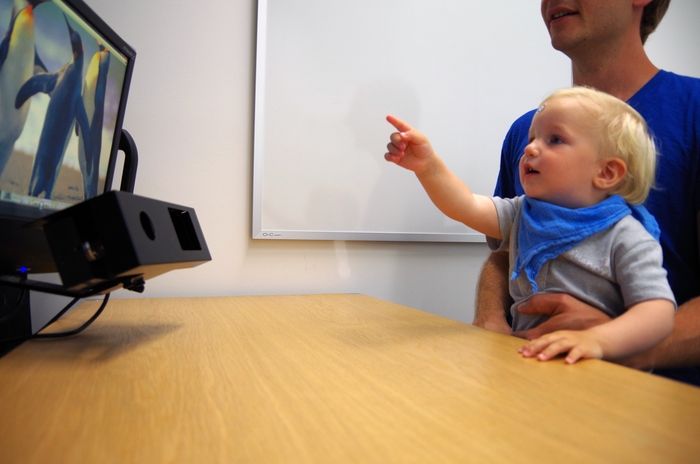
Analyzing gaze behavior

Credit: University of Zurich

Health issues and loss, social isolation and mental health problems – the pandemic has had a drastic effect on our society. But how have the youngest members of society been coping with these changes? Researchers at the University of Zurich have found that the presence of parents and caregivers is enough to mitigate the pandemic’s negative effects on the social development of infants.

The Covid-19 pandemic has had a profound impact on our social lives. Almost overnight, people started to work from home, keep their distance and cover half their face with surgical masks. This affected small children, teenagers and adults alike. And yet, there has been very little research into the effects of pandemic-related changes on infants.

Gaze following fundamental for social development

Researchers at the University of Zurich (UZH) have now studied whether infants born during the pandemic exhibit different social behavior than same-aged infants before the pandemic. The study focused on the children’s ability to follow another person’s gaze. “This ability is fundamental for engaging in social interactions, building relationships and developing language skills,” says Stephanie Wermelinger, who researches developmental psychology in infants and children at the Department of Psychology of UZH. If this ability is impaired, it can hamper a person’s ability to interact with society, as is the case for people with autism.

Eighty infants between the age of 12 and 15 months took part in the study. They were shown different videos in which a person was gazing at one of two objects. By tracking the infants’ eye movements, the researchers recorded how often and how quickly the infants followed the person’s gaze. They then compared their data with eye movement data from 133 children using the same method before the pandemic.

Parents and caregivers soften effects of pandemic

The study revealed no significant behavioral differences between the children born during and before the pandemic. Children born during the pandemic followed the person’s gaze just as often and quickly as the children in the pre-pandemic group. Although the pandemic meant that the children saw fewer people overall and interacted with more people who were wearing masks, they don’t seem to be developing any differently to children who didn’t experience any pandemic-related changes.

“We believe the unchanged social interactions with parents and caregivers at home are enough to mitigate any influence the Covid-19 pandemic might have had on infants,” says author Wermelinger. These contacts could thus be sufficient to provide infants with the social input they need to develop social and emotional skills such as gaze following.


Journal

Infancy

DOI

10.1111/infa.12488

Method of Research

Experimental study

Subject of Research

People

Article Title

How experience shapes infants’ communicative behaviour: Comparing gaze following in infants with and without pandemic experience.

Article Publication Date

29-Jun-2022

Share12Tweet8Share2ShareShareShare2

Related Posts

Marine microplastics retain concerning plastic-additive chemicals even after breaking apart

Marine microplastics retain concerning plastic-additive chemicals even after breaking apart

August 10, 2026
Hebrew University Congratulates Haim Sompolinsky on Receiving 2026 Dirac Medal

Hebrew University Congratulates Haim Sompolinsky on Receiving 2026 Dirac Medal

August 8, 2026

New brain model reveals how regional chemistry shapes large-scale neural activity

August 8, 2026

Topological coupler breaks bandwidth tradeoff in broadband coupled resonator waveguides

August 8, 2026

POPULAR NEWS

  • Pseudomonas Volatiles Disrupt Airway Mucus Balance by Altering AhR Signaling

    29 shares
    Share 12 Tweet 7
  • KIST unveils neuromorphic AI training method for an era of low-power intelligence

    29 shares
    Share 12 Tweet 7
  • Marine microplastics retain concerning plastic-additive chemicals even after breaking apart

    29 shares
    Share 12 Tweet 7
  • Single-Fiber 3D Shape Sensing Uses Femtosecond-Laser-Inscribed Orthogonal Eccentric Scatterers

    29 shares
    Share 12 Tweet 7

About

We bring you the latest biotechnology news from best research centers and universities around the world. Check our website.

Follow us

Recent News

Pseudomonas Volatiles Disrupt Airway Mucus Balance by Altering AhR Signaling

KIST unveils neuromorphic AI training method for an era of low-power intelligence

Marine microplastics retain concerning plastic-additive chemicals even after breaking apart

Subscribe to Blog via Email

Success! An email was just sent to confirm your subscription. Please find the email now and click 'Confirm' to start subscribing.

Join 86 other subscribers
  • Contact Us

Bioengineer.org © Copyright 2023 All Rights Reserved.

Welcome Back!

Login to your account below

Forgotten Password?

Retrieve your password

Please enter your username or email address to reset your password.

Log In
No Result
View All Result
  • Homepages
    • Home Page 1
    • Home Page 2
  • News
  • National
  • Business
  • Health
  • Lifestyle
  • Science

Bioengineer.org © Copyright 2023 All Rights Reserved.