• HOME
  • NEWS
  • EXPLORE
    • CAREER
      • Companies
      • Jobs
    • EVENTS
    • iGEM
      • News
      • Team
    • PHOTOS
    • VIDEO
    • WIKI
  • BLOG
  • COMMUNITY
    • FACEBOOK
    • INSTAGRAM
    • TWITTER
Tuesday, July 7, 2026
BIOENGINEER.ORG
No Result
View All Result
  • Login
  • HOME
  • NEWS
  • EXPLORE
    • CAREER
      • Companies
      • Jobs
        • Lecturer
        • PhD Studentship
        • Postdoc
        • Research Assistant
    • EVENTS
    • iGEM
      • News
      • Team
    • PHOTOS
    • VIDEO
    • WIKI
  • BLOG
  • COMMUNITY
    • FACEBOOK
    • INSTAGRAM
    • TWITTER
  • HOME
  • NEWS
  • EXPLORE
    • CAREER
      • Companies
      • Jobs
        • Lecturer
        • PhD Studentship
        • Postdoc
        • Research Assistant
    • EVENTS
    • iGEM
      • News
      • Team
    • PHOTOS
    • VIDEO
    • WIKI
  • BLOG
  • COMMUNITY
    • FACEBOOK
    • INSTAGRAM
    • TWITTER
No Result
View All Result
Bioengineer.org
No Result
View All Result
Home NEWS Science News Biology

Social animals have more parasite infections but lower infection-related costs

Bioengineer by Bioengineer
December 19, 2018
in Biology
Reading Time: 3 mins read
0
IMAGE
Share on FacebookShare on TwitterShare on LinkedinShare on RedditShare on Telegram

IMAGE

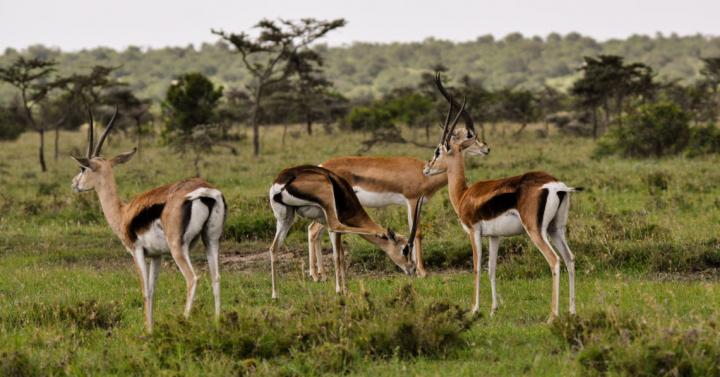
Credit: Ria Ghai

Animals living in large groups tend to have more parasites than less social animals do, but according to a new study in Proceedings of the Royal Society B, they may also be better protected from the negative effects of those parasites.

Ecologists at the University of Georgia found that Grant’s gazelles that live in larger groups were more likely to be infected by intestinal worms, but less likely to suffer their ill effects than those in smaller groups.

“The phenomenon of getting intestinal worm parasites is common to many, many species,” said Vanessa Ezenwa, a professor in the Odum School of Ecology and College of Veterinary Medicine. “And one of the strongest negative impacts of these types of infections, well described in domesticated animals, is that they cause anorexia. We find that in this wild species, being social somehow counteracts that effect.”

Ezenwa conducted the study in Mpala Research Center in Kenya. Using nets deployed from a helicopter, her team captured wild gazelles. After tagging each one, they collected fecal samples and noted each animal’s size, weight and other statistics. They treated half of the gazelles with a deworming drug that was effective for 120 days; the other half were left untreated as a control. The researchers then followed all of the animals for over a year, collecting fecal samples to monitor parasite levels and recording observations on the animals’ social and feeding behavior.

They found that gazelles in larger groups–groups of up to 25 individuals, with an average size of nine–had a 39 percent higher risk of infection than those living in smaller groups.

But infected animals in these larger groups ate significantly more than infected animals in smaller groups–almost as much as uninfected animals.

Ezenwa said that one reason the infected animals in larger groups may eat more is that the larger group offers more protection from predators.

“There’s a hypothesis called ‘many eyes,'” she said. “When the group is bigger, the rate of detection of predators goes up, because at any given time there are more individuals paying attention. So that can free up individuals to put more time into other behaviors, and typically that would be feeding.”

Ezenwa says that an important next step would be to conduct experiments under controlled conditions to explore the physiological and behavioral mechanisms driving the effect she observed.

Ezenwa also cautioned that the phenomenon of social living reducing the cost of infection may not be applicable to all parasites.

“What I’m describing here might be particularly relevant for very common parasites you can’t avoid over the course of your lifetime, but for rarer ones it might be a different story,” she said. “If you’re going to be infected no matter what, like with these worms where the prevalence is really high and there’s no way to protect yourself from them, then being in a big group might be an important way to minimize the impact of infection.”

Ezenwa said that the results of the study show that it’s important to think about both costs and benefits when trying to understand how social interactions shape infectious disease outcomes in individuals and populations.

“We are a social species just like these gazelles,” said Ezenwa. “Being social has a lot of implications for our health. We already know that social contact has a huge impact on our exposure to infectious diseases, so I think what we need to understand better is how social contact might simultaneously give us advantages in terms of reducing the impacts of those infectious diseases.”

###

The study, “Social living simultaneously increases infection risk and decreases the cost of infection,” which is available online at http://rspb.royalsocietypublishing.org/content/285/1892/20182142, was co-authored by Katherine Worsley-Tonks, currently at the University of Minnesota. Support for the research was provided by the National Science Foundation.

Media Contact
Vanessa Ezenwa
[email protected]
706-542-2288

Original Source

https://news.uga.edu/social-animals-parasite-infections/

Tags: BehaviorEcology/EnvironmentMedicine/HealthNature
Share12Tweet8Share2ShareShareShare2

Related Posts

Here are a few rewritten headlines for a science magazine post, each with a slightly different tone: Intriguing & poetic: How do organs sculpt themselves? Sea stars hold the secret Direct & research-focused: Sea stars reveal the hidden rules of organ formation Metaphorical & inviting: Tiny architects beneath the waves: What sea stars teach us about building organs Short & punchy: Star-shaped clues to how our organs take shape Question-led: Could a sea star show us how organs form? Elegant & feature-style: The body’s blueprint, glimpsed in a sea star’s arm

July 6, 2026
Bacteria evolve faster with unconventional gene copies — Biology

Bacteria evolve faster with unconventional gene copies

July 6, 2026

Neighbours rewire soil feedback via root microbiome shifts

July 6, 2026

Evolution-Inspired Biosensors Revolutionize Lipid Tracking in Real Time

July 2, 2026
Please login to join discussion

POPULAR NEWS

  • Detection of EDCs in Breast Milk and Infant Urine Up to Six Months Highlights Early Exposure Risks

    77 shares
    Share 31 Tweet 19
  • New Drug Candidate Developed at McMaster Shows Potential for Treating Brain Cancer

    58 shares
    Share 23 Tweet 15
  • Saying Goodbye to PGY-6: Pediatric Fellowship Realities

    103 shares
    Share 41 Tweet 26
  • KTU Researchers Explore Ultrasound’s Role in Enhancing Blood Flow Beyond Diagnostics

    53 shares
    Share 21 Tweet 13

About

We bring you the latest biotechnology news from best research centers and universities around the world. Check our website.

Follow us

Recent News

Flame retardant BDE-209 targets molecularly linked to ulcerative colitis

Ultra-high frequency particle impacts mimic rockbursts to shatter hard rock

Kidney transplant outcomes in older adults studied by German researchers

Subscribe to Blog via Email

Enter your email address to subscribe to this blog and receive notifications of new posts by email.

Join 83 other subscribers
  • Contact Us

Bioengineer.org © Copyright 2023 All Rights Reserved.

Welcome Back!

Login to your account below

Forgotten Password?

Retrieve your password

Please enter your username or email address to reset your password.

Log In
No Result
View All Result
  • Homepages
    • Home Page 1
    • Home Page 2
  • News
  • National
  • Business
  • Health
  • Lifestyle
  • Science

Bioengineer.org © Copyright 2023 All Rights Reserved.