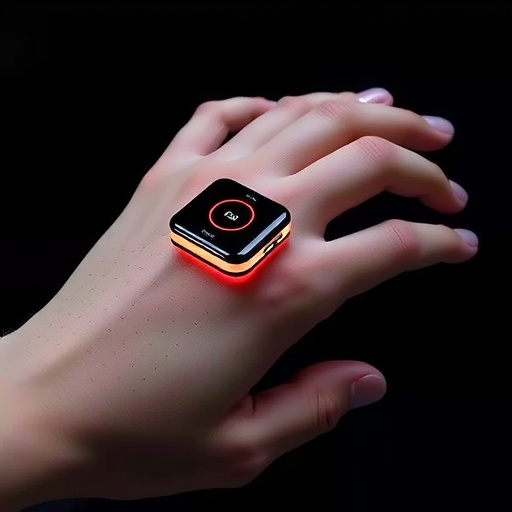
A pioneering research team at Seoul National University (SNU), led by Professor Jerald Yoo from the Department of Electrical and Computer Engineering, has unveiled a transformative advancement in wearable healthcare technology. Their novel system, “SkinECG,” introduces a skin-conformal, battery-free electrocardiogram (ECG) sensor, breaking new ground in how physiological signals can be monitored continuously without the limitations traditionally imposed by power sources.
Wearable healthcare devices have rapidly evolved into critical tools enabling real-time monitoring of vital physiological parameters. Among these, ECG sensors stand out for their role in diagnosing and tracking cardiovascular health conditions such as arrhythmias. However, the dependence on batteries remains a significant obstacle, constraining device miniaturization, user comfort, and the feasibility of uninterrupted long-term health monitoring. SkinECG addresses this challenge by integrating ambient energy harvesting with an innovative body-coupled wireless power transfer system, fundamentally transforming the power supply paradigm for wearable sensors.
Traditional energy harvesting techniques for wearable electronics rely on converting environmental energies—such as sunlight, thermal gradients, or kinetic motion—into usable electrical power. Yet, a persistent problem has been the spatial mismatch between ideal sensor placement and optimal energy harvesting sites. ECG sensors necessitate placement on the chest to accurately capture cardiac signals, whereas solar or motion energy harvesters perform best on areas more exposed to environmental stimuli, such as the arms or legs. This spatial discordance has limited the practical deployment and efficiency of self-powered wearable devices.
Addressing this critical issue, the SkinECG system introduces a multi-source wireless power supply infrastructure enabling the transfer of harvested energy from one or multiple body-worn units to a remotely located ECG sensor on the chest. This system, termed the Orthogonal Energy Harvesting Network (O-EHN), employs skin-adherent hydrocolloid patches housing flexible circuitry and custom semiconductor chips designed for high-fidelity ECG sensing. The O-EHN capitalizes on orthogonal frequency channels assigned to each energy harvester, reducing interference and allowing flexible adjustment of harvester number and placement without compromising stable power delivery.
The research team reimagined the wireless power transfer approach by utilizing the human body’s surface as a transmission medium, rather than relying on electromagnetic wave propagation through air over distances. Conventional wireless power transfer methods face efficiency losses due to electromagnetic wave absorption and scattering caused by the body’s tissues. SkinECG sidesteps this by enabling body-coupled power transfer, where electrical energy is guided and delivered along the skin surface. This technique markedly improves power transfer efficiency while maintaining a compact and unobtrusive form factor for the wearable ECG sensor.
Safety was paramount in the design of this system. The researchers meticulously ensured that the power levels coupled to the human body remained comparable to everyday ambient electromagnetic exposures, adhering to stringent safety standards. Their experiments demonstrated that the skin-like ECG sensor could be fully powered through the energy harvested from the body-worn devices, eliminating the need for bulky batteries and wired connections, thereby significantly enhancing wearability and user convenience.
Beyond overcoming the location mismatch issue, SkinECG’s architecture inherently supports scalability and compatibility with existing commercial energy harvesting technologies. This flexibility paves the way for broader applications across various types of wearable healthcare devices, potentially revolutionizing continuous health monitoring in ambulatory and non-clinical environments.
The implications of this technology extend beyond cardiac monitoring. The system’s principle can be adapted to power devices measuring other complex physiological signals, such as electromyography (EMG) for muscle activity and electroencephalography (EEG) for brain signals. As wearable and implantable medical devices increasingly demand stable, long-lasting power sources without compromising on size or comfort, the SkinECG platform offers a foundational solution addressing these critical power supply challenges.
Professor Yoo emphasized the importance of this breakthrough: “Wearable healthcare systems have long grappled with the fundamental limitation posed by differing optimal locations for energy harvesting and signal sensing. Our work overcomes this by enabling wireless power transfer that is conformed to the human body’s surface, maintaining safety and reliability.” He further noted that this approach holds promise for creating multimodal digital healthcare platforms that support a wide array of biosignal sensors, ultimately contributing to the seamless integration of wearable technologies in daily healthcare management.
This breakthrough is the result of an international collaborative effort spearheaded by SNU, alongside the University of Tokyo and the National University of Singapore. The collaborative team leveraged diverse expertise in electrical engineering, biomedical sensing, and wireless power technologies to bring the SkinECG concept from idea to clinically relevant prototype, demonstrating excellent performance and safety metrics.
The research was led by co-first authors Dr. Zhuoyue Li and Dr. Joanne Si Ying Tan, both of whom earned their doctorates under Prof. Yoo’s mentorship. Their work, alongside contributions from integrated M.S.-Ph.D. students Kyung-Soo Park, Donghan Kim, and Gwangjin Kim, who specialize in Body Area Networks (BANs), provides a strong interdisciplinary foundation supporting ongoing advancements in wearable technology and healthcare.
Published in the prestigious journal Science Advances on May 1, 2026, this work signifies a momentous step forward in wearable biomedical devices. By fundamentally rewriting how power is supplied to body-worn sensors, SkinECG promises to unlock new possibilities in continuous health monitoring with unprecedented freedom from battery limitations.
Korean national research funding supported this innovative project under the Mid-career Research Program Type 2 (RS-2024-00339998), reflecting the country’s commitment to advancing global healthcare technology through cutting-edge research and international collaboration.
Subject of Research: People
Article Title: SkinECG: An orthogonal remote powering wearable skin-like sensor
News Publication Date: 1-May-2026
Web References: http://dx.doi.org/10.1126/sciadv.aec9803
Image Credits: © Seoul National University College of Engineering
Keywords
Wearable healthcare, Electrocardiogram (ECG), Battery-free sensors, Energy harvesting, Wireless power transfer, Body-coupled power transfer, Orthogonal Energy Harvesting Network, Skin-conformal electronics, Physiological monitoring, Biomedical engineering, Seoul National University, Health technology innovation
Tags: ambient energy harvesting wearable devicesarrhythmia detection wearable techbattery-free wearable ECG sensorbody-coupled wireless power transfercontinuous cardiovascular monitoring technologylong-term physiological signal trackingminiaturized wearable healthcare electronicsnon-invasive cardiac health sensorspower supply innovation for wearablesreal-time vital signs monitoringSeoul National University wearable researchskin-conformal health monitoring