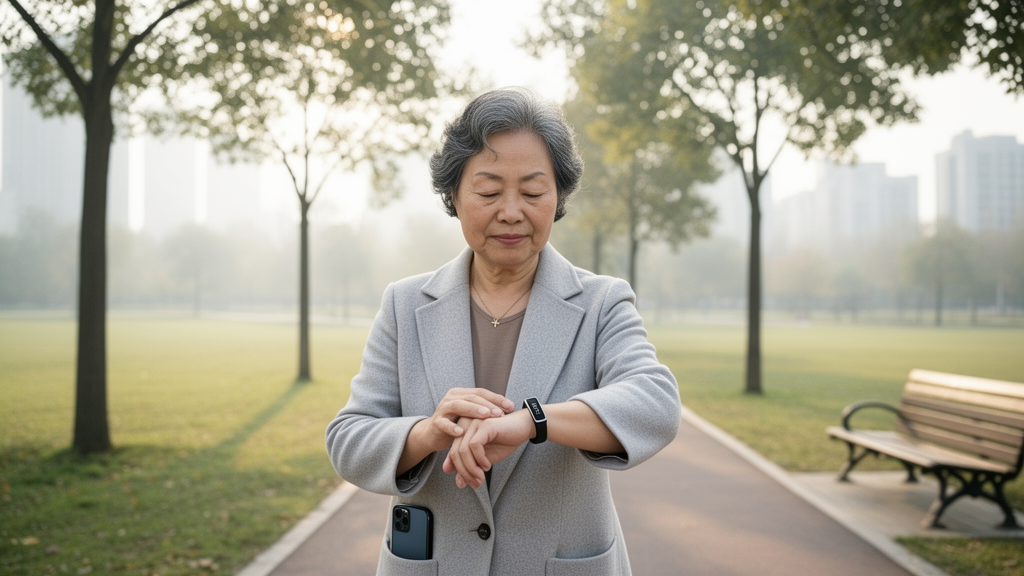
Older adults in China who reported owning a smart wristband or smartwatch tended to report fewer depressive symptoms during survey waves in which they owned a device, according to a longitudinal fixed-effects analysis. The within-person association remained positive across multiple sensitivity analyses, but the observational findings do not establish that wearable ownership caused the difference. The study used data from the 2018, 2020 and 2023 waves of the China Longitudinal Aging Social Survey.
The baseline analytical sample contained 30,255 person-year observations from 16,752 respondents. For the two-way fixed-effects models, the researchers analyzed 22,536 observations from 9,033 respondents observed repeatedly, including 902 participants whose smart wearable ownership status changed between waves. Depressive symptoms were measured with a reverse-coded nine-item CES-D score. A higher score in the analysis indicated fewer depressive symptoms. Smart wearable ownership was positively associated with this score within individuals, with a coefficient of 0.719 and a 95% confidence interval of 0.414 to 1.024.
The analysis also examined whether wearable ownership covaried with concurrent psychosocial and behavioral characteristics. Ownership was positively associated with health perception, social adaptation and leisure participation, according to the study. Because these characteristics were measured at the same time as wearable ownership, the results could not establish that any of them mediated the association with depressive symptoms. Additional analyses considered mobile-phone proficiency, sociodemographic variation, sample selection and attrition.
Contemporaneous analyses found a more favorable association between wearable ownership and the reverse-coded depressive-symptom score among older adults reporting higher mobile-phone proficiency. The linear interaction coefficient was 1.890, with p less than .001. When the researchers instead examined prior-wave mobile-phone proficiency, the evidence for this relationship was weaker. The difference between these approaches means that the results do not identify a single, consistent relationship between earlier digital proficiency and the ownership–depressive-symptom association.
Variation in the association was statistically supported for hukou origin after accounting for multiple comparisons, while evidence of heterogeneity was not supported for gender, age or education. Taken together, the findings show a measurable association between smart wearable ownership and fewer depressive symptoms within the surveyed older Chinese population, alongside differences related to digital capability and hukou origin. The study does not determine whether the devices themselves improve well-being, whether people with better health or social circumstances are more likely to acquire and use them, or whether other factors contribute to the observed pattern.
Subject of Research: Within-person associations between smart wearable ownership and depressive symptoms among older adults in China
Article Title: Smart wearable device ownership and depressive symptoms among older adults in China: a longitudinal fixed-effects analysis
Article References: Ji, H., Pan, W., Zhang, M., & Yu, Y. (2026). Smart wearable device ownership and depressive symptoms among older adults in China: a longitudinal fixed-effects analysis. BMC Geriatrics. https://doi.org/10.1186/s12877-026-08525-0
Image Credits: AI Generated
DOI: 10.1186/s12877-026-08525-0
Keywords: smart wearables, depressive symptoms, older adults, China, longitudinal analysis, fixed-effects models, CES-D, mobile phone proficiency, health perception, digital health, Smart, wearable
News Source: Glenn Wilkins. (October 21, 2026). Smart wearable ownership tracks fewer depressive symptoms in older Chinese adults. Scienmag.