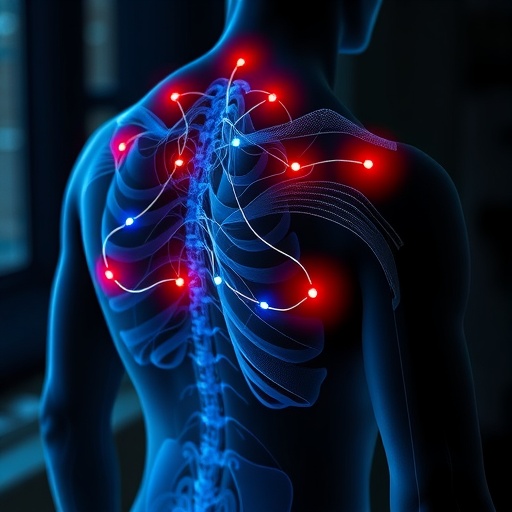
Imagine slipping into a lightweight, form-fitting garment that can silently eavesdrop on the intricate electrical dialogue between your brain and every twitching muscle fiber, all without a single drop of conductive gel or a tangle of wires snaking across your skin. That vision has just leaped from science fiction to laboratory reality. In a study published in Nature Communications, a team of engineers and neuroscientists has unveiled a novel smart textile electrode array capable of mapping the full cortico-muscular axis from the body’s surface with unprecedented resolution. This is not merely an incremental upgrade to existing electrode technology; it’s a fundamental reimagining of how we capture the human body’s electrophysiological symphony, weaving sensing capability directly into the fabric of our clothes.
For decades, the gold standard for non-invasive recording of brain activity, electroencephalography or EEG, and muscle activity, electromyography or EMG, has relied on rigid metal electrodes adhered to the skin with messy gels. While accurate, these systems are cumbersome, limit movement, and offer only sparse spatial sampling—a handful of channels struggling to reconstruct a full picture of the distributed neural commands that choreograph movement. The new textile array smashes these constraints. Engineered from conductive fibers knitted into a stretchable, breathable fabric, the array conforms intimately to the skin’s topography, maintaining stable, low-impedance contact across hundreds of densely packed sensors without any adhesive. The dry electrodes are integrated seamlessly into the textile, making the entire system feel like a second skin.
The core technical marvel lies in the material science. The researchers developed a hierarchical hybrid conductive yarn that combines a stretchable core with a braided metallic microwire sheath, optimized for biopotential acquisition. These fibers are then machine-knitted into a high-density array using a custom-designed pattern that ensures each electrode is electrically isolated while the whole fabric remains pliable. Crucially, the knitting architecture introduces a microscopically rough surface texture at each electrode site, dramatically increasing the effective contact area and reducing the electrode-skin impedance to levels typically only achievable with wet gels, yet the fabric breathes and wicks moisture away, ensuring long-term comfort and signal stability.
What truly sets this technology apart is its ambition: simultaneously mapping brain and muscle activity across the entire upper body in a single unified recording platform. The team deployed a full-sleeve garment embedded with over 300 electrodes, covering the scalp, neck, shoulders, and arms down to the fingertips. This allowed them to track the volley of neural signals from motor cortex preparation to muscle activation patterns in the biceps, triceps, and forearm flexors with millisecond precision. They captured the cortico-muscular coherence—a measure of the rhythmic synchrony between brain and muscle oscillations—across a distributed sensor grid, revealing how motor commands propagate and fractionate into complex muscle synergies during natural, unrestrained movements.
The data flowing from this wearable grid required a new analytical framework. The researchers employed topographic mapping algorithms to render dynamic body surface potential maps, essentially creating movies of electrical activity cascading down the limb. By integrating EEG and EMG signals into a common spatial framework, they could visualize the descending motor command as a wave of potential that shifts, splits, and reshapes itself depending on the task—whether a delicate pinch grip or a powerful overhead throw. This is not just about reading individual channels; it’s about observing the emergent spatiotemporal patterns of the entire cortico-muscular system as a unified physiological entity.
The implications for neurorehabilitation are immediate and profound. Current motor recovery therapies after stroke or spinal cord injury often rely on crude visual feedback or isolated EMG triggers. This textile array could provide a rich, closed-loop interface that detects aberrant cortico-muscular communication and delivers precisely timed electrical or visual feedback to retrain the brain-muscle dialogue. A patient attempting to lift a hand could be shown in real time how their residual motor intention is failing to recruit the correct forearm muscles, with the system adapting the therapy on the fly. The garment’s unobtrusive form factor means it could be worn during everyday activities, turning rehabilitation into a continuous, data-driven process rather than a scheduled clinical visit.
Beyond the clinic, the technology promises to accelerate brain-computer interface (BCI) performance. Typical EEG-based BCIs struggle with slow update rates and limited degrees of freedom because they ignore the rich myoelectric information downstream. By fusing high-density EEG and EMG at the source, a decoder can resolve movement intent with far greater accuracy and speed. The research team demonstrated that their textile array could decode complex hand gestures and individual finger movements in real time from the combination of central and peripheral signals, hinting at next-generation prosthetic limbs that feel like a natural extension of the wearer’s own physiological command chain.
The textile electrode array also enters the arena of elite sports science and ergonomics, where understanding the efficiency of the cortico-muscular axis could unlock new levels of performance. Imagine analyzing a pitcher’s throwing motion not just with motion capture cameras but by directly visualizing how their motor cortex orchestrates the sequential muscle firing from rotator cuff to fingertip, identifying micro-delays or inefficient co-contractions invisible to external observation. The washable, durable nature of the knitted electrodes makes this a practical tool for field use, not just a laboratory oddity.
While the prototype already presents a compelling proof of concept, challenges remain before it becomes ubiquitous. Long-term signal integrity during extreme sweating and vigorous motion, miniaturization of the accompanying wireless electronics, and the sheer computational load of processing hundreds of channels in real time are all active areas of development. Nevertheless, the fusion of textile engineering and systems neuroscience has opened a new window into the body’s electrical landscape. We are moving from a world where we measure biology with rigid instruments to one where the measuring instrument becomes indistinguishable from the clothing we wear, quietly mapping the ceaseless, silent conversation between brain and muscle.
Subject of Research: Body surface potential mapping of the cortico-muscular axis using smart textile electrode arrays.
Article Title: Body surface potential mapping of the cortico-muscular axis using smart textile electrode arrays.
Article References:
Serrano, R.RM., Brunt, C., Tao, X. et al. Body surface potential mapping of the cortico-muscular axis using smart textile electrode arrays.
Nat Commun (2026). https://doi.org/10.1038/s41467-026-75134-1
Image Credits: AI Generated
DOI: 10.1038/s41467-026-75134-1
Keywords: Smart textiles, electrode arrays, body surface potential mapping, cortico-muscular axis, electroencephalography (EEG), electromyography (EMG), brain-computer interface, wearable sensors, neurorehabilitation, conductive fibers.
Tags: brain-to-muscle signal mappingconductive fiber sensorscortico-muscular axisgel-free electrode technologyhigh-resolution body surface mappinghuman movement electrophysiologyneural command recordingnon-invasive electrophysiologysmart textile electrode arraystretchable breathable electronicstextile-based EEG/EMGwearable neural interface