• HOME
  • NEWS
  • EXPLORE
    • CAREER
      • Companies
      • Jobs
    • EVENTS
    • iGEM
      • News
      • Team
    • PHOTOS
    • VIDEO
    • WIKI
  • BLOG
  • COMMUNITY
    • FACEBOOK
    • INSTAGRAM
    • TWITTER
Wednesday, August 12, 2026
BIOENGINEER.ORG
No Result
View All Result
  • Login
  • HOME
  • NEWS
  • EXPLORE
    • CAREER
      • Companies
      • Jobs
        • Lecturer
        • PhD Studentship
        • Postdoc
        • Research Assistant
    • EVENTS
    • iGEM
      • News
      • Team
    • PHOTOS
    • VIDEO
    • WIKI
  • BLOG
  • COMMUNITY
    • FACEBOOK
    • INSTAGRAM
    • TWITTER
  • HOME
  • NEWS
  • EXPLORE
    • CAREER
      • Companies
      • Jobs
        • Lecturer
        • PhD Studentship
        • Postdoc
        • Research Assistant
    • EVENTS
    • iGEM
      • News
      • Team
    • PHOTOS
    • VIDEO
    • WIKI
  • BLOG
  • COMMUNITY
    • FACEBOOK
    • INSTAGRAM
    • TWITTER
No Result
View All Result
Bioengineer.org
No Result
View All Result
Home NEWS Science News Chemistry

Smart pill bottle keeps drugs safe

Bioengineer by Bioengineer
May 6, 2019
in Chemistry
Reading Time: 2 mins read
0
IMAGE
Share on FacebookShare on TwitterShare on LinkedinShare on RedditShare on Telegram

IMAGE

Credit: © 2019 Muhammad M. Hussain

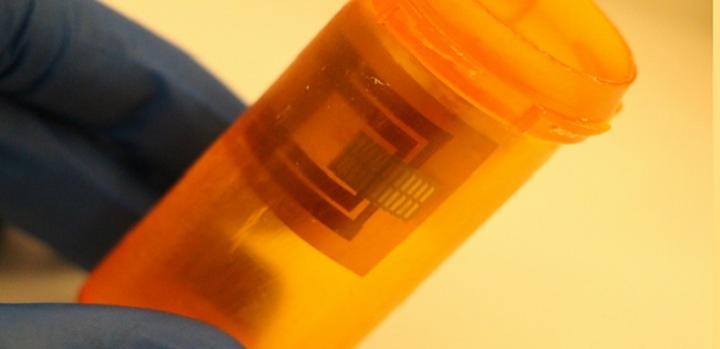
A smart pill bottle that sends wireless alerts when it detects tampering, overdose or unsafe storage conditions is just one of many potential health applications for new sensor technology being developed by a team at KAUST.

Digital technology offers opportunities to improve traditional approaches to issues threatening human health. For example, networks of tiny wearable sensors deployed in hospitals can be used to track influenza outbreaks in real time. But the high costs associated with electronic manufacturing means that these sensors aren’t available where they’re needed most–to the low-income populations that suffer disproportionately from epidemics.

Muhammed Hussain, doctoral student Sherjeel Khan and colleagues are working to make sensors more accessible using cheaper materials. For example, they recently demonstrated that it is feasible to create temperature and humidity sensors from paper by drawing circuits with conductive ink.

The team has now developed a stretchy sensor–an anisotropic conductive tape with a range of touch-sensitive applications. Assembled by sandwiching tiny silver particles between two layers of adhesive copper tape, the new material is nonconductive in its normal state. But when pressed by a finger, the double-layered tape makes an electrical connection that sends a signal to an external reader.

“Similar devices have been used in flat panel displays,” explains Khan, “but we’ve made them simple to build and easy to use by almost anyone.”

The researchers used their technology to create a smart pill bottle to help fight the problem of prescription drug abuse. After 3D-printing a lid that uses light-emitting diodes to count the number of pills dispensed, they taped paper-based humidity and temperature sensors to its underside. The bottle was then sealed with an outer layer of conductive tape that acts as a touch sensor.

If someone attempts to break into the bottle, or the insides become dangerously moist, a flexible control module inside the bottle analyzes the signals and delivers warnings to cell phones via a Bluetooth connection. The conductive tape could be used on its own or as part of a modular sensor system, and so Hussain envisions it could help groups looking for quick tests of innovative health sensors.

This sensor development that is easy to build also opens up broader possibilities for researchers. “If you give researchers a ‘do it yourself opportunity,’ there is a good chance they will use it to expand the horizon of electronics and empower humanity with better technology,” Hussain adds.

###

Media Contact
Carolyn Unck
[email protected]

Original Source

https://discovery.kaust.edu.sa/en/article/833/smart-pill-bottle-keeps-drugs-safe

Related Journal Article

http://dx.doi.org/10.1088/2058-8585/ab10f5

Tags: Medicine/HealthPharmaceutical SciencePharmaceutical/Combinatorial Chemistry
Share12Tweet8Share2ShareShareShare2

Related Posts

AI Forecasts the Ocean Amid the Climate Crisis

August 12, 2026
Dual-interface design enables high-performance ampere-hour aqueous zinc-iodine pouch cells

Dual-interface design enables high-performance ampere-hour aqueous zinc-iodine pouch cells

August 12, 2026

Multiscale Hybridization and Chemical Bonding Create Ultra-Durable Flexible Strain Sensors

August 12, 2026

X-ray Science Moves Beyond the Nobel Prize’s Limits

August 12, 2026
Please login to join discussion

POPULAR NEWS

  • Cement Plants Could Help Remove CO₂ From the Atmosphere

    29 shares
    Share 12 Tweet 7
  • Nearly All Tested Personal Care and Cleaning Products Contain Unlabeled Chemicals

    29 shares
    Share 12 Tweet 7
  • Molecular Clues Reveal Why Neuromas Cause Pain

    29 shares
    Share 12 Tweet 7
  • Mount Sinai Reaches Milestone 2 in $101 Million XPRIZE Healthspan Competition

    29 shares
    Share 12 Tweet 7

About

We bring you the latest biotechnology news from best research centers and universities around the world. Check our website.

Follow us

Recent News

Cement Plants Could Help Remove CO₂ From the Atmosphere

Nearly All Tested Personal Care and Cleaning Products Contain Unlabeled Chemicals

Molecular Clues Reveal Why Neuromas Cause Pain

Subscribe to Blog via Email

Enter your email address to subscribe to this blog and receive notifications of new posts by email.

Join 86 other subscribers
  • Contact Us

Bioengineer.org © Copyright 2023 All Rights Reserved.

Welcome Back!

Login to your account below

Forgotten Password?

Retrieve your password

Please enter your username or email address to reset your password.

Log In
No Result
View All Result
  • Homepages
    • Home Page 1
    • Home Page 2
  • News
  • National
  • Business
  • Health
  • Lifestyle
  • Science

Bioengineer.org © Copyright 2023 All Rights Reserved.