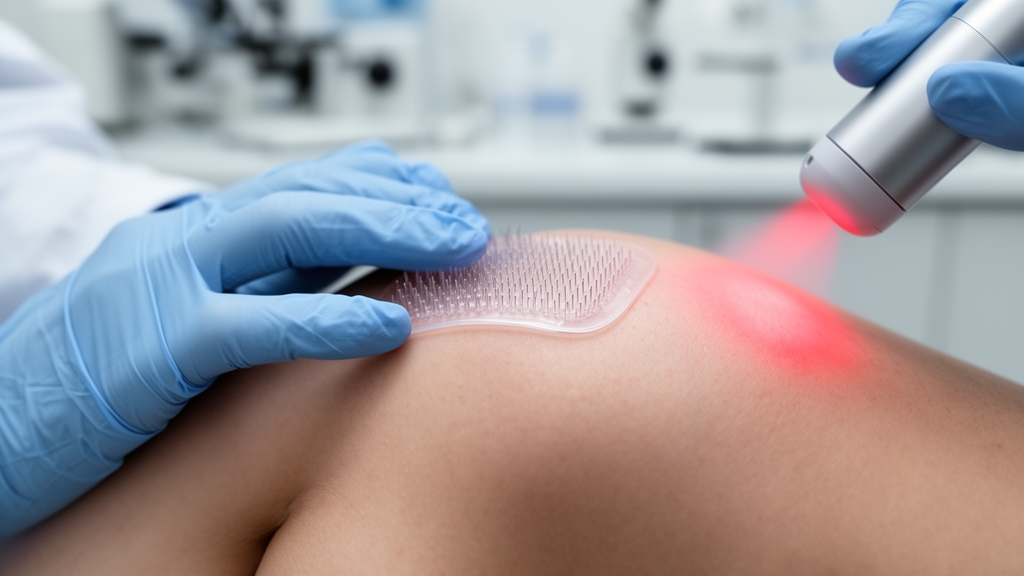
Temporomandibular joint osteoarthritis, a degenerative condition of the small joint that connects the jaw to the skull, causes chronic pain, cartilage breakdown and pathological remodeling of nerves and blood vessels, yet effective local therapies remain scarce. A team of researchers in China has now built a minimally invasive, near-infrared-responsive microneedle system that combines a plant-derived anti-inflammatory compound with a light-activated nanocarrier inside a silk-based hydrogel. In a mouse model of the disease, the patch reduced mechanical hypersensitivity, anxiety-like behaviors, cartilage degeneration and pathological neurovascularization, outperforming the free drug, blank microneedles and drug-loaded microneedles without light activation. The work, published in Nature Communications, offers a locally responsive therapeutic platform for a joint disorder that is notoriously difficult to treat.
The system, which the researchers call SFZICC microneedles, integrates cryptochlorogenic acid, a chlorogenic acid derivative with documented antioxidant and anti-inflammatory properties, and carbon quantum dots into ZIF-8 nanoparticles, a type of metal-organic framework built from zinc ions and imidazolate linkers. These drug-loaded nanoparticles are embedded within a hydrogel made of methacrylated silk fibroin, a chemically modified form of the structural protein that gives silk its strength. The resulting patch provides mechanical integrity, photothermal responsiveness and near-infrared-assisted local drug release, meaning the microneedles hold their shape during insertion, warm up under light and release their cargo on demand.
Microneedles themselves are not new. The technology uses arrays of microscopic needles, typically a few hundred micrometers tall, that pierce the outer layers of skin or tissue without reaching the nerve-dense deeper layers, delivering drugs with minimal pain and no conventional injection. What makes this system smart is the combination of three functions in one patch. The silk fibroin hydrogel gives the needles their backbone, the ZIF-8 nanoparticles act as a protective nanoscale vault for the drug and the carbon quantum dots convert near-infrared light into gentle heat, which both triggers drug release and provides a mild photothermal effect at the target site.
ZIF-8 is an interesting choice of carrier because its framework is stable at physiological pH but dissolves in the acidic microenvironment characteristic of inflamed tissue. This pH sensitivity means the nanoparticles preferentially unload their cargo where inflammation has made the local chemistry acidic, adding a layer of targeting beyond simple diffusion. The carbon quantum dots, meanwhile, are nanoscale carbon-based particles that absorb near-infrared light and re-emit part of the energy as heat, a property that underpins the photothermal responsiveness of the whole patch. Together, the two nanocomponents turn a passive drug depot into an externally controllable release system.
The therapeutic payload, cryptochlorogenic acid, was selected for its ability to interfere with matrix metalloproteinases, a family of zinc-dependent enzymes that degrade cartilage matrix and drive joint destruction. In osteoarthritis, these enzymes, particularly MMP3, MMP9 and MMP13, chew through the collagen and proteoglycans that give cartilage its resilience, and their overactivity is a hallmark of disease progression. In vitro experiments showed that cryptochlorogenic acid directly interacts with MMP3, MMP9 and MMP13 and moderately inhibits their catalytic activities, providing a biochemical rationale for using the compound against cartilage degeneration.
The compound’s effects extend beyond direct enzyme inhibition. In cell-based assays, cryptochlorogenic acid reduced intracellular superoxide accumulation, a reactive oxygen species that fuels oxidative stress in inflamed joints, and dampened the phosphorylation of NF-κB p65, a key signaling step that activates the NF-κB pathway, a master regulator of inflammatory gene expression. The treatment also lowered the abundance of MMP proteins inside cells, suggesting the compound suppresses the production of the destructive enzymes, not just their activity. This dual action, direct catalytic inhibition combined with suppression of inflammatory signaling and enzyme synthesis, is what the researchers describe as dual-targeted therapy.
In vivo imaging in the mouse model further supported the mechanism, showing reduced overall MMP-associated proteolytic activity in the treated joints. The animals received the microneedle patch combined with near-infrared irradiation, and the combination reduced mechanical hypersensitivity, a measure of pain-like responses to touch, and anxiety-like behaviors, which often accompany chronic pain conditions. The treatment also reduced cartilage degeneration and pathological neurovascularization, the abnormal growth of nerves and blood vessels into joint tissue that contributes to pain and structural damage. The full system outperformed free cryptochlorogenic acid, blank microneedles and drug-loaded microneedles without light activation, indicating that both the nanocarrier and the photothermal trigger contribute to the therapeutic effect.
The choice of the temporomandibular joint as the target is significant because this joint is anatomically distinct from the knee or hip, where most osteoarthritis research focuses. The temporomandibular joint sits close to the surface, making it accessible to microneedle delivery, and its osteoarthritis involves the same destructive matrix metalloproteinase activity seen in other joints, along with the pathological neurovascular remodeling that makes the condition so painful. Current local therapies for the condition, such as injections, are limited by rapid drug clearance and the difficulty of achieving sustained therapeutic concentrations in the joint. A patch that can be applied externally and activated with light offers a way to maintain drug presence at the target while minimizing systemic exposure.
The researchers acknowledge that the findings come from a mouse model, and translating the system to human patients will require further validation of safety, dosing and long-term efficacy. The moderate degree of enzyme inhibition observed in vitro suggests the compound works alongside other protective mechanisms rather than as a potent blocker, and the near-infrared doses and photothermal temperatures used in animals will need careful optimization for human tissue. Nevertheless, the platform’s modular design, in which the drug, the nanocarrier and the hydrogel can each be adjusted independently, makes it adaptable to other joint disorders and potentially to other tissues where externally triggered local drug release would be beneficial.
The work was supported by the National Natural Science Foundation of China and the National Key Research and Development Program of China. The study was led by researchers at Tangdu Hospital and the Fourth Military Medical University in Xi’an, with contributions from institutions including Henan Medical University and Lanzhou University. As microneedle technology matures from laboratory curiosity to clinical tool, systems like SFZICC that combine structural biomaterials, responsive nanocarriers and light-triggered release point toward a future where chronic joint pain might be managed not with systemic drugs or repeated injections, but with a small patch, a dose of plant chemistry and a beam of near-infrared light.
Subject of Research: A near-infrared-responsive microneedle system delivering cryptochlorogenic acid via ZIF-8 nanoparticles for MMP-inhibiting therapy of temporomandibular joint osteoarthritis
Article Title: A smart photothermal microneedle system for dual-targeted therapy of osteoarthritis via MMPs inhibition
Article References: Hou, Y., Niu, W., Qin, W., Wang, W., Gao, J., Zhao, H., Gou, S., Han, X., Liu, Y., Ban, K., Sun, L., Chen, X., Zeng, G., Liu, D., & Jiao, K. (2026). A smart photothermal microneedle system for dual-targeted therapy of osteoarthritis via MMPs inhibition. Nature Communications. https://doi.org/10.1038/s41467-026-78588-5
Image Credits: AI Generated
DOI: 10.1038/s41467-026-78588-5
Keywords: microneedles, osteoarthritis, temporomandibular joint, ZIF-8, cryptochlorogenic acid, matrix metalloproteinases, photothermal therapy, near-infrared, silk fibroin hydrogel, carbon quantum dots, NF-κB signaling, drug delivery
News Source: Ophelia Keating. (October 17, 2026). Smart Microneedle Patch Uses Light and Cryptochlorogenic Acid to Quiet Joint Osteoarthritis. Scienmag.