Academy of Finland grants €1.2 million to space researchers
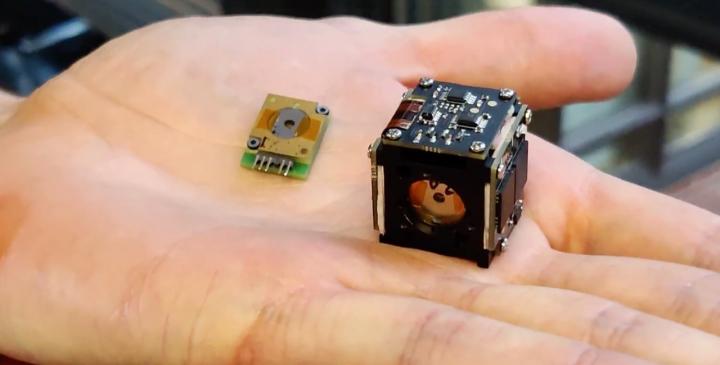
Credit: Leevi Annala
The Academy of Finland has granted €1.2 million in funding for Finnish space research focused on developing hyperspectral imaging solutions to be used in space.
Composition of celestial bodies revealed by their spectrum
The space industry is currently undergoing a major transformation, with compact spaceborne hyperspectral imagers playing a major role.
Hyperspectral imagers capture the image in a number of separate wavelengths of light, from visible to infrared light. This establishes a spectrum for each individual pixel seen in the image, providing information that can be used to characterise an object’s properties, such as its scope within the image or its composition. In space, such devices can be used in observing Earth or other solar system bodies.
“Finland, especially VTT, has been pioneering the development of compact hyperspectral imaging technology,” explains Docent Tomas Kohout, coordinator and principal investigator of the research consortium from the University of Helsinki.
Hardware and software for nanosatellites through Finnish efforts
Finnish first-generation miniaturised hyperspectral imagers are currently orbiting Earth in the Aalto-1 and Reaktor Hello World nanosatellites.
The researchers of the new consortium are now developing a new generation of miniaturised hyperspectral imagers and advanced methods for processing the data they collect, with the aim of developing techniques that make Earth and planetary observations increasingly autonomous.
“In this project, we are developing both hardware and software for nanosatellites. The aim is to reduce the costs of new-era space operations,” Kohout adds.
The project is a partnership of the University of Helsinki, the University of Jyväskylä, the Finnish Geospatial Research Institute under the National Land Survey of Finland and VTT Technical Research Centre of Finland.
In the three-year project ‘Smart hyperspectral imaging solutions for a new era in Earth and planetary observations’ (Smart-HSI), the University of Helsinki is focusing on planetary missions, the Finnish Geospatial Research Institute on Earth observation, VTT on hyperspectral imaging hardware development, and the University of Jyväskylä on the optimisation of hyperspectral data processing.
The overall budget for the Smart-HSI project, which will be launched in January 2021, is €1.7 million.
Summary:
Smart hyperspectral imaging solutions for new era in Earth and planetary observations
The project is developing next-generation miniaturised hyperspectral imagers and smart computational methods that enable the use of the imagers in semi-autonomously conducted Earth and planetary observation. Combining the new computational methods, compact hyperspectral sensors and advanced algorithms with CubeSat platforms significantly reduces the cost of space operations. The results will make it possible to carry out observations that are currently unattainable and that will have unparalleled spatial and temporal coverage. The goal is to make hyperspectral imagers a more readily usable tool for novel remote sensing applications which will promote scientific advancement, enabling new scientific breakthroughs and commercial applications in remote sensing focused on Earth and space.
The project is carried out collaboratively by the University of Helsinki, the University of Jyväskylä, the Finnish Geospatial Research Institute under the National Land Survey of Finland and VTT Technical Research Centre of Finland.
###
Link to the funding decision of the Academy of Finland: https:/
Further information:
Tomas Kohout, docent, University of Helsinki ([email protected]/+358 2941 51008)
Eija Honkavaara, professor, Finnish Geospatial Research Institute ([email protected]/+358 2953 14716)
Ilkka Pölönen, docent, University of Jyväskylä, Faculty of Information Technology ([email protected]/+358 40 024 8140)
Harri Ojanen, senior scientist, VTT Technical Research Centre of Finland Ltd ([email protected]/+358 50 482 1354)
Media Contact
Riitta-Leena Inki
[email protected]
Original Source
https:/