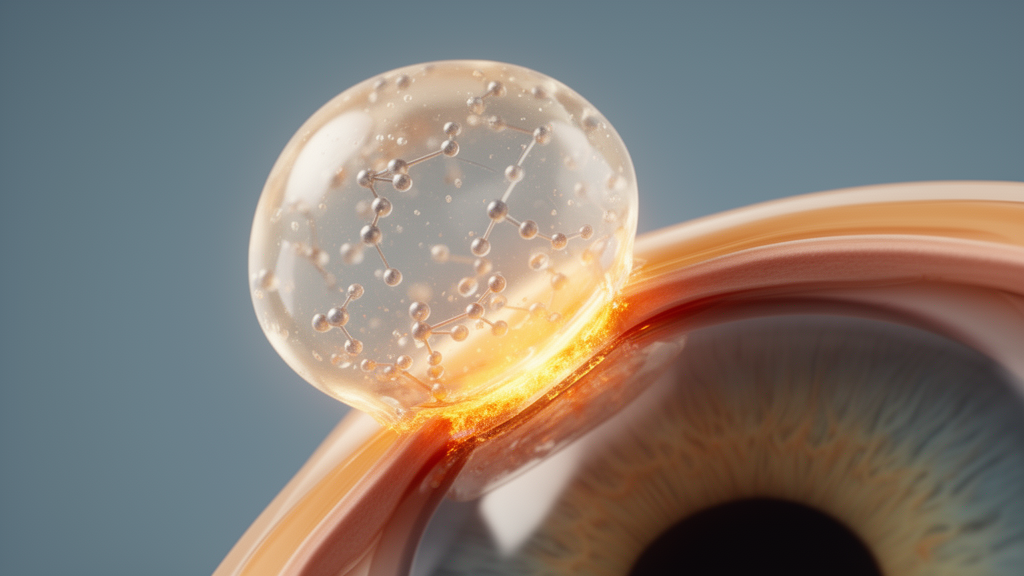
Dry eye disease affects an estimated 5 to 50 percent of people worldwide, and its prevalence is climbing rapidly as screen time, aging populations, and environmental stressors take their toll on the tear film. For millions of patients, the condition means chronic burning, blurred vision, and a relentless cycle of eye drops that seem to vanish almost as soon as they are applied. Conventional ophthalmic drugs face a brutal pharmacokinetic reality: less than five percent of an instilled dose actually stays on the ocular surface, because blinking, tear turnover, and nasolacrimal drainage wash away more than ninety percent of the drug within minutes. Now, a research team reporting in Advanced Science has engineered a multifunctional hydrogel eye drop that attacks this problem on several fronts at once, combining reactive oxygen species responsiveness, mucoadhesion, thermosensitive gelation, and sustained drug release into a single formulation loaded with the water-soluble immunosuppressant mizoribine.
The carrier at the heart of the system, dubbed SPPP, is a multiblock copolymer assembled from four purpose-built segments: an adhesive polydimethylsiloxane block, a selenium-based ROS-responsive block, a thermosensitive poly(propylene glycol) block, and a hydrophilic poly(ethylene glycol) block. Each segment contributes a distinct function. The selenium chemistry gives the material its oxidative sensitivity, because selenide bonds are readily oxidized by reactive oxygen species, which increases polymer polarity, weakens hydrophobic interactions, and loosens the hydrogel network. The PPG segment drives thermal gelation, while PEG maintains water dispersibility, and PDMS contributes both flexibility and optical clarity. Characterization by Fourier transform infrared spectroscopy, nuclear magnetic resonance, and gel permeation chromatography confirmed the successful synthesis of a uniform copolymer with a number-average molecular weight of roughly 21 kilodaltons and a remarkably narrow dispersity of 1.02, indicating a well-controlled polymerization rather than a heterogeneous mixture.
One of the most striking properties of SPPP is its transparency. Many thermosensitive gels, including the widely used Pluronic F127, scatter light because their hydrophobic domains form large aggregates with refractive indices poorly matched to water. SPPP avoids this problem through its PDMS segment, whose refractive index of approximately 1.43 sits close to that of water at about 1.33, allowing the formation of smaller and more uniform hydrophobic microdomains. Ultraviolet-visible spectroscopy showed negligible absorbance above 300 nanometers, meaning the gel is essentially invisible on the eye. Dynamic light scattering placed the nanoparticles at 78.8 to 142 nanometers, expanding slightly to 91.3 to 164 nanometers after mizoribine loading, a size range well suited to cellular uptake. The particles were also nearly electrically neutral, with a zeta potential of roughly 0.30 millivolts, a design choice that minimizes nonspecific interactions with the negatively charged corneal epithelium and avoids the inflammation and cell damage often associated with cationic materials.
The gelation behavior is equally elegant. Rheological measurements showed that the storage modulus overtook the loss modulus at approximately 24 degrees Celsius, marking the sol-gel transition. A drop instilled cold as a liquid flows onto the ocular surface, then gels in place at eye temperature, conforming to the cornea with each blink. This thermally induced phase transition also enables a second round of drug loading beyond the initial encapsulation, boosting the capacity of the system for water-soluble therapeutics like mizoribine. In vitro release studies showed roughly 50 percent of the drug released within one hour and about 80 percent after six hours, with the profile plateauing after twelve hours. Critically, when the release medium was switched to a 500 micromolar hydrogen peroxide solution simulating the oxidative stress of a diseased ocular surface, the release rate accelerated. Scanning electron microscopy provided direct morphological evidence: hydrogen peroxide exposure progressively disrupted the porous gel network, enlarging pores and collapsing structure, exactly the ROS-triggered remodeling the designers intended.
Mucoadhesion is the second pillar of the strategy, and the team traced its mechanism down to the molecular level. The membrane-associated mucin MUC1 is abundantly expressed on corneal and conjunctival epithelial cells and serves as a natural anchoring point. Molecular docking and 200-nanosecond molecular dynamics simulations showed that contact area and hydrogen bonding between SPPP and MUC1 rose rapidly and saturated at around 33 nanoseconds. Surface plasmon resonance then quantified the interaction: SPPP bound MUC1 with a dissociation constant of 22 nanomolar, whereas Pluronic F127 showed a far weaker affinity of 3.64 micromolar. The authors attribute this robust binding to multivalent hydrogen bonding between ether oxygens in the PEG and PPG segments and donors on the mucin glycoprotein, complemented by hydrophobic and dispersion interactions from the methyl-rich PDMS chains. In practical terms, fluorescence imaging demonstrated ocular surface adhesion persisting for more than 150 minutes after a single dose, and pharmacokinetic studies in rabbits confirmed higher mizoribine concentrations in the cornea and aqueous humor at one and three hours post-instillation compared with the free drug.
Beyond delivery, the carrier itself is a therapeutic agent. In ABTS and FRAP antioxidant assays, MZR@SPPP showed significant radical scavenging at 50 micrograms per milliliter, saturating above 100 micrograms per milliliter, with the antioxidant effect contributed mainly by the SPPP component rather than the drug. In human corneal epithelial cells stressed with 250 micromolar hydrogen peroxide, the formulation restored cell viability, suppressed intracellular ROS, and activated the KEAP1-NRF2/HO-1 antioxidant signaling axis: NRF2 accumulated in the nucleus, the expression of SOD2, NRF2, and heme oxygenase-1 rose, and the NRF2 suppressor KEAP1 fell. The formulation also protected mitochondria, the cellular power plants whose dysfunction is increasingly recognized as a driver of dry eye. JC-1 and MitoTracker staining showed preserved mitochondrial membrane potential and mitochondrial mass, while electron microscopy revealed that the treatment prevented the swelling, cristae disruption, and vacuolization induced by oxidative stress. TUNEL assays confirmed reduced apoptosis.
The immunomodulatory half of the synergy comes from mizoribine, a low-molecular-weight, water-soluble nucleoside immunosuppressant that inhibits lymphocyte proliferation by targeting inosine monophosphate dehydrogenase and GMP synthetase, a mechanism distinct from the calcineurin inhibitors cyclosporine A and tacrolimus that dominate current therapy. Those older drugs suffer from poor aqueous solubility and typically require oily vehicles that irritate the eye. In macrophage experiments, MZR@SPPP suppressed pro-inflammatory M1 polarization, reducing CD86, iNOS, IL-6, and CCL2, while promoting the anti-inflammatory M2 phenotype, increasing CD206, arginase-1, IL-10, and CHIL3. Transcriptome sequencing of stressed corneal epithelial cells further showed suppression of TNF and IL-17 signaling and inhibition of the p38 MAPK pathway, with downstream reductions in IL-1β, IL-6, IL-8, and TNF-α.
In vivo, the team induced dry eye in mice using scopolamine injections combined with low-humidity, high-airflow desiccating stress, then treated the animals twice daily for seven days. MZR@SPPP markedly reduced corneal fluorescein staining scores, increased tear secretion, and prolonged tear break-up time. Notably, the formulation matched commercial cyclosporine A in promoting corneal epithelial repair while surpassing it in enhancing tear production. Histology showed restored corneal and conjunctival architecture, preserved goblet cell density, and normalization of the keratin 10 and keratin 12 epithelial phenotype markers. Immunostaining revealed reduced macrophage infiltration and a shift away from the M1 phenotype in the cornea. Safety testing over one month of repeated administration found no structural or functional ocular damage, no pathological changes in major organs, and no abnormalities in blood counts or serum biochemistry.
The authors are candid about the limitations that stand between this preclinical success and the clinic. The scopolamine and desiccating stress model primarily reflects aqueous-deficient dry eye rather than the full heterogeneity of human disease, and the fate of selenium-containing degradation products has not yet been quantitatively tracked. Future work with large-animal models, selenium quantification by mass spectrometry, and ultimately human trials will be needed. Still, the conceptual advance is significant: rather than layering multiple drugs with their attendant burden and interaction risks, MZR@SPPP folds antioxidant, anti-inflammatory, mucoadhesive, and ROS-responsive functions into one biomaterial that acts as both vehicle and medicine. By simultaneously scavenging excess radicals, releasing immunosuppressant on demand under oxidative conditions, and anchoring itself to the tear film through MUC1, the platform aims to break the self-amplifying cycle in which oxidative stress fuels inflammation and inflammation deepens oxidative damage. For a disease that demands long-term management and frustrates patients with frequent dosing, an all-in-one gel that works smarter, stays longer, and heals more completely could represent a genuine turning point in ocular surface therapy.
Subject of Research: A ROS-responsive thermosensitive mucoadhesive hydrogel delivering mizoribine for synergistic dry eye disease therapy
Article Title: A ROS‐Responsive and Mucoadhesive Thermosensitive Hydrogel Encapsulated with Mizoribine for Synergistic Dry Eye Therapy
Article References: Qin, D., Li, J., Ma, P., Wu, S., Guan, W., Huang, Y., Feng, K., Wei, M., Yang, Z., Guo, S., Huang, C., Wu, Y.-L., Han, Y., & Liu, Z. (2026). A ROS‐Responsive and Mucoadhesive Thermosensitive Hydrogel Encapsulated with Mizoribine for Synergistic Dry Eye Therapy. Advanced Science, Article e78106. https://doi.org/10.1002/advs.78106
Image Credits: AI Generated
DOI: 10.1002/advs.78106
Keywords: dry eye disease, hydrogel, mizoribine, drug delivery, reactive oxygen species, mucoadhesion, thermosensitive polymer, oxidative stress, macrophage polarization, KEAP1-NRF2 pathway, ophthalmology, nanomedicine
News Source: Denise Maddox. (October 9, 2026). Smart Hydrogel Eye Drops Fight Dry Eye by Sensing Inflammation and Sticking to the Cornea. Scienmag.