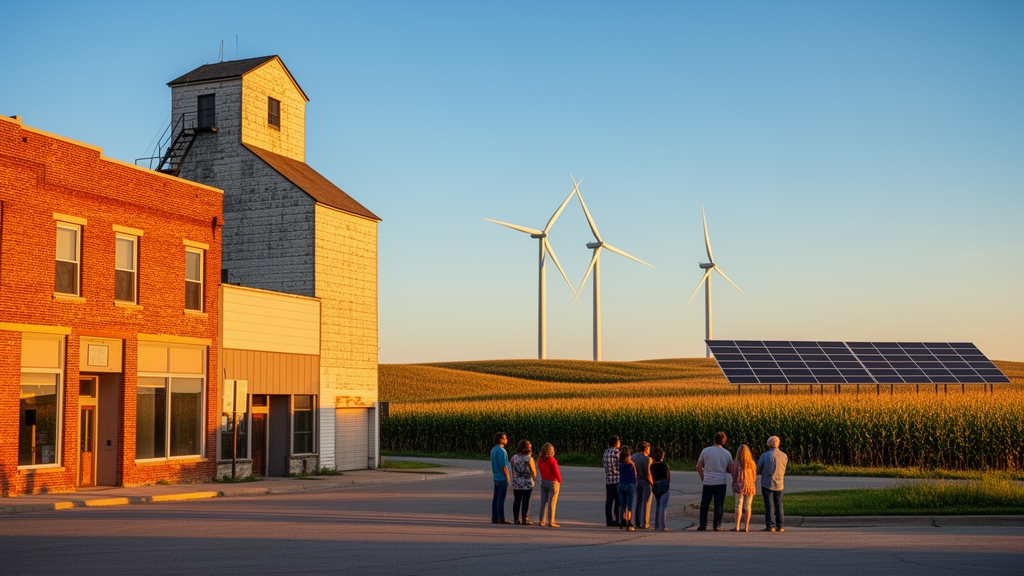
Published in Frontiers of Urban and Rural Planning, the study by Jiwnath Ghimire and Eyad Taamallah used exploratory scenario planning to build four alternative energy futures for Algona, co-created with residents, the municipal utility, and local stakeholders. The central finding is striking for its modesty: the community preferred small-scale, flexible energy options, particularly building-integrated photovoltaics paired with energy efficiency, and the authors argue those preferences can be leveraged to build momentum toward larger transitions rather than forcing an all-or-nothing bet on any single technology.
Algona is a useful test case precisely because it mirrors pressures felt across the rural Midwest. The city’s population slipped from 5,494 in 2013 to 5,414 in 2025, with a median age of 43.1 years, and its Hispanic population grew from 1.4 percent in the 2010 Census to 6.3 percent in 2020. Aging populations, youth outmigration, and shrinking tax bases have weakened public services and complicated investment in renewable energy infrastructure, the authors note. At the same time, climate change is intensifying extreme weather, disrupting fossil fuel supply chains, and reducing the efficiency of conventional energy production, all while Algona’s aging infrastructure leaves little room for error. As coal-based utility systems shut down, communities like Algona must decide whether to reinvest in fossil alternatives or pursue renewables, often with limited technical, financial, and institutional capacity.
What sets Algona apart from many rural towns is its energy load. A Bitcoin mining facility accounts for approximately 60 percent of the city’s annual energy consumption, with peak demand in July, August, and December. The study treats this steady, massive industrial demand as a given, while the potential expansion of the industrial sector remains an indeterminate variable. That creates an unusual constraint: any renewable alternative must be both high-capacity and extremely reliable, since small-scale distributed solutions cannot realistically offset the industrial sector’s draw. For Algona Municipal Utilities (AMU), the local utility, reliability remains the top priority, and the researchers found that solar intermittency poses a genuine risk for a grid supporting such a high baseload.
The research team used a mixed-methods design, combining a community survey, key informant interviews, focus group discussions, and case studies of renewable energy adoption elsewhere in Iowa and other states. Three focus group sessions engaged 15 residents representing a range of energy user types, using small-group breakouts with rotational discussions. A community-wide survey, offered in both English and Spanish and developed with Iowa State University Extension and Outreach, was distributed digitally and in print through AMU; 22 responses were collected. Four semi-structured interviews with academic researchers and rural energy planning practitioners supplied technical and policy insights, and four case studies were analyzed for transferable best practices. Qualitative data were analyzed through thematic coding, survey responses through descriptive statistics, and the findings were triangulated across methods. The study was reviewed and approved by the Office of Research Compliance at Iowa State University.
The scenario-building process began by identifying givens and indeterminates. Givens included steady energy consumption growth driven by the Bitcoin mining facility, demographic changes, rising energy prices, the phase-out of coal plants by 2040, fewer available funding opportunities, and frequent extreme weather events. Indeterminates included government subsidies, infrastructure capacity, the costs of renewable energy infrastructure, technological advancements, and industrial expansion. Driving forces were sorted into social, technological, economic, political, and environmental categories, ranging from favorable public perceptions of renewables and declining renewable technology costs to extreme heat events and the need for grid resilience. Stakeholder values diverged by group: public institutions emphasized energy independence, reliability, cost reduction, and job creation; residents prioritized lower energy costs, community character, land stewardship, and supply reliability; environmental agencies focused on air quality and integrating more renewables.
Four scenarios emerged. The Business-as-Usual baseline projects continued reliance on current sources, primarily wind and coal from outside the city, with no significant policy or infrastructure changes. The Utility-Scale Solar and Biogas scenario proposes a phased 20-megawatt solar farm on city-owned land, complemented by a biogas plant using animal waste from surrounding swine farms totaling 6,000 hogs. Because biogas provides storable energy for nighttime or winter dispatch, the combination could enable a stable, coal-free power supply around the clock, with site suitability criteria including slopes under 10 percent, proximity to hog farms, and road access for truck traffic. The Community Solar and Agrivoltaics scenario emphasizes community ownership and dual land use, pairing community-scale solar gardens under 5 megawatts on a subscription model with agrivoltaics up to 5 megawatts that integrate crops such as blueberries, squashes, and leafy greens or livestock grazing, starting on city-owned land including Future Park in South Algona and the future industrial park in the east. The Energy Efficiency and Building-Integrated Photovoltaics scenario focuses on reducing demand through efficiency upgrades and solar panels integrated into rooftops and facades, financed through mechanisms such as Property Assessed Clean Energy and Energy Performance Contracting, beginning with city-owned buildings and extending to private homes, with a goal of EPA Energy Star certification for all city-owned buildings by 2050.
Evaluation rested on five criteria developed with AMU staff, the Board of Trustees, and energy stakeholders: cost-effectiveness, aesthetic and community compatibility, technical feasibility, energy output and reliability, and scalability and flexibility. Participants rated each scenario’s suitability as low, moderate, or high through green, yellow, and red dot-sticker exercises in focus groups, survey questions, and verbal selections in interviews, with majority rule determining the final ratings. The BIPV and energy efficiency scenario performed best, scoring high on cost-effectiveness, aesthetics and community compatibility, technical feasibility, and scalability, though its energy output rated low because of its smaller scale. The utility-scale scenario earned high marks for energy output and reliability but low for cost-effectiveness due to high upfront costs and long payback periods, and moderate ratings elsewhere; notably, survey respondents favored it while community meeting participants preferred it least. Community solar and agrivoltaics scored low on cost-effectiveness, technical feasibility, and scalability, the latter reflecting a limited number of suitable sites.
That divergence between survey respondents and focus group participants is one of the study’s most instructive findings. Different engagement methods yielded different preferences, underscoring the authors’ argument that multimodal engagement strategies are essential when communicating complex planning topics like energy futures. Residents expressed concerns about the upfront costs of technologies like BIPV, potential rate increases from utility-scale investments, and uncertainty about environmental impacts and visual disruption, pointing toward transparent, incremental implementation that starts small and shares results through public metrics. No single scenario scored highly across all criteria, and the authors stress that the scenarios are not mutually exclusive but represent different strategic emphases that can be combined over time, with evaluations acknowledged as time-bound and subject to change as technology, economics, and policy evolve.
From these evaluations the team built a staged transition framework, discussed and validated in multiple stakeholder meetings with AMU. The first five years emphasize foundational actions: small-scale solar installations, particularly BIPV, pilot biogas systems, and basic energy-efficiency retrofits in public buildings to generate early momentum and internal learning. Stage two, spanning years five to ten, scales up to medium-sized solar arrays and expanded biogas operations alongside city-wide efficiency measures, with schools identified as strategic partners offering both physical space and educational opportunities. Stage three, at fifteen years and beyond, envisions large-scale solar and biogas systems at full operational capacity sufficient to meet the majority of the city’s energy demands, incorporating energy storage and advanced efficiency standards as they become financially viable. The framework is deliberately adaptable, letting pace and scale align with available funding, technological readiness, and community preferences.
The authors are candid about the study’s limits. The engagement sample was small, 15 focus group participants, 22 survey respondents, and four interviewees, against a population of over 5,400, and the findings are highly context-specific, shaped by the Bitcoin facility’s demand and Algona’s particular land availability. The evaluation was primarily qualitative, relying on stakeholder perceptions and majority-rule tallies rather than exhaustive quantitative energy or economic modeling, and financing mechanisms for the broader transition were not discussed during stakeholder engagement. Still, the case demonstrates that exploratory scenario planning can function as a consensus-building tool, giving residents, administrators, and stakeholders a shared language for trade-offs and fostering the trust and ownership the authors consider vital in rural areas where infrastructure investment is limited. For towns facing coal plant closures by 2040 and similar demographic and fiscal pressures, the lesson from Algona is procedural as much as technical: begin with visible, low-risk pilots, treat scenarios as a living strategy reviewed every three to five years, and plan the transition as a collaborative dialogue rather than a single predetermined destination.
Subject of Research: Participatory scenario planning for renewable energy transition in the rural town of Algona, Iowa
Article Title: Scenario planning for renewable energy transition for rural towns in the United States: lessons from Algona City of Iowa, United States
Article References: Ghimire, J., & Taamallah, E. (2026). Scenario planning for renewable energy transition for rural towns in the United States: lessons from Algona City of Iowa, United States. Frontiers of Urban and Rural Planning, 4(1), Article 17. https://doi.org/10.1007/s44243-026-00087-4
Image Credits: AI Generated
DOI: 10.1007/s44243-026-00087-4
Keywords: renewable energy, scenario planning, rural towns, solar energy, biogas, agrivoltaics, energy efficiency, building-integrated photovoltaics, Iowa, community engagement, energy transition, municipal utilities
News Source: Faith Mcneil. (October 29, 2026). Small-town Iowa case shows how scenario planning can steer rural energy transitions. Scienmag.