• HOME
  • NEWS
  • EXPLORE
    • CAREER
      • Companies
      • Jobs
    • EVENTS
    • iGEM
      • News
      • Team
    • PHOTOS
    • VIDEO
    • WIKI
  • BLOG
  • COMMUNITY
    • FACEBOOK
    • INSTAGRAM
    • TWITTER
Wednesday, May 13, 2026
BIOENGINEER.ORG
No Result
View All Result
  • Login
  • HOME
  • NEWS
  • EXPLORE
    • CAREER
      • Companies
      • Jobs
        • Lecturer
        • PhD Studentship
        • Postdoc
        • Research Assistant
    • EVENTS
    • iGEM
      • News
      • Team
    • PHOTOS
    • VIDEO
    • WIKI
  • BLOG
  • COMMUNITY
    • FACEBOOK
    • INSTAGRAM
    • TWITTER
  • HOME
  • NEWS
  • EXPLORE
    • CAREER
      • Companies
      • Jobs
        • Lecturer
        • PhD Studentship
        • Postdoc
        • Research Assistant
    • EVENTS
    • iGEM
      • News
      • Team
    • PHOTOS
    • VIDEO
    • WIKI
  • BLOG
  • COMMUNITY
    • FACEBOOK
    • INSTAGRAM
    • TWITTER
No Result
View All Result
Bioengineer.org
No Result
View All Result
Home NEWS Science News Chemistry

Small precipitates make big difference in mitigating strength-ductility tradeoff

Bioengineer by Bioengineer
February 26, 2020
in Chemistry
Reading Time: 2 mins read
0
IMAGE
Share on FacebookShare on TwitterShare on LinkedinShare on RedditShare on Telegram

IMAGE

Credit: PENG Shenyou

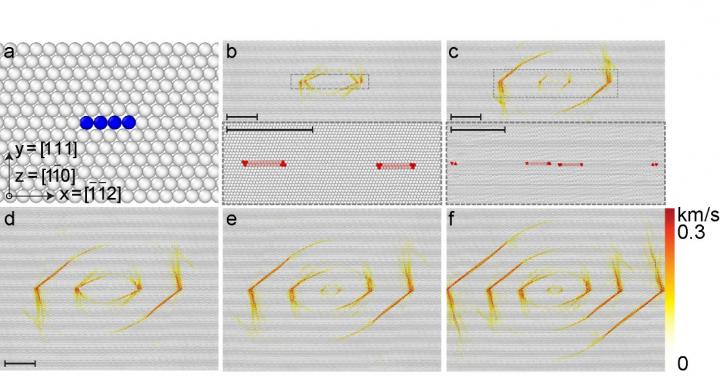
Researchers from the Institute of Mechanics of the Chinese Academy of Sciences, teaming up with scientists from Singapore and the U.S., have found that nanoscale precipitates provide a unique sustainable dislocation source at sufficiently high stress.

The scientists discovered that densely dispersed nanoprecipitates simultaneously serve as dislocation sources and obstacles, leading to a sustainable and self-hardening deformation mechanism that enhances ductility and strength. The results were published in PNAS on Feb. 24, 2020.

In structural materials, resistance against deformation is of vital importance, specifically resistance to the initiation of plastic deformation or yielding; the stress at this point represents the strength of the material. Meanwhile, how much a metal can deform plastically – its ductility – is another important measure. Both strength and ductility depend on the movement of metal dislocations.

Movement of a dislocation becomes more difficult if some barrier or discontinuity enters the path of the dislocation, that is, the materials are hardened. Among many hardening routines, precipitate hardening has been well established and widely employed in engineering materials like Al alloys, Ni super alloys, steel, and recently discovered high-entropy alloys.

Precipitates serve as obstacles to dislocation glide and cause hardening of the material. However, they may lead to premature failure and decreased ductility. Obstacles to dislocation glide often lead to high stress concentration and even microcracks, a cause of progressive strain localization and the origin of the strength-ductility conflict.

According to the researchers, the key to mitigating the conventional strength-ductility tradeoff is to employ a mild yet homogeneous hardening mechanism at a high stress level. Nanoprecipitates provide a sustainable and self-hardening deformation mechanism that enhances ductility and strength. The condition for achieving sustainable dislocation nucleation from a nanoprecipitate is governed by the lattice mismatch between the precipitate and matrix.

Dr. PENG Shenyou, author of the study, said “The interplay of the two length scales, precipitate size and spacing, can be utilized as an optimal design motif to produce a superb combination of strength and ductility, as well as provide a criterion for selecting precipitate size and spacing in material design.”

These findings establish a foundation for strength-ductility optimization through densely dispersed nanoprecipitates in multiple-element alloy systems.

###

The research was support by the National Natural Science Foundation of China and the Strategic Priority Research Program of the Chinese Academy of Sciences.

Media Contact
PENG Shenyou
[email protected]

Related Journal Article

http://dx.doi.org/10.1073/pnas.1914615117

Tags: Chemistry/Physics/Materials SciencesNanotechnology/MicromachinesParticle Physics
Share12Tweet8Share2ShareShareShare2

Related Posts

Harnessing Neural Networks for Advances in Nonlinear Optics — Chemistry

Harnessing Neural Networks for Advances in Nonlinear Optics

May 12, 2026
Innovative Method Unveiled to Detect Signs of Dark Matter — Chemistry

Innovative Method Unveiled to Detect Signs of Dark Matter

May 12, 2026

Illuminating the Science Behind Historical Featherwork Art

May 12, 2026

Humans and Zebra Finches Share Similar Speech Learning Techniques #ASA190

May 11, 2026
Please login to join discussion

POPULAR NEWS

  • Research Indicates Potential Connection Between Prenatal Medication Exposure and Elevated Autism Risk

    842 shares
    Share 337 Tweet 211
  • New Study Reveals Plants Can Detect the Sound of Rain

    728 shares
    Share 290 Tweet 182
  • Salmonella Haem Blocks Macrophages, Boosts Infection

    62 shares
    Share 25 Tweet 16
  • Breastmilk Balances E. coli and Beneficial Bacteria in Infant Gut Microbiomes

    57 shares
    Share 23 Tweet 14

About

We bring you the latest biotechnology news from best research centers and universities around the world. Check our website.

Follow us

Recent News

Mayo Clinic to Undergo Leadership Transition, Honoring Dr. Gianrico Farrugia’s Transformational Impact

Study Finds Sustained Weight Loss Possible by Transitioning from Injectable Obesity Drugs to Daily Oral Orforglipron (ATTAIN-MAINTAIN)

Weight Loss Maintained Seven Times More Effectively with Continued Maximum Dose of Tirzepatide, Study Finds

Subscribe to Blog via Email

Enter your email address to subscribe to this blog and receive notifications of new posts by email.

Join 82 other subscribers
  • Contact Us

Bioengineer.org © Copyright 2023 All Rights Reserved.

Welcome Back!

Login to your account below

Forgotten Password?

Retrieve your password

Please enter your username or email address to reset your password.

Log In
No Result
View All Result
  • Homepages
    • Home Page 1
    • Home Page 2
  • News
  • National
  • Business
  • Health
  • Lifestyle
  • Science

Bioengineer.org © Copyright 2023 All Rights Reserved.